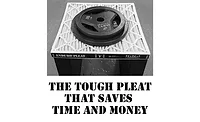
MERV 13 Filtration at One-Half the Pressure Drop
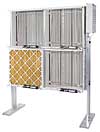
According to the company, Strion’s technology uses electrical
enhancements of the filter media to provide low resistance to airflow.
According to Aaron Ayer, P.E., StrionAir vice president of marketing, “Our technology is very efficient.” The technology uses electrical enhancements of the filter media to provide low resistance to airflow. “And because of the strong electrical field, it’s a germicidal product,” Ayer said. “It grabs pathogens within the air. Anything that gets trapped in the filters gets killed.” This performance has been verified by third-party testing, he said.
Since the product has been installed in the library, there has been “a marked improvement in noticeable air quality, and mold problems are long since gone,” Ayer said. “Students are actively choosing to study in the medical library. Students with allergies or asthma find relief there.”
HOW IT WORKS
Product maintenance simply entails replacement of the filters, “another benefit of the product,” Ayer said. “The filters are particularly long lived. The filters last, in our experience, two to three times longer than other filters.”They are specifically enhanced by the technology, he said. “First we start with a low-caliber (MERV 7-9) filter, and the enhancement brings its efficiency up. The initial filter is very porous. There is an improvement in its particulate capture, but you maintain the porous nature, keeping the pressure drop low.”
It also captures particles all the way through the filter. Typical filters load on the face, which chokes the airflow, Ayer said. “It’s going to hold more dirt. If you pull one of our filters out, it’s dirty on both sides. By holding more dirt at a longer period of time, the filter generally lasts two to three times longer than comparable filters in the field,” Ayer said. “Some of our customers can validate that. Depending on the environment, it’s typically a six-month changeout.”
WHAT'S NEW
There are two products commercially available now, he said. “The brand-new product, the A150, is only a 2-inch-deep filter. The landfill is considerably less.” There are reductions in cost from consumables, and hours consumed on the operations and maintenance side.“Keeping students in school is a prime concern,” said Ayer. A product like this, which has been tested against pathogens ranging from H5N1 to the common cold, helps improve absenteeism. “In any school environment, they don’t have any money to spend. Something that can reduce energy consumption and maintenance costs is a very interesting product.”
Because this filter was designed to start at an extremely low pressure drop, and can last longer at a lower pressure drop, “the value proposition for this thing is a 10-13 percent reduction in fan energy compared to other filters,” said Ayer, which offers a very quick payback. “We reduce their O&M, and provide a compelling energy saving.
“If I were a teacher in one of these facilities, knowing that the air has been run through a germicidal filter, knowing that these little germ generators are running around, it would give me an increased sense of comfort.”
Another thing worth mentioning, he said, is the growing green movement and programs like LEED (Leadership in Energy and Environmental Design) for Schools. “The requirement to get a point for indoor environmental quality for that program is MERV 13. The barrier is that some systems may not be able to tolerate the increased pressure drop without upgrading their air handlers. It is ideal to do so without increasing energy consumption.
“It’s a strong enabler for facilities to get a relatively inexpensive point while substantially improving the operating environment.”
PRODUCT DETAILS
The A130’s electrically enhanced filtration technology is said to keep pressure drop lower throughout the life of the filter. This reduces required fan energy by more than 10 percent compared to other filters, the company said.Second, the technology ex-tends the effective life of the filter media relative to traditional approaches. Filters require fewer changeouts, reducing replacement costs, maintenance expenditures, and landfill burden.
Third, since the filter is designed to be changed out at a lower ending pressure drop compared to mechanical filtration technologies, contractors and engineers can specify smaller overall HVAC system components, the manufacturer said. Lower pressure drop, longer filter life, and lower energy requirements produce a two- to four-year payback.
Besides cutting operational expenses, the filter kills the causes of infectious diseases in a way that traditional air filters cannot. It also captures such allergens as pollen, dander, and dust. Independent testing, including testing from the Centers for Disease Control, shows that it kills more than 99 percent of a range of airborne pathogens.
Its modular design can be configured to fit most air handlers in both new construction and retrofit, the company said. StrionAir is offering select partners early access to this technology during a pilot program that will demonstrate system performance in a small number of high-performance buildings.
For more information, contact Ayer at 303-926-5687 or aayer@strionair.com. For literature that describes the system, contact the company at 866-840-5872 or info@strionair.com.
Publication date: 08/04/2008
Looking for a reprint of this article?
From high-res PDFs to custom plaques, order your copy today!