Group Marches on the Power of People
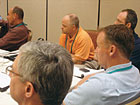
Senior
managers from around the United States met in a special session of the Chiller
Systems Group in Irvine, Calif., on April 17. The main topic of discussion was
how the virtual organization should be structured in the coming years.
Today, the group of 48 companies is described by leadership as a virtual organization, a network of independent contractors dedicated to knowledge sharing and training to provide building owners the highest level of chiller service, and other bold and sometimes daring endeavors. Not the least of which is maintaining a membership that services approximately 15,000 centrifugal and screw chillers throughout the United States.
Robert Owens of Owens Companies Inc., Bloomington, Minn., and Pat Rucker, Entech Sales & Service, Dallas, were the visionary drivers that spearheaded the effort to unify an influential group of contractors, primarily dedicated to large-tonnage chiller service.
That first meeting was hosted by the Owens Companies Inc., in Bloomington, and every semi-annual gathering since has likewise been hosted by member companies. Members pay a modest registration fee, which funds the spartan infrastructure of the organization. Members must adhere to a simple set of guidelines in order to maintain good standing in CSG.
The 28th semi-annual meeting was held in April at the Hilton Irvine/Orange County Airport Hotel. Bill Flynn, chairman of the publicity committee and president of Mallory & Evans Service, an Atlanta-based contracting company, opened the meeting with introductions, a few points about the agenda, and goals for the group’s meeting. The event included a somewhat rare senior manager-meeting component, as the steering committee sought valued input from some of the largest members about important decisions facing the group as it moves forward.
To open those discussions, Pat Rucker and John Owens, now the president of the company his late father founded, shared a history of the development of CSG that actually dates further back than 1994.
LEVEL PLAYING FIELD
“My father would be very pleased and perhaps even amazed at what this organization has accomplished since its inception,” said Owens. “Back in the old days, after the 1982 class action lawsuit, we accomplished a lot with the Trane Company and other manufacturers. York has done a great job of working with CSG, even though they, of course, still compete with us for service work on chillers.”Owens’ comments about competition from manufacturers actually hearken back to the impetus behind the founding of CSG in 1994. Rucker said, “The fight has always been to keep the playing field level. We have to work together to simply do a better job providing service.”
The feisty and sharp-witted Rucker is the senior member of CSG, and still carries the fight when he feels the necessity (see sidebar below). Even during his opening comments to the senior managers, Rucker challenged and sometimes chastised both manufacturers and the CSG membership as he encouraged responsible and fair competition.
A WORKING GROUP
The stated purpose of CSG is to:1. Facilitate sharing of chiller technical information and training;
2. Work with chiller manufacturers to gain timely and economical access to training, technical information, and parts; and
3. Facilitate education on industry trends, technologies, and best practices.
Membership requirements of the virtual organization includes:
1. Company must have a major focus on large tonnage chiller service;
2. Must actively contribute and commit resources to ensure group’s success;
3. Must have active participation of both management and technical personnel; and
4. Must attend semi-annual meetings.
There are no membership dues; the CSG currently funds itself from the nominal registration fees for each semi-annual meeting. Key benefits of membership include an e-mail user group, a relatively new Website, and seven working committees including steering, training, membership, website, publicity, technical, and manufacturers. The manufacturers committee is composed of four two-person teams that serve as liaisons with York, Trane, Carrier, and McQuay.
CHALLENGES AHEAD
During the Senior Manager’s Meeting on April 17, which preceded two days of technical training sessions with service employees, several guests were invited to share their perspectives on competition from manufacturers’ service companies. Paul Stalknecht, president and CEO of the Air Conditioning Contractors of America (ACCA) spoke to the group about the ACCA Co-Stars meeting format.The Co-Stars meetings provide a forum for contractors to meet with top executives from manufacturing companies. The meetings are intended to provide a two-way street for meaningful dialogue that can be helpful to all parties.
Stalknecht told the management group that many of the Co-Stars discussions are of a commercial service nature, and he suggested that greater support of ACCA, through membership, would result in an even more powerful national voice for the members of CSG.
A representative from The NEWS also spoke to the managers about the strength of CSG in the market, and other alternatives for creating positive dialogue. Members were encouraged to consider attending the HVAC-Mechanical Xchange, an executive strategic summit event in Park City, Utah, Sept. 21-24, 2008.
As the first day’s meeting drew to a close, members pondered three key challenges facing the CSG organization.
Structure - The 48-strong membership has never had a problem keeping the rolls full; in fact, requests of prospective members are often turned away. However, members did entertain future growth for the group and how that might be accommodated. The virtual organization may some day find itself in need of a more formal structure with an executive director at the helm.
Funding - Meeting registration fees cover the group’s current needs, but any growth might require a different structure, such as annual dues.
Participation - One of the requirements of membership is that both technical and managerial involvement is required. According to CSG leadership, the technical involvement is exceeding expectations while management participation sometimes wanes.
However, the 28th semi-annual meeting of the Chiller Systems Group brought out perhaps the best attendance of both technical and management people that the group has ever experienced. As the group continues to ask tough questions of not only itself but of those around it, it seems as though the CSG is destined to continue its path of bold leadership.
See the online feature article “Chiller Systems Group Meeting” in this issue for more on the contractor network.
Sidebar: Honor the Leader
IRVINE, Calif - The Chiller Systems Group (CSG) held its spring meeting April 17-19 at the Hilton Irvine/Orange County Airport in Irvine, Calif. During the meeting a special achievement award was presented to Pat Rucker, a founding member of the group and president of Entech Sales & Service of Dallas. For his outstanding leadership and support of the group, CSG also announced that an ongoing special achievement award will carry his name and be awarded to future members who make outstanding contributions.At the beginning of the three-day meeting, Rucker shared a historical perspective from 1994. “People [contractors and manufacturers] were getting into the chiller refrigerant conversion market. Manufacturers would not sell the refrigerant conversion kits to contractors, or would not sell them at the same price as they did to their own service companies.”
Rucker carried a lawsuit through to the Dallas District Federal Court, which resulted in more favorable service and pricing from the manufacturers.
“Building owners were sometimes being charged as much as $75,000 for a conversion kit by a manufacturer’s service group,” said Rucker. “Well they might as well have bought a new chiller for that kind of price. It all resulted in better treatment for contractors and better service for building owners.”
Prior to Rucker’s 1994 lawsuit, a group of contracting companies filed legal proceedings against a group of manufacturers (Trane, Carrier, York, and McQuay) in 1982, claiming unfair practices that were in violation of the Sherman Antitrust Act. Rucker and Entech Sales & Service were in the thick of that battle, along with the Owens Companies Inc., and a few other bold contracting businesses.
The 1982 and 1994 legal proceedings brought to light the need to better unify contracting companies in the pursuit of fairer business practices and the need to ensure access to technical training information.
Publication date: 05/12/2008
Looking for a reprint of this article?
From high-res PDFs to custom plaques, order your copy today!