ACHR News
search
Ask ACHR NEWS AI
cart
facebook twitter instagram linkedin youtube
  • Sign In
  • Subscribe
  • Sign Out
  • My Account
ACHR News
  • NEWS
    • Breaking News
    • New HVAC Products
    • Featured Products
    • Manufacturer Reports
    • HVAC Data
    • Legislation
    • ACHR NEWS Centennial
  • RESIDENTIAL
    • Air Conditioners
    • Furnaces
    • Residential Heat Pumps
    • Ductless
    • Residential IAQ
    • Testing, Monitoring, Tools
    • Components & Accessories
  • COMMERCIAL
    • Air Handlers
    • Rooftop Units
    • Chillers and Cooling Towers
    • Commercial Heat Pumps
    • Boilers and Hydronics
    • VRF/Ductless
    • Commercial IAQ
  • REFRIGERATION
    • Refrigerants
    • Refrigerant Regulations
    • Leak Management
  • CONTRACTOR PRO
    • Geothermal
    • Homeowner Study
    • VRF and VRV Ductless
    • Unitary Trends
  • EDUCATION
    • Training and Education
    • Business Management
    • Service and Maintenance
    • Continuing Education
    • Market Research >
      • HVAC Brand Awareness Report
      • VRV, VRF, VRVZ Report
      • Unitary Trends Report
      • Water Heat Professionals Report
    • Webinars
    • Sponsor Insights
    • eProducts Info
    • White Papers
  • EVENTS
    • HVAC Contractor Forum
    • Industry Events and Webinars
  • MEDIA
    • Videos
    • AHR Expo 2025 Videos
    • Podcasts >
      • ACHR News Podcast
      • HARDI Podcasts
      • AHR Expo Podcasts
      • ACCA Podcasts
    • Interactive Spotlights
    • Quizzes
    • eBooks
    • HVAC Talkback
  • HVAC GROUP
    • ACHR NEWS >
      • Current Issue
      • Digital Edition
      • Subscribe
    • Distribution Trends
    • SNIPS NEWS >
      • Join SNIPS NEWS
    • Engineered Systems News >
      • Join ES News
    • HVACR Directory
    • Contests
    • Newsletters
    • Contact
    • Advertise
    • My Account
HVAC Residential MarketAir Conditioners

Aluminum Vs. Copper: The Great Condensing Coil Debate

By Joanna R. Turpin
February 13, 2002
Copper tubes with aluminum fins are the usual choice for condensing coils. (Photo courtesy of LRC Coil.)

NAPERVILLE, IL — Bob Forty knows all about condensing coils. In fact, he knows a lot about everything in the world of heating and air conditioning. As president of Energy Services Air Conditioning and Heating Co. here in Naperville, and a 30-year self-proclaimed student of the hvac industry, Forty has seen a lot of trends come and go.

One of the trends he’s not happy about at all is condensing coils that are made from aluminum (aluminum tube/aluminum fin). He notes that copper tubes with aluminum fins, which are the usual choice for condensing coils, are superior to aluminum because of copper’s superior strength, reliability, ease of maintenance, and excellent heat transfer characteristics.

READ MORE ABOUT

• Coils and HVACR

• Coil Cleaning

• Condensing Units

Much to Forty’s dismay, some manufacturers continue to use aluminum for their condensing coils. He notes that two of the biggest problems are that aluminum coils are more difficult to maintain and almost impossible to repair in the field — which is why he’d like to see copper condensing coils made by every manufacturer.
 

ALUMINUM GETS A FOOT IN THE DOOR

The aluminum tube/aluminum fin condensing coil first came about in the 1970s. General Electric was in the hvac business at the time, and had built an air conditioning system that used an aluminum condensing coil. “GE was the only company that did that. All the other manufacturers used copper tube with aluminum fins bonded to it. The indoor evaporative coil was always copper with aluminum fins,” explains Forty.

Prior to 1980, probably 80% of the homes didn’t have air conditioning; the equipment was expensive and many considered it to be a luxury they couldn’t afford. According to Forty, the market shifted in the Chicago area around 1980 to a busy add-on market for air conditioning systems caused by a tremendous building boom. Inflation was rampant then, and people’s homes were drastically increasing in value.
 

LRC Coil only manufactures coils with copper tubes. (Photo courtesy of LRC Coil.)

When the new construction boom hit, consumers and builders alike were more interested in the first cost of the a/c equipment, as opposed to the quality. That’s why aluminum was so attractive — it cost less than copper to manufacture. Some manufacturers took note of this and started producing condensing coils made entirely of aluminum. That brought the cost of an a/c system down, making it more palatable to consumers and builders.

There was a difference, however, between the GE coil and the other manufacturers’. “The new aluminum coils were pretty cheap. GE had a real heavy-duty aluminum condensing coil,” says Forty. GE subsequently got out of the hvac business, while other manufacturers continued to produce the aluminum tube/aluminum fin condensing coil. And that’s where we are today.
 

SOME DRAWBACKS

Forty says that one of the biggest problems with aluminum is that leaks can occur where the aluminum meets the copper in the condensing unit due to galvanic action. “What started to happen in the mid-80s is the condensing unit started to leak where the copper tube and the aluminum tube met. It leaked and you couldn’t fix it. It was not repairable,” states Forty.

Looking for quick answers on air conditioning, heating and refrigeration topics? Try Ask ACHR NEWS, our new smart AI search tool. Ask ACHR NEWS →

Leaks can still be a problem, even though manufacturers have used improved equipment so that oxygen doesn’t reach the condensing coil to cause the galvanic action.

“If somebody pokes a hole in an aluminum tube, you can’t easily fix it. You have to use a special fitting, and you have to cut out the bad part and put some kind of fitting in between there, and that’s a lot of rigmarole. Because of the time involved in the process, it’s not done very often. We’ve never done it. And if it’s inside five years, you get a new coil from the factory anyhow. If it’s after five years, it doesn’t make sense to fix it because usually it’s so clogged full of dirt, you just trash the unit and start over. It’s disposable,” says Forty.

Mike Williams, an applications engineer with LRC Coil, Santa Fe Springs, CA, notes that the inability to repair an aluminum tube condensing coil in the field can be a big problem. “You could have a leak in an aluminum-tubed coil and the average contractor cannot repair it. They don’t have a welding rig, and welding aluminum, particularly thin aluminum, is tricky. You can hit a brazing torch to a copper tube and you can fix it.”
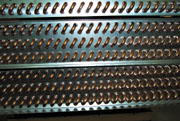
 

Roger Tessier, sales manager for LRC Coil, asserts that most contractors prefer copper tube/aluminum fin coils. (Photos courtesy of LRC Coil.)

That’s one of the reasons why LRC Coil doesn’t manufacture aluminum tube/aluminum fin coils. But many manufacturers consider cost, which is why aluminum can be found in condensing coils today. “Aluminum is roughly the same price per pound as copper, but you use three times as much copper in a copper coil. It does have an impact on manufacturing costs,” says Williams.

Ken Kaye, sales and engineering manager for Super Radiator Coils, Phoenix (AZ) Division, notes that while his company occasionally manufactures an aluminum tube/aluminum fin condensing coil, it’s usually only for special applications. “Some of the larger residential companies have gone to aluminum tube/aluminum fins because of cost and weight. We don’t really recommend that,” he says.

“When we make aluminum coils here, we actually weld the joints. A lot of our competitors will braze aluminum joints. That’s where they get the problems. It’s a tricky business,” he notes.

Besides the fact that leaks are difficult to repair on all-aluminum coils, Forty says that they’re almost impossible to clean. That’s because the coil itself is more fragile than a copper tube coil, so manufacturers place a heavy-duty cabinet around it for protection.

“With the heavy cabinet these units are hard to clean and maintain, so nobody does it,” says Forty. “If they do, they do a cursory clean-up job. You have to charge a decent price, because you have to take the case apart to get at it; then you have to use some special chemicals on those units, not the high-pressure hose, just regular water to clean it off. That doesn’t happen,” he notes.

Roger Tessier, sales manager, LRC Coil, sums it up when he notes that most contractors think copper tube/aluminum fin coils are of higher quality. “They are perceived as being a better piece of equipment and longer lasting in the field. Aluminum tubes are just nightmares to work on, so why ask for trouble?”

Publication date: 02/18/2002

KEYWORDS: coils and HVACR

Share This Story

Looking for a reprint of this article?
From high-res PDFs to custom plaques, order your copy today!


Tn joanna 2017
Joanna Turpin is a Senior Editor at The ACHR NEWS. She can be contacted at 248-786-1707 or joannaturpin@achrnews.com. Joanna has been with BNP Media since 1991, first heading up the company’s technical book division before moving over to The ACHR NEWS, where she frequently writes about refrigerants and commercial refrigeration. She obtained her bachelor’s degree in English from the University of Washington and worked on her master’s degree in technical communication at Eastern Michigan University.

Recommended Content

JOIN TODAY
To unlock your recommendations.

Already have an account? Sign In

  • HVAC-enrollment

    The Trades Are Back: HVACR Programs See Nearly 30% Enrollment Spike

    A new wave of future technicians is entering the pipeline.  
    News
    By: Matt Jachman
  • 2025 Top 40 Under 40

    2025 Top 40 Under 40 HVACR Professionals List

    The 11th annual Top 40 Under 40 list highlights those...
    HVAC Contracting
    By: Hannah Belloli-Oster
  • LG Ductless Mini-Split Systems

    The 9 Types of Heat Pumps

    As the U.S. moves toward electrification, heat pumps are...
    News
    By: Joanna R. Turpin
Subscription Center
  • Create an Account
  • Start a Subscription
  • Manage My Account
  • Sign Up for Newsletters
  • Visit Customer Service
  • Update Preferences

More Videos

Sponsored Content

Sponsored Content is a special paid section where industry companies provide high quality, objective, non-commercial content around topics of interest to The News audience. All Sponsored Content is supplied by the advertising company and any opinions expressed in this article are those of the author and not necessarily reflect the views of The News or its parent company, BNP Media. Interested in participating in our Sponsored Content section? Contact your local rep!

close
  • Piggy Bank
    Sponsored byWatercress Financial

    Energy Prices, Inflation, and HVAC: What Today’s Homeowners Care About

  • Refrigerated Food
    Sponsored bySolstice Advanced Materials

    R-455A Refrigeration: A Cold Storage Solution for the Future

  • Airex Rooftop Units
    Sponsored byAirex Manufacturing Inc

    Consolidating Roof Penetrations: A Growing Trend in Multifamily HVAC Design

Popular Stories

HVAC-Price-Increase-graphic

HVAC Price Increase List: June 2026

Trump-Section-232.jpg

Trump Reduces Section 232 Tariffs on HVAC Equipment to 15%

R410A-Refrigerant-Cylinder.jpg

Refrigerant Recovery is a Revenue Opportunity

Heat-pump-cutaway.jpg

PFAS Rules and A2L Building Codes Continue to Evolve

Midea-training.jpg

HVAC Workforce Crisis Expands Beyond Technicians to Instructor Shortages

View The ACHR NEWS
Centennial Anniversary Timeline

The ACHR News Timeline Chart
Submit a Letter
Submit a letter to our editors.

Events

November 6, 2025

Next-Gen Data Center Cooling: HVAC Innovation and Real-World Solutions

On Demand As AI workloads and high-density computing push traditional cooling methods to their limits, the data center industry is accelerating the adoption of next-generation HVAC technologies.

June 17, 2026

Decarbonization Without Disruption

This webinar will explore practical HVAC decarbonization strategies that minimize disruption while maximizing long-term performance and ROI.

View All Submit An Event

Poll

Summer Staff

Are you fully staffed for the summer season?
View Results Poll Archive

Products

BNI Mechanical/Electrical Square Foot Costbook, 2026 Edition

BNI Mechanical/Electrical Square Foot Costbook, 2026 Edition

See More Products
Decarbonization Without Disruption - Free Webinar - 6/17/2026

Related Articles

  • The Aluminum Side Of The Great Coil Debate

    See More
  • BAM Coils: The Other Aluminum Coil

    See More
  • Circuits

    Cutting Costs vs. Creeping Copper: The Data Center Airside Economizer Conundrum

    See More

Related Products

See More Products
  • bsctppm.png

    Brazing & Soldering: Copper Tubing and Processes

  • The ACHR News - January 19, 2026

    ACHR NEWS January 19, 2026, Issue

See More Products

Events

View AllSubmit An Event
  • July 16, 2025

    Let’s Talk: Condensing Equipment, (Acidic) Condensate, and the Code

    On Demand During this webinar, we will define what acidic condensate is, illustrate how it’s formed in today’s high-efficiency, gas-fired heating appliances, and hit on the damage it can cause if not treated.
View AllSubmit An Event

Related Directories

  • Great American Coil

    Hot and chilled water, chilled beam, DX, condenser, and steam coils for the O.E.M. and replacement markets. Short 4-week standard lead time with 5, 10 and 15 day quick-ship options available.
×

Sign Up. Stay Informed.

The #1 trusted source for the HVACR industry since 1926

SUBSCRIBE
  • RESOURCES
    • Advertise
    • Contact Us
    • Advisory Board
    • Classifieds
    • Submit a Letter
    • Directories
    • Store
  • ACCOUNT CENTER
    • Create an Account
    • Start a Subscription
    • Manage My Account
    • Sign Up for Newsletters
    • Visit Customer Service
    • Update Preferences
  • SERVICES
    • Marketing Services
    • Reprints
    • Market Research
    • List Rental
    • Survey/Respondent Access
  • STAY CONNECTED
    • LinkedIn
    • Facebook
    • Instagram
    • YouTube
    • X (Twitter)
  • PRIVACY
    • PRIVACY POLICY
    • TERMS & CONDITIONS
    • DO NOT SELL MY PERSONAL INFORMATION
    • PRIVACY REQUEST
    • ACCESSIBILITY

Copyright ©2026. All Rights Reserved BNP Media, Inc. and BNP Media II, LLC.

Design, CMS, Hosting & Web Development :: ePublishing