ACHR News
search
Ask ACHR NEWS AI
cart
facebook twitter instagram linkedin youtube
  • Sign In
  • Subscribe
  • Sign Out
  • My Account
ACHR News
  • NEWS
    • Breaking News
    • New HVAC Products
    • Featured Products
    • Manufacturer Reports
    • HVAC Data
    • Legislation
    • ACHR NEWS Centennial
  • RESIDENTIAL
    • Air Conditioners
    • Furnaces
    • Residential Heat Pumps
    • Ductless
    • Residential IAQ
    • Testing, Monitoring, Tools
    • Components & Accessories
  • COMMERCIAL
    • Air Handlers
    • Rooftop Units
    • Chillers and Cooling Towers
    • Commercial Heat Pumps
    • Boilers and Hydronics
    • VRF/Ductless
    • Commercial IAQ
  • REFRIGERATION
    • Refrigerants
    • Refrigerant Regulations
    • Leak Management
  • CONTRACTOR PRO
    • Geothermal
    • Homeowner Study
    • VRF and VRV Ductless
    • Unitary Trends
  • EDUCATION
    • Training and Education
    • Business Management
    • Service and Maintenance
    • Continuing Education
    • Market Research >
      • HVAC Brand Awareness Report
      • VRV, VRF, VRVZ Report
      • Unitary Trends Report
      • Water Heat Professionals Report
    • Webinars
    • Sponsor Insights
    • eProducts Info
    • White Papers
  • EVENTS
    • HVAC Contractor Forum
    • Industry Events and Webinars
  • MEDIA
    • Videos
    • AHR Expo 2025 Videos
    • Podcasts >
      • ACHR News Podcast
      • HARDI Podcasts
      • AHR Expo Podcasts
      • ACCA Podcasts
    • Interactive Spotlights
    • Quizzes
    • eBooks
    • HVAC Talkback
  • HVAC GROUP
    • ACHR NEWS >
      • Current Issue
      • Digital Edition
      • Subscribe
    • Distribution Trends
    • SNIPS NEWS >
      • Join SNIPS NEWS
    • Engineered Systems News >
      • Join ES News
    • HVACR Directory
    • Contests
    • Newsletters
    • Contact
    • Advertise
    • My Account
HVAC ContractingTechnical

Applying Ultraviolet Air Treatment Systems

July 13, 2003
Honeywell UV air treatment systems. (All graphics courtesy of Honeywell.)
Ultraviolet air treatment systems are fairly new to the HVAC industry, and there are still a lot of questions about how they work to treat the air. The U.S. Environmental Protection Agency (EPA) and other authorities on indoor air quality (IAQ) agree that there are three proven ways of improving air quality: source control, ventilation, and filtration. Ultraviolet air treatment systems address the source of air quality problems by killing airborne bacteria and surface mold.

UV Technology: What Is It?

Ultraviolet is a high-energy light, which is not visible to the naked eye. Light waves are generally measured in nanometers (nm). There are three bands of useful UV light:
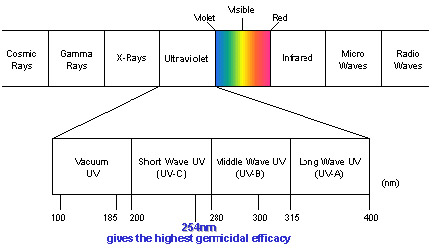
  • UV-A (315nm-400nm) — Used in black lights and tanning booths. Harmful to eyes.

  • UV-B (280nm-315nm) — Causes sunburn, cataracts, and skin cancer.

  • UV-C (200nm-280nm) — Germicidal. In addition to effects above, it also damages cells’ DNA.

    The UV light bands.


    The sun irradiates all three bands of UV but, for the most part, only UV-A and UV-B make it through the earth's atmosphere. UV-C is filtered out with the exception of some that reaches the highest mountaintops. Experts have shown that 253.7nm is the most effective germicidal peak within the UV-C band of germicidal light. This is the wavelength of the light that Honeywell UV air treatment systems emit.

    Ultraviolet technology has been used for a century as a germicidal agent. It is used in water treatment plants, hospitals, pharmacies, and kitchens.

    UV Technology: How Does It Work?

    A cell’s nucleic acid tends to absorb light energy from 230nm to 290nm. The germicidal effect of UV-C is caused by the absorption of these rays by the cell's deoxyribose nucleic acid (DNA). The UV-C energy scrambles the DNA coding rendering the cell nonviable, unable to reproduce, and unable to infect.

    This is a very simplified sketch meant to demonstrate the effect of UV-C on a living cell.


    The amount of UV-C energy required to kill each pathogen is referred to as the "lethal dosage." The lethal dosage needed to kill a microorganism is a measurement of light intensity and exposure time (lethal dosage equals UV-C intensity multiplied by exposure time). Each lethal dosage differs for each type of pathogen.

    Kill Rate Factors — Balancing The Equation

    The following provides kill rate factors for UV lamps relative to various factors.

    Relating To Intensity:

  • Lamp Intensity

    The intensity of a lamp (measured in microwatts/centimeters squared) should be adequate to deliver the desired kill rate. The goal in return air applications is to kill airborne pathogens. Time is limited because they are traveling in and out of the range of the light; therefore intensity is of great importance. In coil applications the goal is to kill surface mold, so light intensity is not as important because the pathogen remains in sight of the lamp giving it “infinite” exposure time.

  • Lamp Life

    The accepted industry standard for UV lights is that they should effectively emit UV-C for 8,000 hours. At this point it is referred to as reaching its “end of life.”

    Mercury collecting on the inside of the lamp walls contributes to the decline of UV-C output. Honeywell uses soft glass lamps that are chemically coated to minimize mercury from collecting, which helps increase effective operation.

    A graph showing the impact of ambient temperature on lamp output.
  • "Wind Chill"

    Temperature also affects the output or intensity of a lamp. Cooler temperatures make it more difficult for UV-C energy to penetrate the glass lamp wall. (Consider it like putting tinting on a window for visible light.) Therefore the ambient temperature accompanied by velocity affects lamp performance. We recommend installing UV lights with the intent to kill airborne bacteria on the return side of the system where they will not be exposed to chilled air during the air conditioning season.

    The coil irradiation model is also affected by the cooler temperatures, but because of the long exposure time, the reduction in light intensity does not affect the lethal dosage to surface molds.
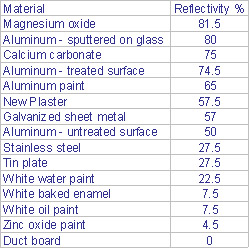
    Reflectivity of various duct materials.
  • Reflectivity

    Certain duct materials can reflect UV rays better than others, thus increasing the intensity and the kill rate. UV rays do not reflect the same way visible light does. The chart at right shows the reflectivity of some example materials.

  • Maintenance

    Like mercury coating the inside of the lamp wall, dust and residue can settle on the outside lamp wall that can also reduce UV-C output and therefore kill rate. To avoid this we recommend proper maintenance including quarterly lamp cleaning with a soft damp cloth. Window cleaner may be used, but be cautious of window cleaners containing any sort of oil that may leave a residue.

    Relating To Time:

  • Fan Speed

    Exposure time is directly linked to fan speed. The slower the fan speed is, the longer a microorganism will be exposed to UV-C, and the higher the kill rate will be. Conversely, the faster the fan speed is, the shorter exposure time will be, and the lower the kill rate will be. This does not mean that the fan speed should be adjusted to increase the kill rate. What it does mean is that the fan speed should be considered when choosing a model.

    The Honeywell models were tested at 2,000 cfm in a 12- by 25-inch duct. The dual lamp return air model delivers an 87 percent kill rate on Serratia marcescens, and the single lamp return air model delivers a 70 percent kill rate on the same pathogen.

  • Lamp Position

    The placement of the lamp is crucial in attaining the desired kill rate. In a return air application for killing the highest amount of airborne microorganisms we recommend that the device be mounted with 3 feet of open space both before and after the lamps. It is understood that this will not be possible in all applications, but the general principal should be kept in mind. In a coil irradiation application the goal is to shed light on the greatest amount of surface area that could be subjected to mold. The Honeywell coil model was found to kill 99.9 percent of colony forming Aspergillus niger mold spores when irradiated for three hours at a distance of 18 inches.

    Note: High intensity UV-C energy can degrade non-metallic materials. We recommend that a minimum distance of 3 feet is maintained between the lamps and non-metallic or non-fiberglass materials. If this is not possible, aluminum-face duct tape can be used to cover the material to shield the light.

    Other:

  • Humidity

    The right humidity level is important to all living things, but just as adding humidity to dry winter homes helps people, it also helps many of the microorganisms to thrive and be hardier. While it is not possible in all applications, we recommend installing return air ultraviolet air treatment systems in front of the humidifier or humidifier bypass.

    Homeowner Benefits

    In a survey conducted by the National Association of Home Builders (NAHB), customers rated indoor air quality as a 4.6 out of 5 in importance for their new home. Ultraviolet air treatment systems create a better indoor environment by reducing mold growth in the air conditioning cooling cools and reducing airborne bacteria blowing through the HVAC systems and into the living space. The availability of UV technology is of particular importance to people concerned about the effects of mold, bacteria, and other bioaerosols.

    Since so many customers are concerned about their indoor air quality and a solution is available, you have the opportunity to provide them with a complete comfort system that alleviates indoor environment problems as it heats and cools their home.

    Reprinted with permission from Honeywell’s “Ultraviolet Air Treatment Systems” technical bulletin 50-8887. For more information, visit www.honeywell.com.

    Publication date: 07/14/2003

  • Share This Story

    Looking for a reprint of this article?
    From high-res PDFs to custom plaques, order your copy today!


    Recommended Content

    JOIN TODAY
    To unlock your recommendations.

    Already have an account? Sign In

    • HVAC-enrollment

      The Trades Are Back: HVACR Programs See Nearly 30% Enrollment Spike

      A new wave of future technicians is entering the pipeline.  
      News
      By: Matt Jachman
    • 2025 Top 40 Under 40

      2025 Top 40 Under 40 HVACR Professionals List

      The 11th annual Top 40 Under 40 list highlights those...
      HVAC Light Commercial Market
      By: Hannah Belloli-Oster
    • LG Ductless Mini-Split Systems

      The 9 Types of Heat Pumps

      As the U.S. moves toward electrification, heat pumps are...
      Air Source Heat Pumps
      By: Joanna R. Turpin
    Subscription Center
    • Create an Account
    • Start a Subscription
    • Manage My Account
    • Sign Up for Newsletters
    • Visit Customer Service
    • Update Preferences

    More Videos

    Sponsored Content

    Sponsored Content is a special paid section where industry companies provide high quality, objective, non-commercial content around topics of interest to The News audience. All Sponsored Content is supplied by the advertising company and any opinions expressed in this article are those of the author and not necessarily reflect the views of The News or its parent company, BNP Media. Interested in participating in our Sponsored Content section? Contact your local rep!

    close
    • Piggy Bank
      Sponsored byWatercress Financial

      Energy Prices, Inflation, and HVAC: What Today’s Homeowners Care About

    • Refrigerated Food
      Sponsored bySolstice Advanced Materials

      R-455A Refrigeration: A Cold Storage Solution for the Future

    • Airex Rooftop Units
      Sponsored byAirex Manufacturing Inc

      Consolidating Roof Penetrations: A Growing Trend in Multifamily HVAC Design

    Popular Stories

    HVAC-Price-Increase-graphic

    HVAC Price Increase List: June 2026

    Trump-Section-232.jpg

    Trump Reduces Section 232 Tariffs on HVAC Equipment to 15%

    R410A-Refrigerant-Cylinder.jpg

    Refrigerant Recovery is a Revenue Opportunity

    Heat-pump-cutaway.jpg

    PFAS Rules and A2L Building Codes Continue to Evolve

    Kroger.jpg

    Kroger to Spend $100 Million to Reduce Refrigerant Leaks

    View The ACHR NEWS
    Centennial Anniversary Timeline

    The ACHR News Timeline Chart
    Submit a Letter
    Submit a letter to our editors.

    Events

    November 6, 2025

    Next-Gen Data Center Cooling: HVAC Innovation and Real-World Solutions

    On Demand As AI workloads and high-density computing push traditional cooling methods to their limits, the data center industry is accelerating the adoption of next-generation HVAC technologies.

    June 17, 2026

    Decarbonization Without Disruption

    This webinar will explore practical HVAC decarbonization strategies that minimize disruption while maximizing long-term performance and ROI.

    View All Submit An Event

    Poll

    Summer Staff

    Are you fully staffed for the summer season?
    View Results Poll Archive

    Products

    BNI Mechanical/Electrical Square Foot Costbook, 2026 Edition

    BNI Mechanical/Electrical Square Foot Costbook, 2026 Edition

    See More Products
    Decarbonization Without Disruption - Free Webinar - 6/17/2026

    Related Articles

    • UltraViolet Devices Inc.: Air Treatment Unit

      See More
    • Research Products Corp.: Water Treatment Systems

      See More
    • UltraViolet Devices Inc.: Portable Air Treatment Unit

      See More

    Related Products

    See More Products
    • Manual B.jpg

      Manual B - Balancing and Testing Air and Hydronic Systems

    • 9781482255676.jpg

      Testing and Balancing HVAC Air and Water Systems, Fifth Edition

    • HVACR Troubleshooting Fundamentals Cover Image One Sheet.jpg

      HVACR Troubleshooting Fundamentals: Refrigeration and Air Flow Systems - Student Text

    See More Products

    Related Directories

    • American Ultraviolet Co.

      AUV makes UVC products for air handlers, on coil and in duct. Our lamps are 2-year life time and the highest output in the industry. Ballasts are good for 5 years. We also have in-room upper air systems for indoor air disinfection.
    ×

    Sign Up. Stay Informed.

    The #1 trusted source for the HVACR industry since 1926

    SUBSCRIBE
    • RESOURCES
      • Advertise
      • Contact Us
      • Advisory Board
      • Classifieds
      • Submit a Letter
      • Directories
      • Store
    • ACCOUNT CENTER
      • Create an Account
      • Start a Subscription
      • Manage My Account
      • Sign Up for Newsletters
      • Visit Customer Service
      • Update Preferences
    • SERVICES
      • Marketing Services
      • Reprints
      • Market Research
      • List Rental
      • Survey/Respondent Access
    • STAY CONNECTED
      • LinkedIn
      • Facebook
      • Instagram
      • YouTube
      • X (Twitter)
    • PRIVACY
      • PRIVACY POLICY
      • TERMS & CONDITIONS
      • DO NOT SELL MY PERSONAL INFORMATION
      • PRIVACY REQUEST
      • ACCESSIBILITY

    Copyright ©2026. All Rights Reserved BNP Media, Inc. and BNP Media II, LLC.

    Design, CMS, Hosting & Web Development :: ePublishing