A Primer On Energy Recovery Ventilators

What They Are
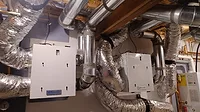
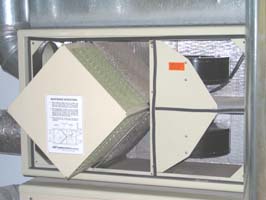
An energy recovery ventilator (ERV) moves fresh outdoor air into a home while at the same time moving stale indoor air out of the home, to improve indoor air quality. Like a heat recovery ventilator (HRV), the ERV recovers the sensible energy (temperature) of the outgoing air stream. Unlike an HRV, the ERV also transfers latent energy (moisture). The exchange of latent energy and sensible energy between the airstreams is achieved through the special material of a core or with a desiccant wheel.Airflow (cfm) and apparent sensible effectiveness (ASE) are the major features of an ERV. Often units will also offer filters, controls, drain, defrost, etc. Don’t get too caught up in available options, though. An ERV works best when operated constantly. The moisture transfer keeps the core above dewpoint temperatures, preventing the core from freezing in all but the most extreme conditions. And filtering only a small amount of the air in the home will not replace a good whole house air cleaner.
What They Do
An ERV is designed to provide constant ventilation. Since transferring both temperature and moisture is beneficial in both winter and summer, the ERV provides year-round fresh air.During the heating season the outdoor air is colder and generally has less moisture than the indoor air. The moisture transfer core of an ERV allows the incoming air to be humidified by the outgoing airstream. Some dehumidification of the house does occur, but not the over-dehumidification that can be experienced with an HRV or a fresh air intake. This provides more control of humidity in all but the most northern climates.
During the cooling season the air conditioning coil removes energy from the air. This lowers the temperature of the air to its dewpoint. At dewpoint the coil must remove more energy to condense the water out of the air before a temperature drop will occur. This condensation represents a significant amount of energy, and cost, to cool the air. An ERV will transfer moisture from the outdoor airstream coming into the home to the outgoing airstream from inside the home, saving the energy required for an air conditioner to condense and remove the humidity.
How They Are Installed
An ERV can be installed in any space where an air exchange is desired. They are typically installed in conjunction with the HVAC system, but can be installed completely independent of it. Installations using existing ductwork save time and money by using the HVAC return duct to distribute the fresh air to the home.In every application, the flow of the fresh air into and the exhaust out of the home should be properly measured and balanced. Balancing is important to maintain the optimum ASE as well as prevent pressurizing or depressurizing the home. When installing an ERV in a home, make sure that any ductwork to a grille in the home is insulated for sound. Sizing is exactly the same as an HRV. Take the cubic footage of the area or home (square footage times ceiling height), multiply by the desired or required air changes per hour (ACH), and divide by 60 minutes per hour. This will give you the required volume for the ERV (in cfm).
For example: In a 2,200-square-foot home with 8-foot ceilings you need 0.35 ACH.
2,000 square feet x 8 ft = 16,000 cubic feet
16,000 cubic feet x 0.35 ACH = 5,600 cubic feet per hour
5,600 cubic feet per hour/60 minutes per hour = 93.3 cubic feet per minute (cfm)
Service Recommendations
Every six months the units will need to be cleaned and inspected. Most units contain washable filters; clean and re-coat with filter adhesive as necessary. If the filters are disposable, replace them as recommended. Clogged filters will lead to airflow restriction.The energy transfer core or wheel can be cleaned by lightly vacuuming with a soft brush attachment. Most manufacturers do not recommend washing or submerging the core or wheel.
Looking for quick answers on air conditioning, heating and refrigeration topics? Try Ask ACHR NEWS, our new smart AI search tool. Ask ACHR NEWS
The most often overlooked service is to assure the fresh air intake and exhaust vents are clean. Outdoor grilles can become clogged with lawn debris, insects, and windblown material. Clogging of a grille reduces the transfer of energy and can put the home under negative or positive pressure.
Doug Dettlaff is product coordinator for Research Products Corp., Madison, Wis. For more information, call 800-334-6011, ext. 870, or visit www.aprilaire.com.
Publication date: 05/05/2003
Looking for a reprint of this article?
From high-res PDFs to custom plaques, order your copy today!