ACHR News
search
Ask ACHR NEWS AI
cart
facebook twitter instagram linkedin youtube
  • Sign In
  • Subscribe
  • Sign Out
  • My Account
ACHR News
  • NEWS
    • Breaking News
    • New HVAC Products
    • Featured Products
    • Manufacturer Reports
    • HVAC Data
    • Legislation
    • ACHR NEWS Centennial
  • RESIDENTIAL
    • Air Conditioners
    • Furnaces
    • Residential Heat Pumps
    • Ductless
    • Residential IAQ
    • Testing, Monitoring, Tools
    • Components & Accessories
  • COMMERCIAL
    • Air Handlers
    • Rooftop Units
    • Chillers and Cooling Towers
    • Commercial Heat Pumps
    • Boilers and Hydronics
    • VRF/Ductless
    • Commercial IAQ
  • REFRIGERATION
    • Refrigerants
    • Refrigerant Regulations
    • Leak Management
  • CONTRACTOR PRO
    • Geothermal
    • Homeowner Study
    • VRF and VRV Ductless
    • Unitary Trends
  • EDUCATION
    • Training and Education
    • Business Management
    • Service and Maintenance
    • Continuing Education
    • Market Research >
      • HVAC Brand Awareness Report
      • VRV, VRF, VRVZ Report
      • Unitary Trends Report
      • Water Heat Professionals Report
    • Webinars
    • Sponsor Insights
    • eProducts Info
    • White Papers
  • EVENTS
    • HVAC Contractor Forum
    • Industry Events and Webinars
  • MEDIA
    • Videos
    • AHR Expo 2025 Videos
    • Podcasts >
      • ACHR News Podcast
      • HARDI Podcasts
      • AHR Expo Podcasts
      • ACCA Podcasts
    • Interactive Spotlights
    • Quizzes
    • eBooks
    • HVAC Talkback
  • HVAC GROUP
    • ACHR NEWS >
      • Current Issue
      • Digital Edition
      • Subscribe
    • Distribution Trends
    • SNIPS NEWS >
      • Join SNIPS NEWS
    • Engineered Systems News >
      • Join ES News
    • HVACR Directory
    • Contests
    • Newsletters
    • Contact
    • Advertise
    • My Account
HVAC ContractingService and Maintenance

Quick Facts: Evacuation

August 7, 2005
What is the purpose of "evacuating" a refrigeration system?
Evacuating a refrigeration system serves two primary objectives:

1. It removes noncondensables.

2. It dehydrates (removes water vapor).

If noncondensables such as air are not removed, the system will operate at higher than condensing pressures. This happens because the air is trapped at the top of the condenser, effectively reducing the condenser capacity. Increasing the condensing pressure results in higher compression ratios and higher discharge temperatures, both of which decrease system efficiency and can lead to decreased reliability.

Water vapor must be removed from refrigeration systems for several reasons. The water vapor can cause a "freeze-up" at the expansion device (TXV or capillary tube), causing a complete loss of refrigeration effect. Moisture, refrigerant, and heat can also combine to form acids. These acids mix with oil and metal wear particles resulting in the formation of sludge. This sludge tends to collect at the hottest areas, usually the discharge valve plate, and if allowed to build up can prevent the discharge valves from properly sealing.

Does evacuation actually pull liquid water out of the system?
No, evacuation will not pull liquid water out of the system. When you evacuate a system you are actually dropping the pressure sufficiently to allow water to "boil" at room temperature. As the water boils, it of course changes to the vapor state, and this vapor is drawn out by the vacuum pump.
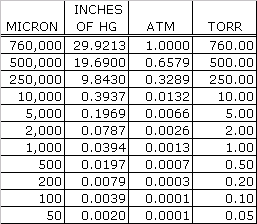
Table 1. The various units of measure of vacuum, showing how a micron relates to inches of Hg, atmosphere, and torr.
How low a vacuum do I need to properly evacuate a system?
Modern deep vacuum pumps should be used for this purpose. These pumps have the ability to evacuate down to 20 microns in field situations. Equipment manufacturers should be consulted to determine their recommended vacuum levels. However, if a vacuum of 250 microns can be achieved, that is usually considered adequate.

Care must be taken to assure that the vacuum measured at the gauge is equal to the vacuum level in the system being evacuated. Use as large a hose as possible to connect the evacuation equipment to the refrigeration system. It is also advisable to remove any Schrader cores prior to connecting evacuation lines so as to eliminate large pressure drops. Once the system is evacuated, it is also advisable to isolate the pump from the system and observe if the system holds its low vacuum. Some increase is acceptable (up to about 500 microns), but if the system vacuum level exceeds that, a second and even third evacuation may be needed. If during the equalization time the system vacuum level goes back to atmospheric, it is an indication that a leak is present.

If a vacuum pump is no longer able to pull a deep vacuum, it is usually an indication that the oil in the pump is contaminated and must be replaced. Be sure to use oil specifically produced for vacuum pump applications. This oil has a much lower vapor pressure than conventional oils. It is advisable to replace the vacuum pump oil at regular intervals, usually after each use, to make certain a low vacuum level can be achieved. The oil should be replaced while still warm, enabling better drainage.

Looking for quick answers on air conditioning, heating and refrigeration topics? Try Ask ACHR NEWS, our new smart AI search tool. Ask ACHR NEWS →

What is a micron?
A micron is a metric measure and is defined as 1 millionth of a meter or 1 thousandth of a millimeter.

Most people in the U.S. think of a perfect vacuum as 30 inches of mercury (Hg). The last inch (from 29-30) of vacuum is equal to 25,400 microns. The micron then is a much more precise method for measuring deep vacuums.

1 micron = 0.001 mm Hg = 0.000039 inches of Hg = 1 millitorr

Quick Facts is courtesy of the Flow Controls Division of Emerson Climate Technologies (formerly Alco Controls). For more information, visit www.emersonclimatecontractor.com.

Publication date: 08/08/2005

Share This Story

Looking for a reprint of this article?
From high-res PDFs to custom plaques, order your copy today!


Recommended Content

JOIN TODAY
To unlock your recommendations.

Already have an account? Sign In

  • HVAC-enrollment

    The Trades Are Back: HVACR Programs See Nearly 30% Enrollment Spike

    A new wave of future technicians is entering the pipeline.  
    News
    By: Matt Jachman
  • 2025 Top 40 Under 40

    2025 Top 40 Under 40 HVACR Professionals List

    The 11th annual Top 40 Under 40 list highlights those...
    HVAC Contracting
    By: Hannah Belloli-Oster
  • LG Ductless Mini-Split Systems

    The 9 Types of Heat Pumps

    As the U.S. moves toward electrification, heat pumps are...
    HVAC Residential Market
    By: Joanna R. Turpin
Subscription Center
  • Create an Account
  • Start a Subscription
  • Manage My Account
  • Sign Up for Newsletters
  • Visit Customer Service
  • Update Preferences

More Videos

Sponsored Content

Sponsored Content is a special paid section where industry companies provide high quality, objective, non-commercial content around topics of interest to The News audience. All Sponsored Content is supplied by the advertising company and any opinions expressed in this article are those of the author and not necessarily reflect the views of The News or its parent company, BNP Media. Interested in participating in our Sponsored Content section? Contact your local rep!

close
  • Piggy Bank
    Sponsored byWatercress Financial

    Energy Prices, Inflation, and HVAC: What Today’s Homeowners Care About

  • Refrigerated Food
    Sponsored bySolstice Advanced Materials

    R-455A Refrigeration: A Cold Storage Solution for the Future

  • Airex Rooftop Units
    Sponsored byAirex Manufacturing Inc

    Consolidating Roof Penetrations: A Growing Trend in Multifamily HVAC Design

Popular Stories

HVAC-Price-Increase-graphic

HVAC Price Increase List: June 2026

Trump-Section-232.jpg

Trump Reduces Section 232 Tariffs on HVAC Equipment to 15%

R410A-Refrigerant-Cylinder.jpg

Refrigerant Recovery is a Revenue Opportunity

Heat-pump-cutaway.jpg

PFAS Rules and A2L Building Codes Continue to Evolve

Kroger.jpg

Kroger to Spend $100 Million to Reduce Refrigerant Leaks

View The ACHR NEWS
Centennial Anniversary Timeline

The ACHR News Timeline Chart
Submit a Letter
Submit a letter to our editors.

Events

November 6, 2025

Next-Gen Data Center Cooling: HVAC Innovation and Real-World Solutions

On Demand As AI workloads and high-density computing push traditional cooling methods to their limits, the data center industry is accelerating the adoption of next-generation HVAC technologies.

June 17, 2026

Decarbonization Without Disruption

This webinar will explore practical HVAC decarbonization strategies that minimize disruption while maximizing long-term performance and ROI.

View All Submit An Event

Poll

Summer Staff

Are you fully staffed for the summer season?
View Results Poll Archive

Products

BNI Mechanical/Electrical Square Foot Costbook, 2026 Edition

BNI Mechanical/Electrical Square Foot Costbook, 2026 Edition

See More Products
Decarbonization Without Disruption - Free Webinar - 6/17/2026

Related Articles

  • Quick Facts: Superheat And Subcooling

    See More
  • Quick Facts: TXV Selection and Sensing Bulb Location

    See More
  • Quick Facts: Migration And Pump Down Systems

    See More

Related Products

See More Products
  • quick guide.png

    Quick Guide to Refrig Cycle, Refrigerants, Components

  • srepm.png

    System Recovery & Evacuation

  • The ACHR News - July 14, 2025

    ACHR NEWS July 14, 2025, Issue

See More Products

Related Directories

  • GlobalFACT

  • measureQuick®

    measureQuick is an application that technicians use to display measurements from arrayed smart tools, run equipment diagnostics, view just-in-time education and resources, generate easy-to-read homeowner-facing PDF reports and more.
×

Sign Up. Stay Informed.

The #1 trusted source for the HVACR industry since 1926

SUBSCRIBE
  • RESOURCES
    • Advertise
    • Contact Us
    • Advisory Board
    • Classifieds
    • Submit a Letter
    • Directories
    • Store
  • ACCOUNT CENTER
    • Create an Account
    • Start a Subscription
    • Manage My Account
    • Sign Up for Newsletters
    • Visit Customer Service
    • Update Preferences
  • SERVICES
    • Marketing Services
    • Reprints
    • Market Research
    • List Rental
    • Survey/Respondent Access
  • STAY CONNECTED
    • LinkedIn
    • Facebook
    • Instagram
    • YouTube
    • X (Twitter)
  • PRIVACY
    • PRIVACY POLICY
    • TERMS & CONDITIONS
    • DO NOT SELL MY PERSONAL INFORMATION
    • PRIVACY REQUEST
    • ACCESSIBILITY

Copyright ©2026. All Rights Reserved BNP Media, Inc. and BNP Media II, LLC.

Design, CMS, Hosting & Web Development :: ePublishing