ACHR News
search
Ask ACHR NEWS AI
cart
facebook twitter instagram linkedin youtube
  • Sign In
  • Subscribe
  • Sign Out
  • My Account
ACHR News
  • NEWS
    • Breaking News
    • New HVAC Products
    • Featured Products
    • Manufacturer Reports
    • HVAC Data
    • Legislation
    • ACHR NEWS Centennial
  • RESIDENTIAL
    • Air Conditioners
    • Furnaces
    • Residential Heat Pumps
    • Ductless
    • Residential IAQ
    • Testing, Monitoring, Tools
    • Components & Accessories
  • COMMERCIAL
    • Air Handlers
    • Rooftop Units
    • Chillers and Cooling Towers
    • Commercial Heat Pumps
    • Boilers and Hydronics
    • VRF/Ductless
    • Commercial IAQ
  • REFRIGERATION
    • Refrigerants
    • Refrigerant Regulations
    • Leak Management
  • CONTRACTOR PRO
    • Geothermal
    • Homeowner Study
    • VRF and VRV Ductless
    • Unitary Trends
  • EDUCATION
    • Training and Education
    • Business Management
    • Service and Maintenance
    • Continuing Education
    • Market Research >
      • HVAC Brand Awareness Report
      • VRV, VRF, VRVZ Report
      • Unitary Trends Report
      • Water Heat Professionals Report
    • Webinars
    • Sponsor Insights
    • eProducts Info
    • White Papers
  • EVENTS
    • HVAC Contractor Forum
    • Industry Events and Webinars
  • MEDIA
    • Videos
    • AHR Expo 2025 Videos
    • Podcasts >
      • ACHR News Podcast
      • HARDI Podcasts
      • AHR Expo Podcasts
      • ACCA Podcasts
    • Interactive Spotlights
    • Quizzes
    • eBooks
    • HVAC Talkback
  • HVAC GROUP
    • ACHR NEWS >
      • Current Issue
      • Digital Edition
      • Subscribe
    • Distribution Trends
    • SNIPS NEWS >
      • Join SNIPS NEWS
    • Engineered Systems News >
      • Join ES News
    • HVACR Directory
    • Contests
    • Newsletters
    • Contact
    • Advertise
    • My Account
HVAC ContractingService and Maintenance

Btu Buddy 39: Burned Transformer Due to Shorted Coil in Relay

June 26, 2006
Bob is a service technician who is well trained and nationally certified. However, he sometimes suffers from the same confusion that all technicians occasionally do - the facts that he gathers may or may not point to the obvious cause of the problem or the best solution. But Bob has something that no one else has. He recalls his long-time HVACR mentor and imagines him accompanying him as "Btu Buddy," someone who reminds him to take time to stop and think before rushing to judgment, helping keep him on the right track, even with facts that are confusing.

Bob receives a call from the dispatcher that a customer has a system that is not heating. The customer explained that nothing on the system was working this morning when she was getting the family started on the day. The system is a heat pump with an electric furnace.

Bob arrives and talks to the customer to see what he could learn. She says that when she got up, the house was cold and she went to the thermostat and pushed the lever up for heat and the furnace didn't start as it usually did. They go to the thermostat and Bob pushes the lever to "fan-on" and the fan doesn't start up. Bob tells the customer that he will get started on the job and find the problem.

The indoor unit has a 230 V power supply so Bob checks the voltage going to the unit, 235 V. That is as it should be. He then checks the power to the low voltage circuit, which is the load side of the 24 V transformer. The voltage is 0 V. The transformer has voltage going in, but no voltage coming out. This is simple enough, he thinks.

Bob turns off the power and changes the transformer, and attributes the failure to random transformer failure. Little does he know that there are other problems.

Figure 1. A clamp-on ammeter can be used to measure very low amperages by wrapping the wire to be checked around the ammeter’s jaws to amplify the reading. Ten wraps will amplify 10 times. The true reading can be arrived at by dividing by 10. (Figures are from Refrigeration & Air Conditioning Technology, 5th Edition, by William Whitman, William Johnson, and John Tomczyk, published by Thomson Delmar Learning.)
Bob is ready to start the unit when Btu Buddy appears and asks, "What do you think caused that transformer to fail?"

Bob says, "I think it just randomly failed."

Btu Buddy then says, "You may be right, but doesn't it make you wonder why it would work for years and then just fail?"

Bob says, "No, it just looked to me like it failed."

Looking for quick answers on air conditioning, heating and refrigeration topics? Try Ask ACHR NEWS, our new smart AI search tool. Ask ACHR NEWS →

Btu Buddy then says, "A real professional technician should always look for why. Otherwise you just become a ‘parts changer.' Oftentimes that will come back to bite you."

Bob asks, "What do you think I should do?"

Btu Buddy responds, "Transformers are notoriously famous for being reliable. When they last for years, they could be subject to some stress that caused them to fail. Let's look for that stress to see for sure if there is one or not."

Bob asks, "How would we go about that?"

Btu Buddy explains, "Use a 10-wrap coil of wire to check the amperage in the low voltage circuit when you start the furnace up (Figure 1). This system has a 40 volt-amp transformer. The maximum amperage that the low voltage of the transformer can output without overheating is 1.66 amps (40 volt/amps divided by 24 volts equal 1.66 amps). This amperage is very low and your ammeter may not measure that low. The 10-wrap of wire will amplify the amperage by 10 times, so the amperage should not exceed 16.6 (10 times 1.6 equals 16.6 amps). Set the ammeter scale to 50 amps."
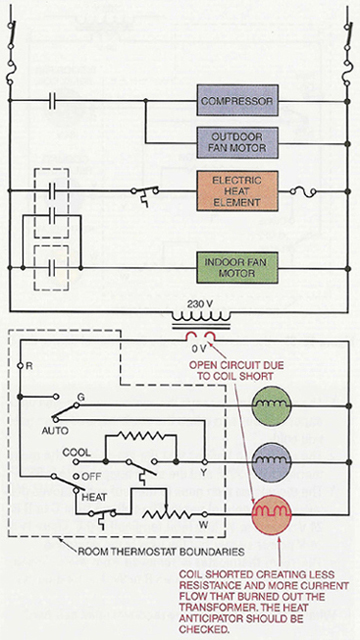
Figure 2. The heat relay in this circuit has a shorted coil. Some of the coil’s wires are touching internally causing the resistance to be less than normal.
Bob gets the system ready to start with a 10-wrap of thermostat wire in the circuit. With the power off at the air handler, he then sets the thermostat to call for heat and returns to the furnace to start the system. When he turns the system on, using the disconnect, the amperage in the low voltage circuit goes up to 25 amps, or an actual 2.5 amps in the circuit. Bob shuts the system back off, scratches his head, and says, "Now what? I can see that the amperage is too high, but where is the problem?"

Btu Buddy then says, "There may be some wires touching together or there may be a ‘shorted' coil. A shorted coil would be one where some of the coil turns are touching together causing it to draw too much amperage. The resistance in the coil would be less than it should. Since there are only two coils in this circuit, the fan and the electric heat coil, lets check them for resistance. You have some low voltage coils in the truck that are new. Let's compare them with the ones in the system and see if there is a big difference."

Bob brings in a typical 24 V heat relay and a fan relay for comparison. When he compares the heat relay in the system with the heat relay from his truck, it shows much less resistance.

Btu Buddy then says, "That heat relay is shorted (Figure 2). You may have changed that transformer and left without noticing that it was drawing too much amperage. It would have burned the new transformer in a short period of time and you would have been back to find the real problem. Some manufacturers put inline fuses in the system to prevent the transformer from failing. This one did not have that fuse, so the transformer overheated and failed."

Bob says, "I am glad that you insisted that I do the right thing. I really hate callbacks. The company doesn't like them either."

Btu Buddy explains, "When a technician gets called back to a job, the company has to pay the technician to do the job again that should have been done correctly the first time. The company cannot collect for these callbacks so management frowns on them. It is part of being professional to do the best you can the first time to eliminate a second call at no charge to the customer."

Bob then says as they are riding away, "It is not easy to be professional all of the time."

Btu Buddy then says "That is why there are fewer real professional technicians. A number of people will settle for taking the easy way out."

Bill Johnson has been active in the HVACR industry since the 1950s. He graduated in gas fuel technology and refrigeration from the Southern Technical Institute, a branch of Georgia Tech (now known as Southern Polytechnic Institute). He taught HVAC classes at Coosa Valley Vocational & Technical Institute for four years. He moved on to become service manager for Layne Trane, Charlotte, N.C. He taught for 15 years at Central Piedmont Community College, part of this time as program director. He had his own business for five years doing installation and service work. Now retired, he is the author of Practical Heating Technology and Practical Cooling Technology, and continues as a co-author of Refrigeration & Air Conditioning Technology, 5th Edition, all published by Thomson Delmar Learning. For more information, he can be reached at 704-553-0087, 704-643-3928 (fax), or billj@carolina.rr.com.

Publication date: 06/26/2006

Share This Story

Looking for a reprint of this article?
From high-res PDFs to custom plaques, order your copy today!


Recommended Content

JOIN TODAY
To unlock your recommendations.

Already have an account? Sign In

  • HVAC-enrollment

    The Trades Are Back: HVACR Programs See Nearly 30% Enrollment Spike

    A new wave of future technicians is entering the pipeline.  
    Training and Education
    By: Matt Jachman
  • 2025 Top 40 Under 40

    2025 Top 40 Under 40 HVACR Professionals List

    The 11th annual Top 40 Under 40 list highlights those...
    HVAC Residential Market
    By: Hannah Belloli-Oster
  • LG Ductless Mini-Split Systems

    The 9 Types of Heat Pumps

    As the U.S. moves toward electrification, heat pumps are...
    Ground Source Heat Pumps
    By: Joanna R. Turpin
Subscription Center
  • Create an Account
  • Start a Subscription
  • Manage My Account
  • Sign Up for Newsletters
  • Visit Customer Service
  • Update Preferences

More Videos

Sponsored Content

Sponsored Content is a special paid section where industry companies provide high quality, objective, non-commercial content around topics of interest to The News audience. All Sponsored Content is supplied by the advertising company and any opinions expressed in this article are those of the author and not necessarily reflect the views of The News or its parent company, BNP Media. Interested in participating in our Sponsored Content section? Contact your local rep!

close
  • Piggy Bank
    Sponsored byWatercress Financial

    Energy Prices, Inflation, and HVAC: What Today’s Homeowners Care About

  • Refrigerated Food
    Sponsored bySolstice Advanced Materials

    R-455A Refrigeration: A Cold Storage Solution for the Future

  • Airex Rooftop Units
    Sponsored byAirex Manufacturing Inc

    Consolidating Roof Penetrations: A Growing Trend in Multifamily HVAC Design

Popular Stories

HVAC-Price-Increase-graphic

HVAC Price Increase List: June 2026

Trump-Section-232.jpg

Trump Reduces Section 232 Tariffs on HVAC Equipment to 15%

Heat-pump-cutaway.jpg

PFAS Rules and A2L Building Codes Continue to Evolve

Midea-training.jpg

HVAC Workforce Crisis Expands Beyond Technicians to Instructor Shortages

U.S. Supreme Court building

95% Furnace Efficiency Rule to Get New Hearing

View The ACHR NEWS
Centennial Anniversary Timeline

The ACHR News Timeline Chart
Submit a Letter
Submit a letter to our editors.

Events

November 6, 2025

Next-Gen Data Center Cooling: HVAC Innovation and Real-World Solutions

On Demand As AI workloads and high-density computing push traditional cooling methods to their limits, the data center industry is accelerating the adoption of next-generation HVAC technologies.

June 17, 2026

Decarbonization Without Disruption

This webinar will explore practical HVAC decarbonization strategies that minimize disruption while maximizing long-term performance and ROI.

View All Submit An Event

Poll

Summer Staff

Are you fully staffed for the summer season?
View Results Poll Archive

Products

BNI Mechanical/Electrical Square Foot Costbook, 2026 Edition

BNI Mechanical/Electrical Square Foot Costbook, 2026 Edition

See More Products
Decarbonization Without Disruption - Free Webinar - 6/17/2026

Related Articles

  • Btu Buddy 8: Burned Four-Way Valve Coil On A Heat Pump

    See More
  • Btu Buddy 111: Burned Hermetic Compressor - Part 2

    See More
  • Btu Buddy 7: Changing A Badly Burned Compressor

    See More

Related Products

See More Products
  • Lessons Learned in a Boiler Room: A common sense approach to servicing and installing commercial boilers

  • 0880690186-228x228.jpg

    Airflow in Ducts

  • EHEP002028.jpg

    Principles of Heating, Ventilation, and Air Conditioning in Buildings, 1st Edition

See More Products

Related Directories

  • Great American Coil

    Hot and chilled water, chilled beam, DX, condenser, and steam coils for the O.E.M. and replacement markets. Short 4-week standard lead time with 5, 10 and 15 day quick-ship options available.
×

Sign Up. Stay Informed.

The #1 trusted source for the HVACR industry since 1926

SUBSCRIBE
  • RESOURCES
    • Advertise
    • Contact Us
    • Advisory Board
    • Classifieds
    • Submit a Letter
    • Directories
    • Store
  • ACCOUNT CENTER
    • Create an Account
    • Start a Subscription
    • Manage My Account
    • Sign Up for Newsletters
    • Visit Customer Service
    • Update Preferences
  • SERVICES
    • Marketing Services
    • Reprints
    • Market Research
    • List Rental
    • Survey/Respondent Access
  • STAY CONNECTED
    • LinkedIn
    • Facebook
    • Instagram
    • YouTube
    • X (Twitter)
  • PRIVACY
    • PRIVACY POLICY
    • TERMS & CONDITIONS
    • DO NOT SELL MY PERSONAL INFORMATION
    • PRIVACY REQUEST
    • ACCESSIBILITY

Copyright ©2026. All Rights Reserved BNP Media, Inc. and BNP Media II, LLC.

Design, CMS, Hosting & Web Development :: ePublishing