Meat Processing Dries Out Bacteria

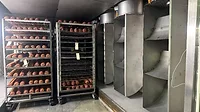
To prevent Listeria outbreaks and manage moisture, this meat processing facility installed a Niagara No Frost® liquid desiccant dehumidification system.
1. Address the problem.
2. Close the plant.
Recognized as an important public health problem in the United States, Listeria monocytogenes are intracellular pathogens known to cause food-contaminating outbreaks. These microorganisms have the ability to multiply within host cells and spread from cell to cell. Common occurrences of Listeria are found in meat, poultry, and seafood.
To prevent future outbreaks and manage moisture, the meat-processing facility installed a Niagara No Frost® liquid desiccant dehumidification system. This system provides consistent air dry bulb and dewpoint temperatures for contamination control. According to the processing plant, there haven’t been any problems regarding mold or bacteria since the installation.
With reliable environmental conditions, the system manages mold and bacteria and has the ability to handle large moisture loads. The technology is typically ideal for processing, packaging, and storage applications where consistent, frost-free conditions are required. Many meat-processing plants depend on this technology to control moisture and ensure germ-free air throughout their facilities.
INNER WORKINGS
The patented dehumidification system is comprised of a conditioner and a liquid concentrator. In the conditioner, a continuous spray of USDA-approved No-Frost liquid is pumped over an evaporator coil, with a fan pulling air from the space through the spray coil chamber and back into the processing area(s).The liquid spray cools air, controls dewpoint, captures airborne particles (including bacteria such as Listeria, Salmonella, and Yersinia), deodorizes air passing through the spray chamber, and picks up moisture that would otherwise become frost on the coil surface.
As the desiccant liquid becomes diluted, it is circulated to a patented No-Frost liquid concentrator that removes the moisture from the liquid using a heat source. The concentrator maintains the liquid at its proper concentration.
For humidity-control applications, the amount of dewpoint depression can be varied by changing the concentration of desiccant liquid or by utilizing a patented Hygrol method of dehumidification for higher temperature ranges.
TESTED, APPROVED
These No-Frost conditioners are designed to meet USDA sanitation standard requirements for the food industry. Interior parts are accessible for inspection and cleaning. Interior surfaces are designed to eliminate pockets that could collect dirt, lint, and bacteria. Available in stainless steel or FRP construction, finishes are smooth and corrosion-resistant.Testing performed by Buffalo Testing Laboratories Inc. determined the effectiveness of a No-Frost conditioner in removing dust and microorganisms to be 98 percent of all airborne contaminants. Of that 98 percent, 99.9-100 percent were removed by the liquid itself, depending on concentration, said the company.
The University at Buffalo Department of Microbiology performed separate testing on the antibacterial effects of the desiccant liquids on Listeria, Salmonella, and Yersinia. The department found that Listeria was inhibited by 99.4-99.9 percent in 24 hours or less, depending on the concentration.
Niagara Blower is a design-build manufacturer providing engineered solutions to heat-transfer applications at power, process, refinery, food, and brewing facilities worldwide. For more information, visit www.niagarablower.com.
Publication date: 08/10/2009
Looking for a reprint of this article?
From high-res PDFs to custom plaques, order your copy today!