What to look for in leak detection equipment

What’s more, refrigerants that escape into the atmosphere are a major hazard to our environment. Chlorofluorocarbon (CFC) emissions are believed to destroy the earth’s ozone layer, causing irreparable damage to the environment.
In the United States, the problem is so serious that the Environmental Protection Agency (EPA) mandates that contractors and service people who vent CFCs or hydrochlorofluorocarbons (HCFCs) will be fined up to $25,000 per day for each violation.
Unfortunately, refrigerant leak sites are usually sought only after a loss of cooling has been detected by discomfort, spoilage, or production difficulties. Repairing the leaks is not the problem; finding them is.
No single method for finding refrigerant leaks will locate every leak in every situation. So, how do you determine which detection method is most accurate for various air conditioning and refrigeration systems?
Leak detection methods
Fluorescent leak detection: With this method, a fluorescent dye is added to the air conditioning or refrigeration system. The dye mixes with the lubricant and circulates with the refrigerant throughout the system. Wherever the refrigerant leaks out, so does the dye.
The refrigerant evaporates, but the dye remains at every leak site. When the system is scanned with an ultraviolet (UV) or UV/blue light lamp, the dye glows a bright yellow-green color to pinpoint the exact location of even the smallest leaks.
With the fluorescent leak detection method, the contractor should be sure to use an oem-approved dye that is compatible with the lubricant in the system. Also, it is best to select a UV or UV/blue light lamp that produces high-intensity output. The greater the light intensity, the brighter the dye glows, and the easier it is to find leaks.
Bubble solutions: This is the simplest and probably the oldest and least-expensive method of leak detection. A soapy solution is applied at suspected leak points, usually with a squeeze bottle, brush, or dauber. The escaping refrigerant causes bubbles to develop.
Looking for quick answers on air conditioning, heating and refrigeration topics? Try Ask ACHR NEWS, our new smart AI search tool. Ask ACHR NEWS
Halide torches: This is a step up from bubble solutions. However, halide torches reveal only a limited number of leaking refrigerants. The method is based on the fact that the flame of a torch turns green when exposed to refrigerants containing chlorine atoms (CFCs and HCFCs).
Electronic detectors (sniffers): There are two basic types that can be used to test for escaping refrigerant.
1. Heated diode technology consists of a ceramic element that heats the refrigerant and breaks the molecule apart, leaving positively charged chlorine or fluorine ions which are attracted to a negatively charged center collection wire.
The flow of chlorine/fluorine ions to the center collection wire creates a small current. As the concentration of refrigerant between the electrodes increases, the current increases to a level that sets off an audio-visual alarm.
2. Corona suppression technology measures variations in the conductivity of gases passing between two electrodes. The instrument creates a high-voltage dc spark that jumps from one point to another in the sensor.
This establishes a baseline current between the two points. A drop in current between the two points indicates the presence of an insulating gas. The greater the current drop, the higher the concentration of gas.
Ultrasonic detectors: Using highly sensitive microphones, these ac- or battery-powered devices are the only detectors that “listen” for the high-pitched, inaudible sound of a leak, which sets off an audio-visual alarm.
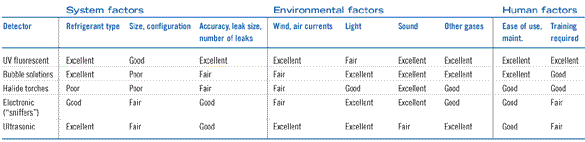
When selecting a leak detection method, the technician must consider system factors, environmental factors, and human factors. A summary of ratings for the five methods described above appears in Table 1, “Refrigerant leak detector ratings.”
System factors
The refrigerant used is an important factor in choosing a leak detection method. Not all detectors work well with all types of refrigerants. There are CFCs, HCFCs, HFC blends, ammonia, and the lubricants that go with them. And the list is growing.System size and configuration must be considered when selecting a leak detection method. There are tremendous differences among, say, a small refrigerator unit, a residential a/c unit, a large supermarket parallel rack refrigeration system, and a huge industrial system running on ammonia.
Large systems are more likely to develop multiple leaks, possibly hundreds of feet apart. In a small unit, multiple leaks are more apt to be right next to one another, but you still need to precisely locate every leak.
Whatever the size of the system, its configuration can cause problems in finding leaks. For a small unit, tight space limitations may make the job difficult. For a large system, you may need a personnel lift to reach piping in the ceiling, and you may also have to check behind walls and around other barriers.
Accuracy, leak size, and the number of leaks are also system factors. A good leak detector should be able to pinpoint virtually every leak, regardless of the size and number.
In an indoor system, a big leak can raise the concentration of refrigerant in the air high enough to set off an area monitor or electronic sniffer.
By then, you may never be able to find the exact source of a leak. At the opposite end of the scale, small leaks can be masked by large leaks; you might miss small leaks until you’ve repaired the larger ones and reinspected the system.
Then there is the situation of multiple leaks. What do you do if you get a leak indication in an area where there are several leak sites in close proximity? Will a large leak hide smaller leaks from detection until after the large one is repaired? Will the detector clearly identify two or more leaks that are close to each other?
When you can’t locate a leak but you know there is one, you may be dealing with an intermittent leak. It’s there under some conditions, but not others. This can be a hit-or-miss (mostly miss) proposition with some detection methods, because the refrigerant may not be leaking at the moment you are checking.
Environmental factors
Wind and air currents affect the accuracy of electronic detectors and halide torches, which depend on sampling and testing the air in the vicinity of leaks.In outdoor systems, wind or even occasional breezes can lead to a missed leak or a false alarm. Wind can also create problems with bubble solutions.
Indoors, ventilation fans and convection currents can cause the same problems. You may be able to eliminate air currents by shutting down fans, but you could still face a problem with convection currents, which can disrupt the readings.
Ambient light can wash out the response of some visual detectors, making leaks difficult or impossible to see. UV and UV/blue light lamps help minimize this problem.
Ambient sound, other than that caused by leaks, will obviously affect ultrasonic detectors. Noisy environments, such as parallel rack refrigeration systems, can fool this type of detector. Gas flowing through a pressure-regulating valve sounds similar to a leak.
Other gases, especially those that contain chlorine, can produce false positive readings from electronic air sampling/testing detectors. Chlorine-containing gases can emanate from urethane insulation, hydrocarbon-based solvents, and other sources.
Human factors
Experience certainly is the best teacher for finding leaks, but the simpler a detection method is to use and maintain, the better are your chances of pinpointing every leak quickly and accurately.Ease of use and maintenance are important considerations. Most detectors are relatively easy to use. The most basic method is bubble solutions. The most difficult can be the electronic detector, which requires calibration and, on some models, switching sensitivities.
Detector maintenance includes cleaning the detector and replacing parts. You should also determine how well a detection device can stand up to the wear and tear of everyday use without breaking down or giving inaccurate results.
Training requirements vary from method to method. Decide whether a detection method requires special knowledge or experience. Use the method that provides the level of accuracy desired with a minimum of training.
Maintenance is key
With the high costs of refrigerants, equipment repair, and the time and effort needed to locate leaks, proper preventive maintenance of air conditioning and refrigeration systems is essential.Select a method that pinpoints leaks quickly and accurately, so refrigerant losses are cut to a minimum.
By finding and repairing a minor leak today, you can avoid a major headache tomorrow.
Provided by Spectronics Corp. (Westbury, NY), manufacturer of several refrigerant leak detection devices. For further information, call 800-274-8888.
Looking for a reprint of this article?
From high-res PDFs to custom plaques, order your copy today!