Refrigerant Talk Urges Reclaim

More interest in alternative refrigerants is resulting from a phase out of R-22 as signified by DuPont’s sign at AHR Expo.
The HVACR industry is facing a shortfall of HCFC-22 as early as 2010 rather than 2015 as had long been expected. So talk is now on alternative HFC refrigerants that can be retrofitted into R-22 systems and the need for a major step up in reclamation efforts.
Driving the focus was the recent release of a U.S. Environmental Protection Agency (EPA) proposed allocation rule that would take effect in 2010 and result in about a 20 percent shortfall in the amount of virgin R-22 needed by the industry.
“With this new projection, it’s become increasingly clear that the industry will need to rely on the recovery and reuse of recycled and reclaimed R-22 as well as retrofits of existing equipment to HFC replacement products to avoid shortfalls going forward,” said Diane Juliano Picho, global business manager for DuPont Refrigerants.
During the International Air-Conditioning, Heating, Refrigerating Exposition (AHR Expo) in Chicago in late January, she said there would be a major step up in industry educational initiatives to “ensure that refrigerant users understand the effects of proposed regulations and are able to put effective refrigerant management programs in place in anticipation of 2010 shortfalls.” One of those initiatives is coming from the Air-Conditioning, Heating, and Refrigeration Institute (AHRI) which announced a Website (www.phaseoutfacts.org) launching in March.
The hard numbers show the U.S. HVACR industry needing 137 million pounds of R-22 in 2010 and the EPA allowing refrigerant manufacturers to produce only 110 million pounds. Thus the renewed focus on reclaim. An EPA final ruling is not expected until this summer, only months before the cutbacks would kick in.
RECLAIM
The reclamation sector consists of companies that will take used R-22 (as well as other refrigerants) of questionable purity and bring it back to ARI-700 standard of purity, the same standard required of virgin R-22. Some reclaimers work through the wholesale supply chain, some work directly with contractors. The main issue centers around incentives for contractors to submit recovered R-22 for reclamation. These include banking options, swaps, paying contractors per pound for refrigerant turned in, and having the contractor pay for the reclaimer to take in a 30-pound cylinder but then getting back a 30-pound cylinder of ARI-700 reclaimed refrigerant that the contractor could theoretically resell to customers for more than he paid to have it reclaimed.Contractors are encouraged to check out incentive programs thoroughly, the methodology reclaimers use to reach ARI-700 purity, and the reputability of the providers.
One place to find some of the newest info on reclaim was at the Chicago expo. At that show Airgas (www.airgas.com) noted its link to the Refron brand name and also cited its reclaim buyback program. “We will buy back your used refrigerants. (This is) ideal for returns of 200 pounds or more of the same refrigerant type. Airgas will provide DOT-approved recovery cylinders, all shipping tags, documents, and labels for their return to our reclamation facility.”
Arkema (www.arkema.com) used the expo to highlight its new R-22 refrigerant reclaim program. “Successful reclaim programs are an industry imperative,” said Craig Thomas, business manager for Arkema’s refrigerants business in North America. The Forane® Refrigerant Reclaim Program supplements Arkema’s new product development activities.” The program is incentive-based, and nationwide.
For DuPont’s (www.usa.dupont.com) part, Picho said, “We are expanding our refrigerant reclaim program to make it easier to use than ever before.” She noted an expanded network of DuPont authorized refrigerant reclaim centers and more options for distributors to handle used refrigerant.
National Refrigerants (www.refrigerants.com) talked about its refrigerant banking program. “After cleanup fees and nominal storage fees are factored in, each 30-pound cylinder of R-22 can net you a savings of approximately $120 per cylinder,” it was noted.
Ecotech from Polar Technology (www.refrigerantauthority.com) was billed as “responsible recovery.” The company said it will provide a cylinder in exchange for a contractor’s returned cylinder.
The Refri-Claim® Service Division of ICOR International (www.refri-claim.com) has users bringing full cylinders to an authorized Refri-Claim program provider and exchanging them for an empty one. The company said the program “was designed with the refrigerant user in mind by offering through its network of distributor-based exchange centers an easy, over-the-counter cylinder swap program.”
USA Refrigerants (www.usarefrigerants.com) offered a buyback program saying it will “pay you top dollars for your used/recovered R-22.”
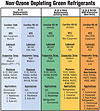
Alternative refrigerants, such as these shown in a chart from Comstar, are part of the new world beyond R-22.
RETROFITS
While dealing with reclamation, many in the industry also say contractors should look at HFC refrigerants that are being introduced to the market that can be retrofitted into existing R-22 systems. They were either blends that included a small amount of a hydrocarbon (HC) to allow them to work with mineral oil, or HFCs without HC that would need a changeout to a POE oil. Recurring questions deal with the range of applications for each alternative and the energy efficiencies of the alternatives versus a system optimally running on R-22. People considering alternatives are encouraged to discuss those issues with manufacturers before undertaking a retrofit. They are also encouraged to rely on reputable manufacturers.Later this year, The NEWS will look at those retrofits in detail as part of its “Countdown to 2010” special series. But for now, here are some of the latest developments from the AHR Expo.
Arkema reported that its R-427A “is proving to be an effective replacement for R-22 in a variety of temperature-critical refrigeration and air conditioning applications,” including three R-22 retrofits at a supermarket, food manufacturer, and computer data center.
At its booth, ComStar (www.comstarproducts.com) was exhibiting its replacement refrigerants for R-22, R-502, and R-12. The refrigerants were part of the company’s RS Series. R-428A refrigerant is making inroads as a R-22/R-502 replacement at some supermarkets in Canada, according to Comstar’s Steve Mella. “In the United States, we are in negotiations with a nationwide refrigeration wholesaler to promote and market this refrigerant.”
He also noted, “As a result of numerous OEM tests in the United Kingdom, United States, and China, our RS-45 (R-434A) refrigerant is now being marketed not only as an OEM alternative to R-410A and -134A in new equipment, but also as a replacement for R-22 larger low-temp refrigeration systems.”
In a newer announcement from DuPont, the company noted the use of its Isceon® refrigerants in supermarket applications and claimed they “demonstrate up to 12 percent more energy savings than R-22 in low-temperature equipment.”

Leak detection and sealing using products such as these by Cliplight have long been part of a technicians servicing skills. But with tightening regulations and dwindling supplies of refrigerants like R-22, it becomes even more important.
RECOVERY
Whether dealing with reclamation or retrofits, one necessary component is recovery of refrigerants. In all cases, when working with refrigerants, they cannot be vented, whether being pulled to just be reintroduced after servicing, or taken out to be replaced with a retrofit refrigerant, or for submission for reclaim.Recovery technology has been around for more than 20 years. The number of companies making such products has dropped to a handful today versus more than 50 in the early days. Those still around continue to tweak the technology. At the most recent AHR Expo, one of the newest products was from SPX (www.spx.com) which showed the Promax® RG6000, which utilizes a twin-cylinder design. It’s lightweight, said the company, which was a recurring theme of the latest generation of such products. An added aspect of the Promax unit is what the company said is the ability to take apart the unit with basic tools in about 25 minutes to allow for repairs or replacement of parts.
The issue of leak detection also drew attention with even more urgency due to dwindling supplies of R-22. Spectronics (www.spectroline.com) noted a kit called the OPK-50GS/E, which consists of a LED flashlight, dye capsules based on system capacity, bleed valves, and dye cleaner.
Also related to leak issues is the Ultra Pack from Cliplight (www.cliplight.com), a combination of complementary products designed to knock out moisture/acid. It consists of a can of DRY R™ and seals refrigerant leaks with a can of the manufacturer’s Super Seal HVACR™ air conditioning and refrigeration system leak sealant.
Publication date: 03/09/2009
Looking for a reprint of this article?
From high-res PDFs to custom plaques, order your copy today!


