Following survey results from restaurants across the country, Budderfly's senior energy engineering manager says the answer is more diagnostics – not more ventilation
A 251-site test-and-balance field study across forty national and regional quick-service brands found 91% running net-negative pressure, 46% of make-up air units not working, and a median imbalance of nearly 1,900 CFM.
An overlooked control logic detail in hospital air handling units led to recurring freezestat trips and heating instability during the winter, illustrating how small automation choices can have big operational impacts.
When air handlers first enable economizer mode, overlooked control sequences can trigger temperature and humidity spikes that pose real risks to critical environments.
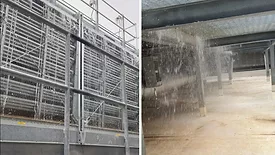
Cooling tower spillover during chiller rotation shows how thoughtful programming, sequence tweaks, and field fixes can tackle system instability in both winter and summer conditions
HVAC systems experience their most challenging moments during operational transitions – when systems first enable, modes shift, or equipment rotates or stages to meet demand. These brief windows often reveal instability that routine operation may hide.
When a bronze valve met incompatible boiler chemicals in a hospital, the result was catastrophic: widespread system failure and costly damage, all avoidable with a single review step, says John Rophael, P.E., mechanical engineer at Engineering Design & Testing Corp.
How small changes in chiller sequencing can trigger outsize instability – and practical automation strategies to keep HVAC transitions smooth and alarms quiet
Dive into how chiller rotation sequences in variable flow HVAC systems can unexpectedly disrupt operations –
and how refined automation logic can help keep things running smoothly.
 RSS
RSS