Bringing Duct Fabrication In-House: A 2026 Equipment Guide for Sheet Metal Shops
Margin on purchased spiral and rectangular duct is thin and lead times move with someone else’s schedule, writes Ryan Tao of SBKJ Group
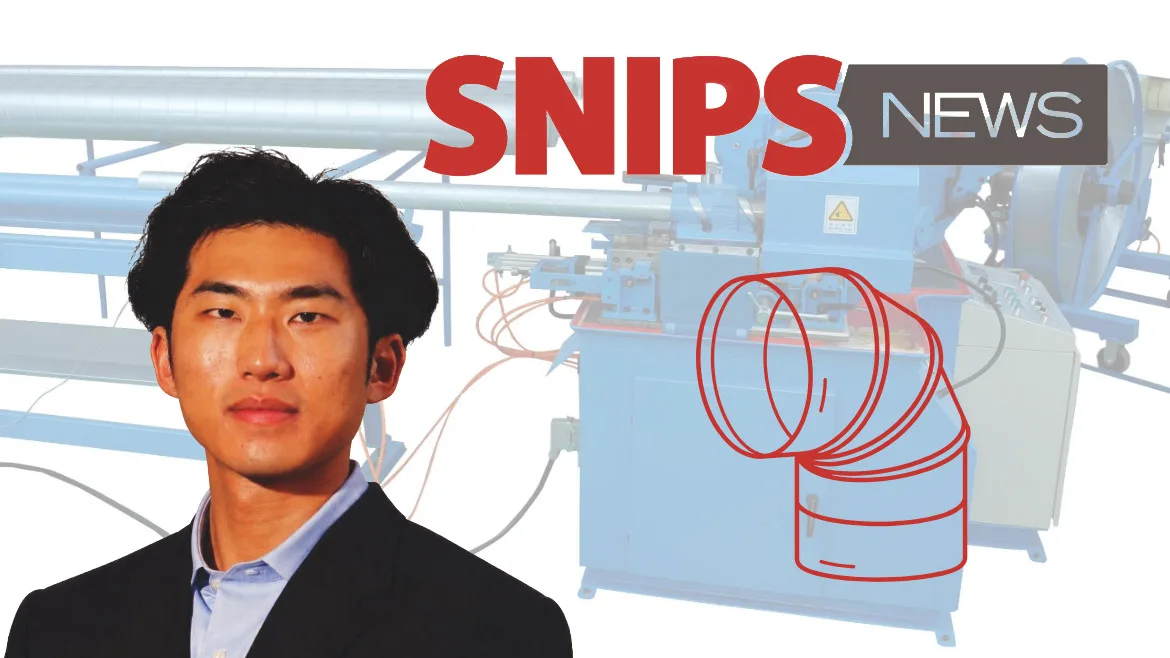
SPIRAL: A spiral tubeformer turns flat steel coil into continuous spiral duct, letting shops control both cost and schedule in-house.
Most shops that outsource their duct reach the same wall. The margin on purchased spiral and rectangular duct is thin, the lead times move with someone else's schedule, and the phone call you dread is the one where your supplier says next week became the week after. Bringing fabrication in-house fixes all three at once. It also puts a large capital decision in front of you, and the wrong first machine is an expensive way to learn.
This is a plain guide to what that decision looks like in 2026: what to make, the core machine set, real capital ranges, the space and power you need, and how to judge one supplier against another. It is written for the owner signing the check, not as a sales pitch.
Start With What You Actually Build
Before you price a single machine, settle one question: round, rectangular, or both.
Round (spiral) duct and rectangular duct are made on completely different equipment. A shop that lives on spiral lockseam pipe needs a spiral tubeformer and very little else to start. A shop making rectangular supply and return needs either a coil line or a set of standalone machines. Trying to do both from day one is the most common way to overspend. Pick the work that pays your bills now, buy for that, and add the second capability once the first line is earning.
Volume matters as much as shape. A shop turning out a few hundred pounds of duct a week does not need an automated coil line, and a high-volume commercial shop will lose money running manual equipment. Match the automation level to your real weekly output, not to the busiest week you can imagine.
The Core Machine Set
For a round-duct shop. The anchor is a spiral tubeformer: a coil of steel goes in one end, finished spiral pipe comes out the other, cut to length. Add a decoiler to feed it and an elbow or gore-lock machine for fittings, and you have a working round-duct cell. This is the cheapest way into in-house fabrication and the fastest to profit, because one machine and one operator replace a whole category of outsourcing.
For a rectangular-duct shop. You have two routes. The manual route assembles separate machines: a decoiler, a shear or coil-fed cutter, a notcher, a Pittsburgh lockformer for the seams, a flange former (TDF or TDC) for the ends, and a roll former for cleats. It is cheaper to buy and flexible, but it is labor-heavy and only as fast as your slowest hand.
The automated route is a coil line, sometimes called an auto duct line. It takes a coil and produces cut, notched, seamed, and flanged rectangular duct in one pass with one or two operators. It costs far more up front and rewards you in labor saved per foot. The crossover point in 2026 is roughly the volume at which two or three duct fabricators are working full time; below that, the manual set usually pays back faster.
For Heavy Gauge and Stainless
Kitchen exhaust, industrial, and marine work in thicker or stainless material adds welding. A longitudinal seam welder and a spot welder cover most of it. This is a later purchase for most shops, not a starting one.
What It Costs in 2026
Landed prices vary widely by automation level, build quality, and country of origin, so treat these as planning ranges rather than quotes. All figures are US dollars for the machine itself, before freight, duties, and installation.
| Machine | Description | Price Range |
|---|---|---|
| Decoiler | Feeds coil into the line | $3,000 to $15,000 |
| Pittsburgh lockformer (manual) | Forms the rectangular seam | $6,000 to $18,000 |
| TDF / TDC flange former | Rolls the flange on duct ends | $20,000 to $55,000 |
| Spiral tubeformer | Makes round spiral pipe from coil | $45,000 to $130,000 |
| Elbow / gore-lock machine | Round fittings and elbows | $15,000 to $45,000 |
| Seam / spot welder | Heavy gauge and stainless | $12,000 to $35,000 |
| Plasma or laser blanking table | Cuts fittings and transitions | $30,000 to $150,000 |
| Coil line (auto duct line) | Coil to finished rectangular duct | $130,000 to $450,000 and up |
A round-duct cell can open for well under $100,000. A full automated rectangular line with fittings capacity runs several hundred thousand. Most shops do not buy the whole list at once. They buy the one machine that removes their biggest bottleneck, run it until it pays for itself, then add the next.
Budget for the parts that never appear on the machine quote: freight and duty, three-phase power drops, a coil crane or forklift, tooling, and operator training. A useful rule is to add 15 to 25 percent to the machine price for everything needed to make it produce.
Space and Power
Coil lines are long. A full auto duct line can run 45 to 50 feet end to end, and you need clear run-out space beyond that for the finished duct to exit straight. A spiral tubeformer is more compact but throws pipe out one end, so plan the run-out the same way. Sketch the material flow before you sign anything: coil in, machine, finished product out, with a forklift path that never crosses an operator.
Power is where imported machines catch shops out. Most fabrication equipment is three-phase. A manual lockformer draws little, often under 2 kW. A coil line can pull 20 to 40 kW, and adding a plasma station puts another 12 kW or so on the service. If you are buying from an exporter, confirm the machine is configured for your grid: North American shops run 480V 60Hz or 208/240V, and equipment built for 380V 50Hz needs the right transformer and drive configuration set at the factory, not improvised later. Get that in writing.
Do not forget compressed air, dust and scrap handling, and a maintenance gap around each machine so a technician can actually reach it.
How to Compare Suppliers
Once you know the machine, judging suppliers comes down to a short, unglamorous checklist.
Match the machine to your gauge range and volume, not to the headline speed on the brochure. A line rated at 60 feet a minute means nothing if it chokes on the material you actually run. Line speed is not the same as usable output.
Ask about the electrical configuration for your grid, spelled out, before you order. Ask what commissioning and operator training are included, and whether documentation comes in your language. Ask where the nearest spare parts and service are, and how long a common wear part takes to arrive, because downtime on a single line stops a whole department.
Then ask the question that settles it: can they put you in touch with a shop running the same machine, in the same configuration, that has had it for several years? A supplier who can hand you a reference that has run their equipment for a decade is telling you something a spec sheet cannot.
The Short Version
Decide round or rectangular first. Buy the one machine that removes your biggest bottleneck, size it for the next three years of work rather than today's, and add capability one line at a time as each earns its keep. Confirm the electrical build for your grid in writing, budget a quarter again on top of the machine price for everything around it, and choose the supplier who can show you a shop that has run the same line for years.
Done in that order, in-house fabrication stops being a gamble and starts being the most reliable margin in the building.
A fuller 2026 duct machine price breakdown and a set of vendor-neutral buyer references are at https://sbkjduct.com/insights
Looking for a reprint of this article?
From high-res PDFs to custom plaques, order your copy today!