How to Solve the Toughest Challenges in Commercial HVAC Retrofits
Real-world solutions for contractors facing complex retrofits and adaptive reuse projects
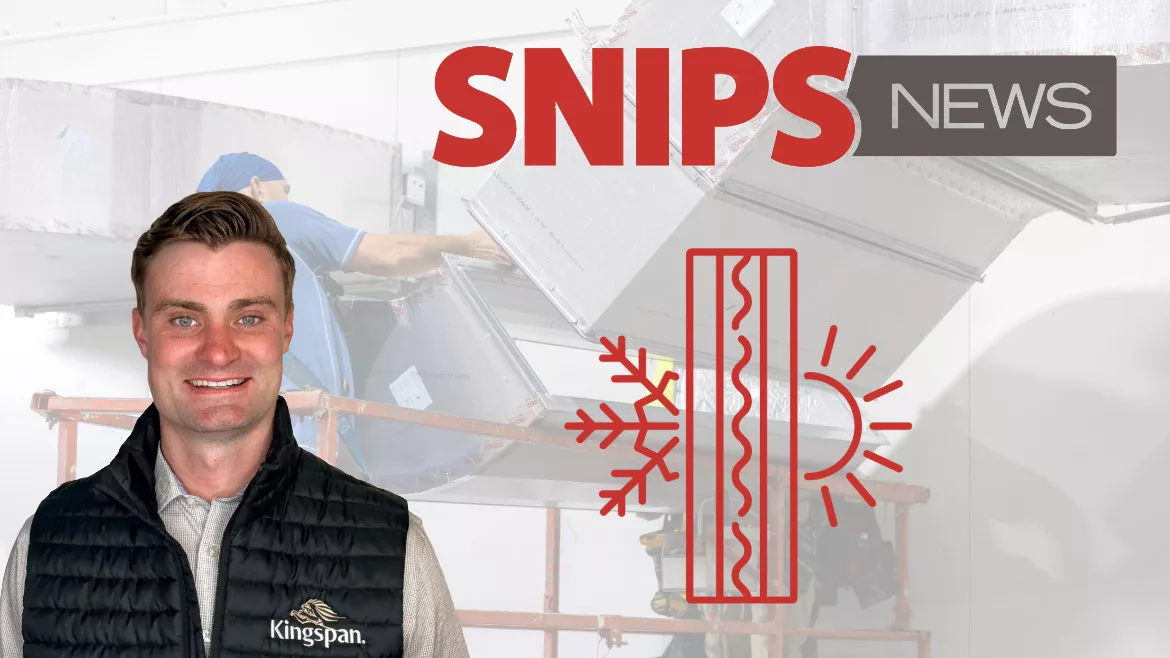
INSULATION: Ryne Sullivan, national sales manager at Kingspan Insulation North America, discusses the latest advances in duct system technology and what it takes to deliver high-performance retrofits in today’s built environment.
Retrofitting HVAC systems in commercial buildings is rarely simple. Tight schedules, occupied spaces, hidden surprises above ceilings, and outdated ductwork can make even the most experienced contractor sweat. Yet, as technology advances, so do the solutions. Ryne R. Sullivan, national sales manager at Kingspan Insulation North America and a recognized innovator in the phenolic ducting industry, draws on nearly two decades of experience to share his insights on tackling tough retrofit jobs. In this Q&A, Sullivan breaks down the most persistent challenges and the practical strategies that help contractors build better, faster, and smarter.
What are some of the most common challenges you see in commercial HVAC retrofit projects, and how can contractors overcome them?
One of the biggest challenges in commercial retrofits is that contractors are rarely working with a clean slate or flexible schedules. Buildings often need to remain occupied during retrofit projects, and older facilities commonly have congested ceiling spaces, undocumented field conditions, out-of-code duct layouts, inadequate insulation, air leakage, limited access, and equipment that has been modified multiple times over the life of the building. In addition to maintaining building occupancy, contractors must navigate tight schedules and changing field conditions while minimizing disruptions to daily operations.
This is where pre-insulated ductwork can be especially valuable. Unlike traditional ductwork, which is installed and then insulated in two separate phases, the Kingspan KoolDuct System combines a double-wall aluminum vapor barrier, a closed-cell phenolic insulation core, and a micro-perforated acoustic liner into a single lightweight assembly that is ready for operation immediately after installation. Additionally, KoolDuct modular sections weigh up to 70% less than insulated sheet-metal ductwork and can be fabricated into sections up to 13 feet long. Sections are delivered to the jobsite prefabricated and ready for installation, designed to fit from the factory, or fabricated and modified onsite to accommodate changes in the field.
The result is a system that is safer to handle in tight spaces, easier to coordinate above ceilings, and faster to install in the field, making KoolDuct well-suited for projects where schedule and access constraints are just as important as thermal performance.
When retrofitting older buildings, what strategies are most effective for improving HVAC performance without major structural renovations?
The most effective retrofit strategies typically include reducing air leakage, improving insulation, rebalancing airflow, updating controls, and replacing or upgrading duct sections that create excessive pressure drop or comfort issues. In many older buildings, performance problems are not caused solely by the central plant or rooftop unit. Instead, they often stem from the inefficient delivery of conditioned air throughout the building. The Department of Energy notes that proper duct design, sealing, insulation, and balanced supply and return airflow are critical to maintaining occupant comfort and reducing energy losses.
For retrofit applications, thin, high-R-value duct insulation and pre-insulated duct systems can improve thermal performance without requiring major structural changes. KoolDuct panels provide installed R-values of R-6.0, R-8.1, and R-12.0, depending on panel thickness, and feature a closed-cell phenolic insulation core with aluminum FSK vapor barrier facings. This makes it possible to improve both the thermal and acoustic performance of ductwork while helping preserve ceiling height and usable space—two major concerns in older buildings.
Duct leakage is often underestimated—how significant is its impact on energy efficiency and overall system performance, and what solutions do you recommend?
Duct leakage can have a major impact because it wastes fan energy, allows conditioned air to escape before it reaches occupied spaces, and contributes to comfort complaints, pressurization issues, and poor system balancing. A commercial and institutional building study from the Center for Energy and Environment found that measured duct leakage averaged 7% across tested systems and noted that excessive leakage can increase fan power by more than 50% in extreme cases.
The solution starts with proper specification and verification. Contractors should not assume duct leakage is acceptable simply because the system is operating. Instead, they should define a target leakage class, properly seal joints and seams, pressure-test critical sections, and document performance during commissioning. KoolDuct is designed to achieve SMACNA Air Leakage Class 3 with its coupling systems, while its pre-insulated construction reduces the number of field-applied insulation steps that can introduce quality variation.
For existing systems, contractors should also evaluate whether targeted sealing, partial duct replacement, or relining provides a better solution than full replacement. The KoolDuct liner system can be installed within traditional sheet metal ductwork using conventional pin-and-glue methods or a VLB attachment method that eliminates the need for glues, aerosols, pin welding, and sharp retention clips.
Adaptive reuse projects often come with unique space constraints. How can advanced duct system design help address these limitations?
Adaptive reuse projects are often defined by what contractors cannot change: existing structures, low floor-to-floor heights, historic ceilings, narrow shafts, exposed architectural features, and limited access routes. Advanced duct design helps address these constraints by reducing the physical footprint of the air distribution system and making installation more flexible. Pre-insulated ductwork can be especially beneficial because the insulation is integrated into the duct wall, allowing the system to be installed closer to ceilings or structural elements without requiring a separate external insulation wrap.
With an industry-leading R-value of 6.8 per inch, KoolDuct delivers more thermal performance in less space. It can be visibly mounted, concealed above ceilings, installed below raised floors, or used in confined enclosures such as prefabricated modules.
With labor shortages and construction schedules growing tighter, what are some practical ways contractors can streamline installation and ensure quality?
The most practical approach is to move as much work as possible out of the field and into the shop. Contractors can streamline installation by using coordinated submittal drawings, prefabricated sections, longer duct runs, fewer field joints, clear labeling, and standardized connection details. Eliminating the need for a second trade to insulate ductwork after installation and commissioning can also save weeks on the construction schedule.
KoolDuct supports that approach because its prefabricated, lightweight, pre-insulated rectangular duct sections are available in lengths up to 13 feet and can be pre-joined, making it possible to hoist entire assemblies into place with smaller crews and less lifting equipment.
Are there any recent advancements in duct system technology or installation practices that you think are game-changers for retrofits?
One of the biggest advancements in duct system technology for retrofit applications is Kingspan's KoolDuct Liner System. This patent-pending system uses the VLB (Viscoelastic Lamination Bonding) method to attach KoolDuct as a liner for both new construction and retrofit sheet-metal duct applications. The system integrates Kingspan KoolDuct panels with the interior or exterior of sheet metal ductwork to enhance thermal and acoustic performance.
Kingspan's VLB attachment method eliminates the need for toxic aerosols and glues while preventing the thermal bridging commonly caused by pin welding and sharp retention clips. Because the insulation is not penetrated by mechanical fasteners, its integrity is preserved, resulting in improved acoustic performance, reduced thermal transfer, and greater resistance to moisture and corrosion.
The result is a duct liner system that is faster, safer, and simpler to install, making it well-suited for retrofit applications.
Looking for a reprint of this article?
From high-res PDFs to custom plaques, order your copy today!