Nippon Steel’s $2.5 Billion Gamble on Mon Valley: Resetting the Sheet Metal Supply Chain
Reviving a historic steelmaking hub in Pennsylvania amid a nationwide realignment of the industry
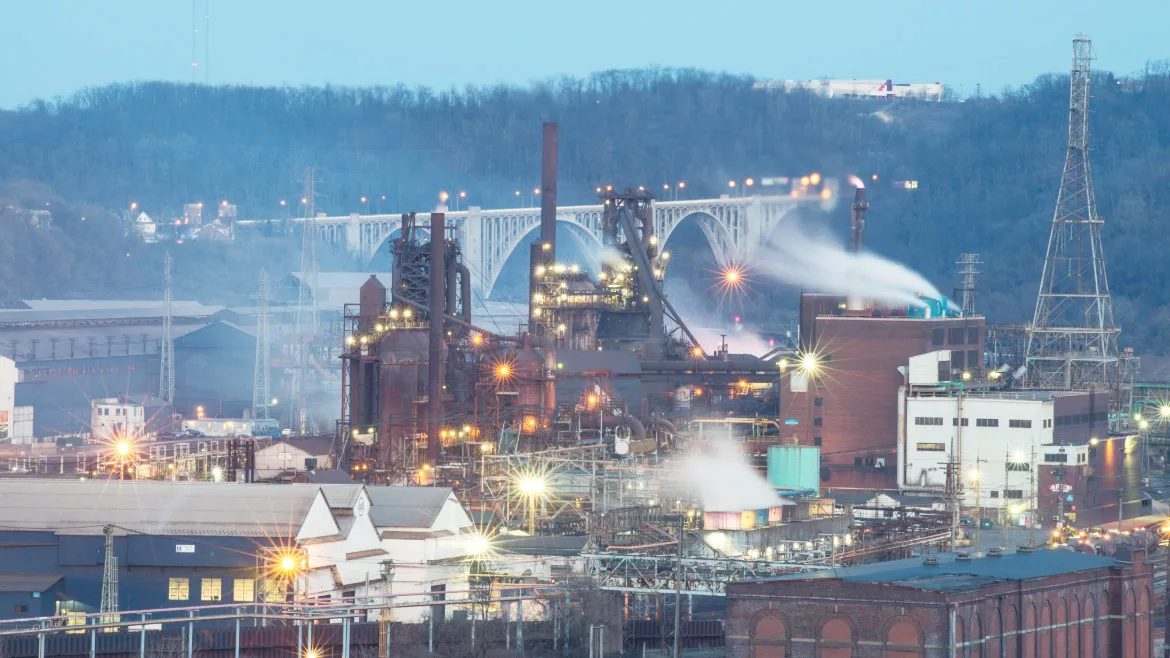
STEEL: At the historic Edgar Thomson plant in Braddock, Pennsylvania, decades-old equipment will soon be replaced as part of Nippon Steel’s $2.5 billion modernization.
A $2.5 billion investment from Tokyo-based Nippon Steel is breathing new life into U.S. Steel’s Mon Valley Works in western Pennsylvania, with impacts set to ripple across the sheet metal and HVAC supply chain. The company’s commitment to overhaul the historic Edgar Thomson plant is remarkable for both its scale – up to 6,000 jobs created and $1.7 billion in regional economic impact – and its timing, coming as U.S. industrial policy, tariffs, and global trade tensions force a rethink of domestic manufacturing.
U.S. Steel CEO David Burritt has been candid about what made this possible, saying “these investments would not have been able to happen without [Nippon Steel].” Just two years ago, U.S. Steel warned it might shut down the Mon Valley plant and move its headquarters out of Pittsburgh. Today, the same facility is poised to be a linchpin for domestic flat-rolled steel production for decades to come, reviving an industrial legacy that once defined the region – even as much of America’s steelmaking capacity has shifted southward in recent years, as detailed in SNIPS NEWS.
Nippon Steel’s investment comes after a bruising political fight over its takeover of U.S. Steel, which was initially blocked on national security grounds at the end of the Biden administration but then revived under a hybrid structure with President Trump. Today, Nippon does own U.S. Steel – but not outright in the traditional sense. The deal was approved only with strict conditions, including a U.S. government “golden share” that gives Washington veto power over key decisions like plant closures and offshoring, along with mandates to invest billions in domestic facilities.
At the heart of the investment is a new, state-of-the-art hot strip mill to replace equipment dating back nearly ninety years. The upgrade will boost annual output to about 3.5 million tons – up from 2.2 million – while improving yield, energy efficiency, and product quality, as detailed by WPXI and Recycling Today. These advances matter for sheet metal and HVAC contractors: flat-rolled coils from this mill are the base material for ductwork, air handlers, rooftop units, and an array of fabricated products. As Recycling Today explains, tighter tolerances and higher-value steel grades will mean less waste, better formability, and more durable end products.
This transformation isn’t happening by market forces alone. In early 2025, the Biden administration blocked Nippon Steel’s acquisition of U.S. Steel on national security grounds (White House Statement). The deal was revived just months later, in June, when the Trump administration approved it with conditions, according to Hunton Andrews Kurth LLP. One key provision: the U.S. government secured a “golden share,” granting veto power over plant closures, offshoring, and other strategic decisions. Additionally, Nippon Steel committed to at least $11 billion in U.S. investments through 2028, with Mon Valley as a flagship. Analysts at Hudson Institute note that ongoing tariffs also made U.S. production more attractive for foreign direct investment.
John Anton, steel analyst at S&P Global, told Recycling Today that “this isn’t just a capital project – it’s a new hybrid model for U.S. industry.” For fabricators and contractors, the results will be immediate. Flat-rolled steel supply will be stronger and less reliant on imports, as detailed by TribLIVE. Improved efficiency and increased output should stabilize prices, though not necessarily lower them, according to Hudson Institute. And while much attention has focused on the automotive sector, demand for high-quality steel is deeply tied to commercial construction, data centers, and energy infrastructure – all of which drive HVAC consumption.
The project has drawn a rare, broad base of support from industry, labor, and government alike. “Investment in steel and American steel is coming back … production is going to come back right here,” said U.S. Commerce Secretary Howard Lutnick, speaking to TribLIVE. Burritt, the U.S. Steel CEO, “This investment means thousands of good-paying jobs … and steel that will supply American manufacturers for generations.” The Pennsylvania Manufacturers’ Association called the move “jobs, opportunity, and renewed strength for the region.”
For the sheet metal and HVAC sector, Nippon Steel’s Mon Valley investment is more than a plant upgrade – it’s a sign that domestic steelmaking is being rebuilt with staying power.
Looking for a reprint of this article?
From high-res PDFs to custom plaques, order your copy today!