Judge Dismisses Federal Charges Against Deported Sheet Metal Worker
High-profile union-backed legal battle exposes the risks immigrant workers face, as the administration signals a possible shift on Abrego Garcia’s deportation destination
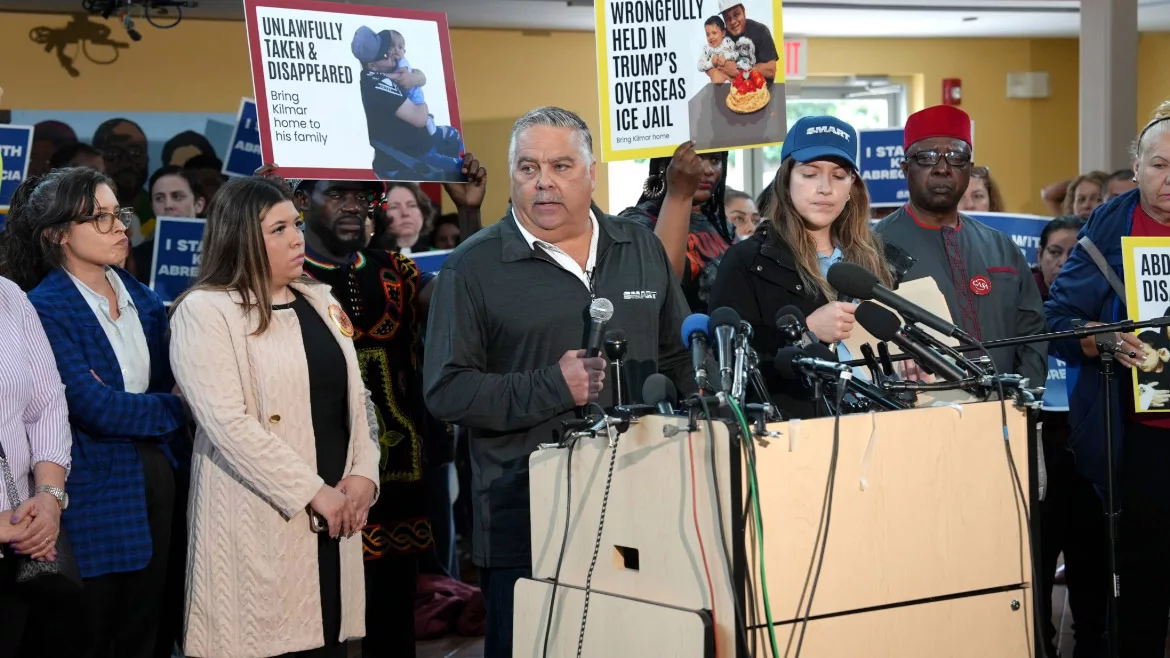
OPPOSITION: SMART General President Michael Coleman appears before a protest on behalf of a union sheet metal worker apprehended by ICE.
A federal judge’s decision to toss out all criminal charges against sheet metal worker Kilmar Abrego Garcia has sent shockwaves through the labor movement, marking what advocates are calling a “watershed” for union tradespeople fighting for basic due process on the job. The ruling didn’t just vindicate Abrego Garcia, a SMART union apprentice deported in 2025 despite court orders to the contrary – it delivered a rare and stinging rebuke to the Department of Justice itself, raising urgent new questions about the intersection of immigration enforcement and prosecutorial power.
For union contractors, tradespeople, and labor organizers nationwide, the case is much bigger than one man’s legal fight. It’s a test of whether the promise of workplace protections and fair treatment extends to all workers – regardless of birthplace or immigration status.
Vindictive Prosecution, Judge Finds
On May 22, U.S. District Judge Waverly Crenshaw formally dismissed the federal human smuggling case brought against Abrego Garcia, a sheet metal worker whose 2025 deportation to El Salvador had already sparked a wave of union outrage and congressional scrutiny. In his ruling from Nashville, Crenshaw found that the prosecution was “presumptively vindictive,” noting that federal authorities revived the dormant charges only after Abrego Garcia successfully challenged his removal from the United States.
“The evidence before this Court sadly reflects an abuse of prosecuting power,” Crenshaw wrote, concluding that the criminal case would not have moved forward “but for” Abrego Garcia’s own lawsuit against his deportation. In other words: the government’s pursuit of charges appeared to be retaliation for fighting a wrongful removal – a finding with broad implications for both labor and immigration law.
From a Traffic Stop to a Legal Battle
The origins of this dispute trace back to a 2022 Tennessee traffic stop. Abrego Garcia was transporting nine passengers when he was pulled over, but authorities made no arrest at the time. For nearly two years, nothing happened – until, after Abrego Garcia won his challenge to deportation, prosecutors suddenly dusted off the old investigation and filed new charges.
Judge Crenshaw zeroed in on this timing, writing that the government never convincingly explained why it reignited the case. That “suspicious” sequence of events, he said, couldn’t be squared with normal prosecutorial discretion.
Immediate Fallout and a Shifting Deportation Fight
The judge’s decision landed like a thunderclap. Abrego Garcia, speaking through advocates, called it “a step forward for justice.” His legal team argued he was the victim of “a politicized, vindictive White House and its lawyers at what used to be an independent Justice Department.” Senator Chris Van Hollen (D-Md.) called the prosecution “a blatant abuse of prosecutorial power … one that should disturb all Americans.” The Justice Department, for its part, issued a sharply worded statement calling the ruling “wrong and dangerous,” and signaled it will appeal.
Yet even as criminal charges were tossed, the political and legal battle over Abrego Garcia’s future only intensified. For months, his lawyers have argued he would end his high-profile legal fight if the administration allowed him to go to Costa Rica, which has agreed to accept him as a refugee. According to the New York Times, officials instead repeatedly tried – and failed – to deport him to a series of African countries, including Uganda, Ghana, Eswatini, and most recently Liberia, none of which would accept him. In a surprising turn, Homeland Security Secretary Markwayne Mullin told Congress in early June that the department had “no problem” sending Abrego Garcia to Costa Rica if he was willing – a reversal his lawyers quickly flagged for the judge overseeing his deportation case. Whether this marks a true policy shift remains unclear, as the administration’s legal filings continue to argue for deportation to Liberia.
A Symbol for Labor – and a Warning for the Trades
For the International Association of Sheet Metal, Air, Rail and Transportation Workers (SMART) and the broader building trades, Abrego Garcia’s story has become a rallying cry at the heart of the labor movement. On Friday, May 22, 2026, Judge Waverly D. Crenshaw Jr. dismissed the criminal case against Kilmar Abrego Garcia, “ruling that the Trump administration had brought human trafficking charges against him as part of a vindictive effort to punish him for challenging his wrongful deportation to El Salvador last year,” according to the New York Times.
SMART General President Michael Coleman issued a strong statement on the ruling: “From the beginning, our demand has been simple: Kilmar, like every single one of our members and every person in this country, must be granted his constitutional right to due process. He must be given his day in court. In Nashville, Kilmar was given his day in court, and on Friday, we saw just how important that is – for Kilmar, for his family and for the principles of justice that we all rely on. We will continue to stand for Kilmar’s rights and for every person’s right to due process, because that is what makes this country great.”
Abrego Garcia, a sheet metal apprentice who had lived in the U.S. for years, became the face of a national movement after his 2025 deportation – an action federal officials later admitted was an “administrative error.” His removal, in defiance of a 2019 court order blocking deportation to El Salvador due to credible threats of violence, came to symbolize the precarious position of immigrant workers.
Unions, led by SMART, responded with jobsite rallies, advocacy campaigns, and a sustained push in Congress. Their message: immigrant workers are essential to the trades, and the law must protect them as fiercely as any other American worker.
A Judicial Rebuke of Political Prosecution
The ruling comes at a time when immigration enforcement is a political flashpoint. Judge Crenshaw’s opinion cited not only the timing of the charges, but also the unusually hands-on involvement of senior DOJ officials – factors that lent credence to claims of retaliation. While the judge stopped short of declaring explicit retaliation, his finding of “presumptive vindictiveness” is a rare and potent censure of federal prosecutors.
Legal experts say such a finding is unusual, and it shifts the burden of proof to the government – one that prosecutors failed to meet. But with the DOJ’s decision to appeal, the legal saga is far from over.
Despite his courtroom victory, Abrego Garcia’s status remains unresolved. While the administration now appears more open to deporting him to Costa Rica – a move he has supported and Costa Rica has agreed to – the Justice Department continues to argue for removal to Liberia, and the final decision rests with a federal judge in Maryland. Advocates warn that the human toll of forced removals and legal limbo is immense. “Just as the government unlawfully wielded its criminal powers against Abrego Garcia,” his lawyers argued in court, “so it seeks to unlawfully exploit its immigration powers against him.” [New York Times, June 3, 2026]
For the sheet metal industry and its unions, the case closes a major c
Abrego Garcia’s Future Still Uncertain
For the sheet metal industry and its unions, the case closes a major chapter but opens another. The dismissal of charges is a victory for due process and worker advocacy – but whether Abrego Garcia will be allowed to stay in the country, or finally find safe haven in Costa Rica, remains unresolved.
Looking for a reprint of this article?
From high-res PDFs to custom plaques, order your copy today!