Experts Weigh Cost, Codes, and the Future of HRVs/ERVs
Industry leaders explore strategies to improve residential ventilation affordability and compliance amid tightening codes

PREMO: Dan Breitbarth, engineering manager of current products at RenewAire, shows how balanced ventilation products comply with new building codes, like California's Title 24, by showing energy use reduction. (Staff photo)
Imagine walking into your home and seeing a sleek touchscreen display mounted right next to your light switches. With a few taps, you can adjust the airflow in different rooms or simply press a button for 15 or 30 minutes of fresh air. This isn’t a distant vision – it’s a new reality with RenewAire’s EV Premium Plus MH system, designed to put ventilation control directly in homeowners’ hands.
Dan Breitbarth, engineering manager of current products at RenewAire, showcased this innovation at the AHR Expo, highlighting how it empowers users with clear information: “Users want to know, what's my watts per CFM? Just to figure out how much energy am I having used to basically recover the energy of the conditioned air that's already in the building.” This kind of transparency and control is a game changer for homeowner engagement amid heightening energy costs, but as industry experts emphasize, the bigger challenge is articulating the full value of these systems – balancing upfront costs, long-term savings, health benefits, and code compliance – to builders, contractors, and consumers alike.
Modern mechanical codes typically recognize three methods of providing ventilation air for dwelling units: exhaust, supply, and balanced mechanical ventilation. Balanced ventilation systems such as Heat Recovery Ventilators (HRVs) or Energy Recovery Ventilators (ERVs) offer significant advantages by delivering controlled, tempered, and consistent fresh air across multiple zones or levels while recovering heat – and moisture in the case of ERVs – from exhaust air to improve energy efficiency.
HRVs’ and ERVs’ ability to recover energy and maintain balanced ventilation enhances occupant comfort and reduces operational costs. Industry standards such as ASHRAE 62.2 incentivize balanced ventilation for all dwelling units and require ventilation systems to avoid air transfer from the unit into the corridor. Balanced ventilation is one method to achieve this.
The Cost Equation: Balancing Upfront Investment and Long-Term Value
For manufacturers and builders alike, the biggest challenge with implementing HRV and ERV technology (even in cases where they make the most sense) remains cost – not just the equipment sticker price, but the total cost of installation, operation, and maintenance over a system’s lifespan.
Mike Moore, senior consultant at Stator LLC, emphasized the nuance in cost comparisons, noting, “The installed cost for an exhaust-only ventilation system is significantly lower than for an HRV or ERV. When compared to a supply ventilation system, an HRV or ERV’s installed costs are almost on par, because with a supply fan, there’s intake and supply ducting, there’s an extra piece of equipment, and there’s a filter.”
When compared to a system that delivers and filters outdoor air from a known location (i.e., a supply system and not an exhaust system), the perceived price gap shrinks considerably once the full system – ductwork, filtration, and equipment – is taken into account. The remaining installed cost premium can be offset by energy savings throughout the life of the equipment.
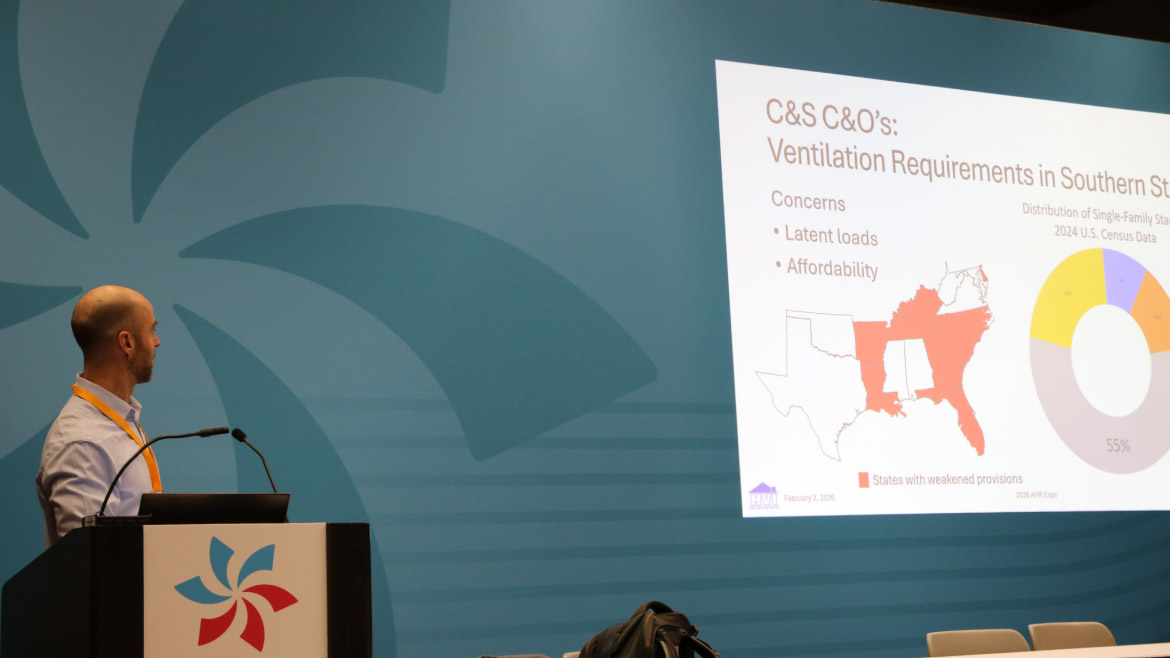
HVI: Mike Moore, senior consultant at Stator LLC, addresses ventilation system cost-effectiveness and code compliance during the Heating, Ventilation Institute session at the AHR Expo. (Staff photo)
Energy Code Credits and Strategies for Cost-Effectiveness
Mike Moore highlighted several strategies the industry is exploring to make HRVs and ERVs more affordable and energy-efficient, especially in the context of increasingly stringent energy and building codes.
A key factor is the availability of a ventilation rate reduction in building codes like the International Residential Code. Moore explained, “If you install a balanced ventilation system and distribute the ventilation air, you can run a lower air rate, and that helps in the cost effectiveness.” Properly distributing ventilation air throughout the home can allow builders to reduce the required outdoor air volume, lowering fan energy use and the energy required to condition ventilation air.
Beyond distribution, Moore emphasized the potential for system integration to reduce costs. By connecting HRVs/ERVs with the central air handling unit, duct runs can be shortened and simplified, reducing installation complexity and expense. However, this integration raises questions about whether the central air handler fan must run whenever the HRV/ERV operates, which could increase energy use if not carefully managed.
Another promising opportunity lies in improving fan technology. Moore described the industry push to improve energy codes’ minimum required fan efficacy from 1.2 cubic feet per minute (CFM) per watt to 1.7 CFM per watt. He also emphasized the value of higher turndown ratios – the ability for heating or cooling system air handlers to efficiently reduce speed to as low as 20% of max capacity – which can drastically cut energy use when using the air handler to distribute ventilation air.
Finally, Moore suggested innovations like low-cost economizers with smart bypass controls that allow ventilation systems to provide “free cooling” to homes by bypassing the heat exchanger when outdoor temperatures are below the indoor cooling setpoints during the cooling season, especially in dry climates. This strategy can reduce the need for mechanical cooling using vapor compression. These strategies, combined with code incentives, aim to make high-performance ventilation systems more cost-competitive against simpler exhaust or supply fan solutions.
California, Codes, and the Patchwork of Progress
California’s Title 24 building code is now a reference point for the entire industry, setting tough new benchmarks for ERVs and HRVs – including requirements to display power consumption and prompt users when filters need replacement. Breitbarth summed up the changes: “Regulations keep getting more stringent. Like the California Title 24, they have some additional requirements with ERVs starting this year … one is, the ERV has to be able to show what's my power consumption for this unit, to get full credit for modeled energy savings.”
But California is only part of the story. As Moore pointed out, “The assumption that a supply or balanced system will be installed a significant percentage of the time... has supported requirements for HRVs/ERVs within the prescriptive path of ASHRAE 90.1 and the International Energy Conservation Code.” Progressive states are moving beyond bare-minimum requirements, while others – especially in the Southeast – are rolling back model code provisions. Today, over half of all new U.S. homes are built in areas with weaker ventilation codes.
This patchwork leaves manufacturers, specifiers, and contractors with a moving target – and a need to design equipment that can satisfy code requirements and specifications within jurisdictions spanning multiple climate zones. While it can be onerous, the challenge has spawned equipment innovation, improved performance, and improved affordability.
The Contractor’s View: Where Policy and Physics Collide
For those who actually have to install and maintain these systems, code language is only the beginning. Jon Simard of ProCon LLC spoke for many in the audience when he raised issues that rarely make it into policy debates.
Simard highlighted the practical dilemma of integrating HRVs and ERVs with existing air handlers: “If we couple the ERV/HRV with the air handling unit, how will the air pass through the coil and filters in the heating and cooling system? The air handler fan shuts off when the temperature is satisfied, so we would need to have it run continuously, which could reduce efficiency and cause unnecessary cycling of the unit. This ultimately undermines the intended benefits of incorporating an ERV/HRV in the first place.”
It’s a revealing point. While codes may envision a seamless system, real-world installations often require costly upgrades or clever workarounds. If you don’t integrate, Simard warned, you risk occupant comfort; if you do, you might “have to think about the energy loss due to controls changes and the unit not functioning as intended.” The code minimum may sound simple, but the real-world implementation isn’t always cheaper – or more efficient.
As codes and expectations rise, so too does the need for accessible controls and easy maintenance. Modern ERVs and HRVs now offer features like auto-balancing airflow to address design challenges like the ones Simard raised, filter change alerts, and the ability to shed or shift modes during wildfire smoke events – a beneficial feature in regions with periodic poor outdoor air quality.
Codes, Complexity, and the Need for Translation
One recurring theme was just how hard it is for even experienced professionals to keep up with code changes. Moore described the growing burden: “One of the challenges with codes and standards is that the requirements are ballooning, and they can be tough to track.”
Simard put it more bluntly: “Honestly, I try not to navigate the code book. So I always use ChatGPT to point me to the code section that I need.” There’s broad agreement that tools – whether digital or institutional – are needed to translate massive codebooks into actionable, situation-specific guidance for builders, inspectors, and homeowners.
As building envelopes get tighter, the stakes for balanced ventilation get higher. “How tight do buildings need to be before we should be prescribing balanced ventilation, especially in radon country,” Moore posited. It’s a question that doesn’t just affect engineers – it’s central to how we build healthy, affordable homes in a changing climate.
Looking for a reprint of this article?
From high-res PDFs to custom plaques, order your copy today!