How Digital Tools Are Transforming HVAC, Sheet Metal Contracting
Digital tools and new approaches are changing how sheet metal work gets done, from the shop floor to the field

TECH TALK: Jake Olsen, CEO of Stratus, speaks with attendees of the product expo at SMACNA's 2025 annual convention after presenting alongside Hermanson Company's Matt Cordova.
Change is sweeping through the mechanical and sheet metal contracting world, reshaping everything from the invisible flows of air in a building to the tangible metalwork in the shop. As new digital tools tackle long-standing challenges, contractors find themselves working faster, smarter, and with fewer surprises.
One of the most exciting areas of innovation focuses on connecting the shop floor to the field through digital workflows – a transformation Hermanson Company is driving with help from Stratus. Later in this story, we also explore insights from industry leaders across the globe on how technology and culture are evolving in sheet metal fabrication.
Digitizing the Shop Floor
On the shop floor, Hermanson Company is rewriting decades-old workflows with digital tools. Matt Cordova, Director of Construction Technology, recalls a critical moment when their longtime shop superintendent fell ill during a period of rapid growth. “We could have fallen apart,” he said, “but the systems we had in place kept us running.”
Central to that resilience is connected data – centralized, real-time information accessible from shop dashboards to field crews. “We’re taking paper out of the shop,” Cordova said. “Guys build directly from models on iPads, scanning QR codes that tell them exactly what to build and where it goes.”
This approach echoes the insights of industry veteran Jake Olson, who emphasizes the power of measuring every variation in production – from hanger lengths to packaging methods – to understand what truly drives efficiency. “Very few companies actually have the data to know which jobs are optimizing for cost and labor in real time,” Olson noted.
Automated tracking solves problems that once caused costly delays. From shipment weight dashboards to reports that trigger automatically when packages move to fabrication, Hermanson’s shop runs leaner and smoother. Even complex areas like spiral ductwork are now run with Surface tablets and software apps that generate cut lists and labels, cutting prep time from hours to minutes.
Out in the field, crews use the same digital backbone. QR codes on every part carry detailed location data, letting installers know exactly where each piece fits – no prints needed. “We can isolate packages, assign crews, and cut through the noise,” Cordova said.
With over 775,000 pounds of sheet metal moved last year and a goal of 2 million this year, the system’s impact is clear. “We never missed a beat,” Cordova said.
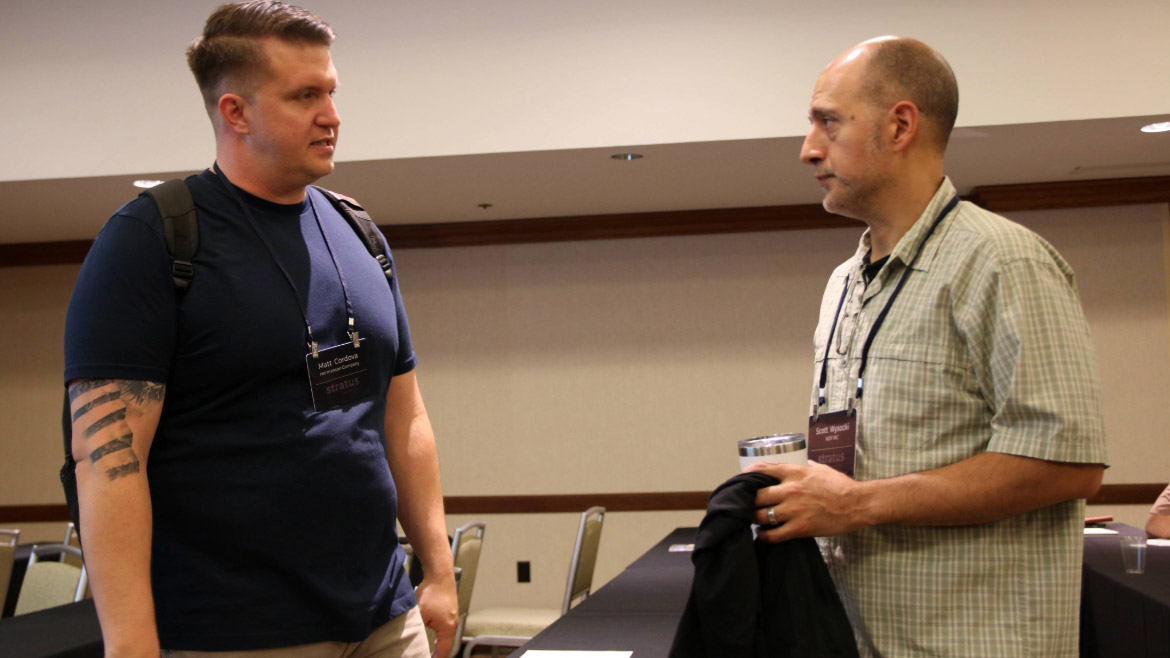
BEYOND THE FLOOR: Matt Cordova is driving Hermanson’s digital transformation, bringing real-time workflows to the shop floor and beyond.
Global Sheet Metal
Beyond Hermanson’s digital transformation, industry leaders from across the globe are pioneering technology-driven changes that streamline sheet metal fabrication and contracting. In a recent conversation on the Innovation in Sheet Metal podcast, Joseph Lansdell, president of Poynter Sheet Metal in Indiana; Aidan Kavanagh, managing director of Kavanagh Industries in Australia; and Mike Bailey, senior vice president at Mestek Machinery, shared practical insights on how digital tools and process improvements are reshaping the trade.
Their focus? Making sheet metal work faster, leaner, and more accessible through technology.
Lansdell described how his company replaced decades-old manual processes with low-code digital applications, transforming everything from truck scheduling to project controls. “We digitized workflows that were paper-based for 20 years,” he explained. “We’re now three and four months in advance. Have our schedules for our job sites with trucks scheduled already.” Lansdell added, “The throughput here has been crazy. The amount of volume we’ve done without adding overhead is incredible.”
Kavanagh emphasized the power of real-time data visualization to motivate and manage shop performance. “We made a simple scoreboard, yeah, a tracking board,” he said. “It’s color coded. You walk into the shop and go, it’s green, it’s red. And it’s just that simple.” He continued, “We have 15 KPIs that are scored weekly that we share with the entire company so everybody knows the score. You don’t play football or soccer without keeping score. Employees want to know if they’re winning or losing.”
Both leaders stressed the importance of empowering workers through technology and culture. Lansdell highlighted, “We pay our guys for their ideas. The best suggestion, we pay them for it every month.” Kavanagh described his shop culture as “a little like Survivor,” where “the teams vote you off the island” if you don’t fit. “People want respect, and they want to do a good job, at least those are the employees we want to stay here.”

SHEET METAL: On the Innovation in Sheet Metal podcast, Mike Bailey led a conversation with Joseph Lansdell and Aidan Kavanagh on how technology is reshaping the trade.
Advanced automation is also making its mark. Lansdell said, “We digitized that 20-year-old, 20-year supervisor that retired. We digitized his workflow.” Kavanagh detailed how their spiral machine is “run from a Surface tablet,” where “the cut list is generated and sent right to the app – multiple jobs at one time. Every cut prints a label, QR code, top, bottom, elevation.” He noted, “It used to take hours to build and get ready. Now it takes minutes.”
Looking ahead, Lansdell and Kavanagh see gamification, augmented reality, and enhanced data analytics as key technologies to attract younger workers and embed innovation more deeply. Kavanagh shared, “I think the next level for us is a bit of gamification. The guys, they’re contributing, we’re getting points for whatever they’re doing. If they’re attending, they’re getting points. If we’re doing preassembly, we can use augmented reality.” Lansdell added, “Technology should always tie back to making ductwork in the fewest steps possible. That’s where you get your ROI.”
While artificial intelligence remains mostly a buzzword, practical AI applications are emerging. Lansdell explained, “We’ve started talking about AI from a service level. The machine will give you an error code, and if you put those cases in over the last few years, it will pick up that error code trend and tell you what to do, versus having to call somebody and try three things.” He concluded, “Remote self-diagnostics is huge. We should be able to tap into the machine from afar.”
Their advice to contractors launching or growing their businesses is pragmatic: “Does your business justify its own existence? Do the mathematics stack up?” Lansdell asked. “Start small and just build it up slowly. None of these businesses were built overnight.” Kavanagh urged patience, noting, “I think the digital phone has lent the human condition to be very impatient. We want to skip steps and grow big. These businesses take time.”
From digital dashboards and smart automation to empowered teams, these leaders are helping write a future where sheet metal contracting runs leaner, faster, and smarter – without losing sight of the craftsmanship at its core.
Looking for a reprint of this article?
From high-res PDFs to custom plaques, order your copy today!