Breathing New Life into America’s Schools: The Fight for Cleaner Indoor Air
How outdated systems and materials harm health and learning, and what a new coalition intends to do about it

CLASS: Students fill a public school classroom, their health and learning shaped by the unseen quality of the air they breathe.
In many American schools, the air inside classrooms is more than just invisible – it’s a barrier to learning. Outdated HVAC systems, combined with aging building materials, quietly sap student performance, worsen health, and deepen inequities. Experts say fixing this isn’t just about comfort. It’s a public health imperative, an education issue, and a civil rights challenge all wrapped into one.
“The buildings themselves can make kids sick or sleepy,” said Craig Schiller, a Director at the Center for Green Schools at at the U.S. Green Building Council. “The research shows that cleaner fresh air, views of nature, and better lighting improve test scores and reduce stress. Yet, for decades, school facilities have been an afterthought.”
The problem is gargantuan: Roughly 36,000 percent of schools urgently need HVAC overhauls. The funding available is patchy and inequitable, and not enough to solve the scale of the problem. Distrust of new technology runs deep. Broken systems are patched together like Frankenstein’s monster, making upgrades complex and costly.
But a coalition of experts, non-profits, associations, manufacturers, and advocates is pushing back with a new initiative called the HVAC Change Lab. Armed with a new multi-lateral approach, industry-leading solutions, and hands-on technical assistance programs, they’re fighting to bring clean, healthy air – and with it, brighter futures – to classrooms across the nation.
Schiller laid out the scale of the problem: “There are over 100,000 public school buildings in this country. About 1/3 of them need HVAC replacement and they disproportionately affect the forty percent of school districts that have half their buildings, or more, needing replacements and modernizations.” He recounted stories of inefficiency – “Leaky ducts, equipment running longer than needed, broken or missing filters, moisture issues creating mold, unhealthy indoor air quality, or spaces that are heated and cooled simultaneously.” The scope, he said, “is massive.”
Schiller emphasized the research linking indoor environmental quality to student performance: “The more fresh air you get, the better you do on math tests. The more daylight and views you have, the better your cognitive load. These are all now quantifiable things.” Yet, he noted, “the leadership in most school districts doesn’t take into account the physical environment as any sort of value or benefit to the students.”
Reilly Loveland, associate director at New Buildings Institute and a key figure in the HVAC Change Lab initiative, described funding as a major barrier. “Seventy percent of school funding for infrastructure comes from local property taxes. Communities with more wealth can raise more money, while poorer districts struggle – creating a cycle of inequity,” Loveland said.
She detailed how school districts juggle multiple project types: “You have projects in procurement now; projects planned for 2027 or 2028; and ‘oh s***’ projects – unexpected breakdowns that demand immediate funding.” Such unpredictability disrupts budgets and forces reprioritization, often sidelining planned upgrades.
Schiller reflected on the recent federal efforts that boosted school infrastructure upgrades, including HVAC improvements. He acknowledged “there was a big push” with resources post-COVID from the Inflation Reduction Act, but added that momentum has slowed and districts now face “more limited resources and increased competition,” complicating long-term planning.
Loveland pointed out that despite such federal support, the bulk of infrastructure funding still comes from local property taxes. This reliance “creates ongoing inequities and makes sustained investment difficult” for many districts, especially those with fewer resources. The scarcity for funding highlights why coordinated initiatives like the HVAC Change Lab are so critical, she said.
Recently, new legislation has been introduced to address these funding challenges. Representative Wesley Bell put forward the Reinvest in Public Schools Act of 2026, aiming to restore and expand bond programs to reduce borrowing costs for school districts and support critical upgrades. Similarly, Senator Mazie Hirono and colleagues proposed a $130 billion fund focused on rebuilding public schools nationwide, with an emphasis on equitable investment in infrastructure to help underserved districts catch up.
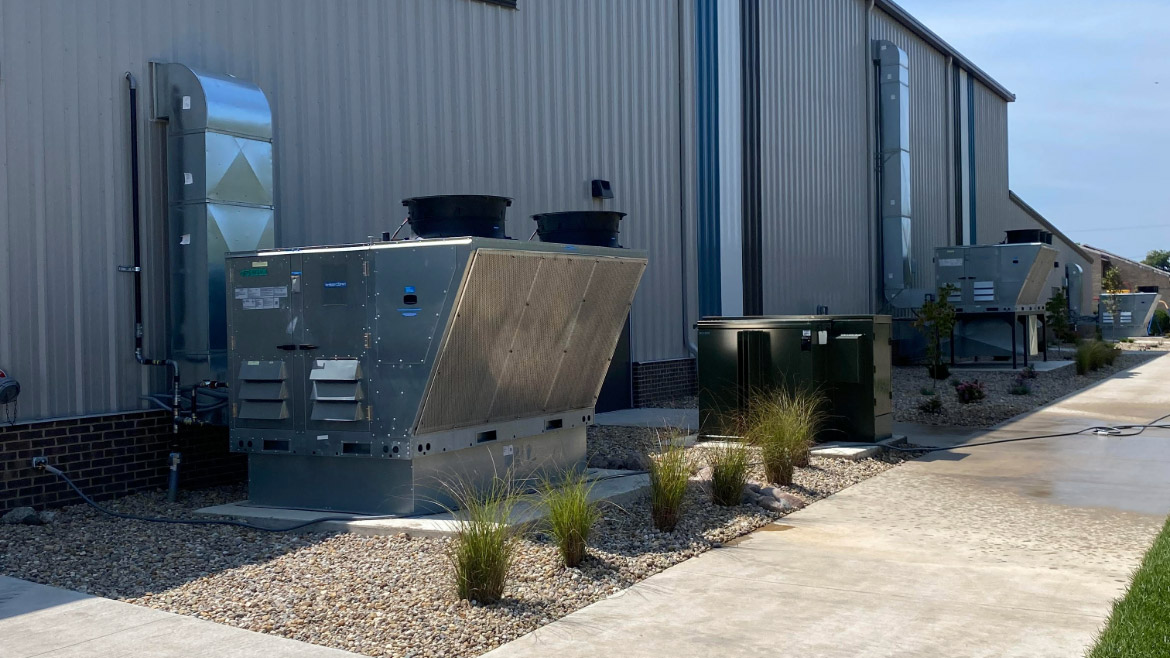
DOAS: Pictured is a state-of-the-art Dedicated Outdoor Air System (DOAS). While new schools can integrate this technology from day one, most of America’s 110,000 schools are older buildings. (Staff photo)
Frankenstein’s Monster
Schiller painted a vivid picture of many schools’ physical state: “School buildings are generational, often ‘Frankensteined’ structures patched together over decades with a hodgepodge of systems that don’t communicate well. They often don’t have universal building controls; they have complicated, legacy systems that can’t operate parts of the building properly.” He pointed out how upgrading one component can trigger costly ripple effects: “You upgrade a filter, and suddenly you need a bigger motor, the roof has to be reinforced, ADA compliance kicks in – a $200 filter becomes a $20 million renovation.”
Distrust of new technology compounds the problem. Loveland recalled a district in Arizona that refused mini-splits or variable refrigerant flow (VRF) systems, a more efficient technology, due to bad experiences with outdated models using expensive Freon. “They hadn’t realized technology had advanced leaps and bounds. We had to work closely with them and their stakeholders to demonstrate new options.”
Meanwhile, Dave Morrissey, chief innovation officer at Allergy Standards Ltd. (ASL), highlighted the importance of maintenance beyond new equipment. “Filters that pass our tests capture mold spores, but they don’t kill them. Maintenance of the HVAC system is critical to prevent mold growth and ensure ongoing air quality.”
His colleague Leah McInerney, client success manager at ASL, broadened the scope: “It’s not just the HVAC system – every room contributes. Bathrooms, kitchens, flooring, pets – all matter. We even consider outdoor allergens tracked inside on shoes.”
They also stressed the challenge of transparency. McInerney noted, “Some school districts hesitate to install air quality sensors, fearing lawsuits or backlash if poor conditions come to light. But transparent monitoring, paired with proactive upgrades, is vital for healthier environments.”
To launch the HVAC Change Lab, Loveland and Schiller’s organizations are working with the National Center on School Infrastructure (NCSI), an organization focused on building the capacity of state and local leaders to improve school facilities nationwide by improving centralized access to resources and technical assistance.
“There are lots of groups doing great work,” Schiller said, “but it is scattered across nonprofits, technical organizations, and government agencies. School districts often don’t know where to turn for clear, practical guidance.”
Reilly echoed this frustration: “Facilities teams are overwhelmed by conflicting standards, patchwork funding streams, and a lack of centralized support. The complexity of legacy systems combined with new technologies leave many stuck in ‘business as usual’ – relying on outdated fixes rather than proactive improvements.”
Recognizing many districts faced the same challenges repeatedly, they envisioned a collaborative model to break the cycle. “We needed a way to bring districts together to share what works, learn from each other, and access hands-on technical help,” Loveland said. This peer-learning approach aimed to demystify decision-making and build capacity.
Equity was central to their mission. “Without targeted support, wealthier districts keep getting better facilities while poorer districts fall further behind,” Schiller explained. The HVAC Change Lab would engage a diverse set of schools to help level the playing field.
They sought to replace the patchwork of systems with standardized best practices and open protocols – making upgrades more manageable, affordable, and effective. This holistic approach set the stage for the HVAC Change Lab’s launch as a practical, equity-focused solution to a sprawling problem.
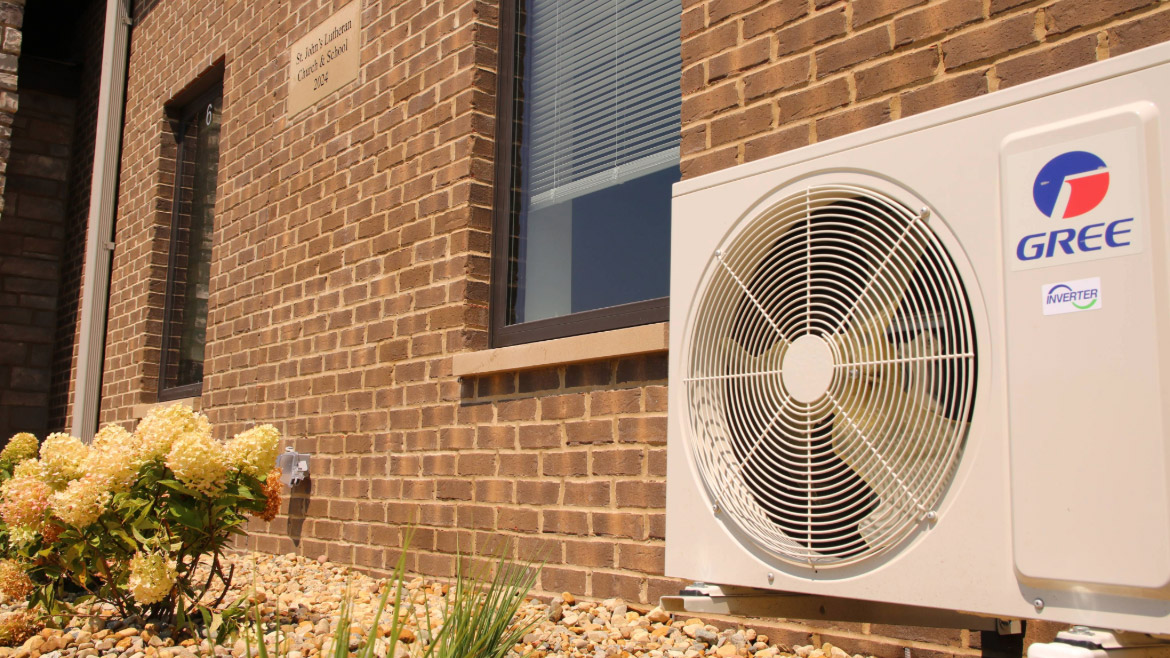
FRESH AIR: At this newly built private school, clean air isn’t just a luxury, it’s built into the foundation. But of the 10,000 public schools in the country, roughly a third need new HVAC systems. (Staff photo)
Beyond Systems: The Materials Matter
It isn’t just HVAC equipment influencing air quality – building materials also play a pivotal role. Knauf Insulation North America understood the importance of fiberglass insulation’s part in air quality and recently took action, becoming the first fiberglass insulation manufacturer to produce a fully formaldehyde-free duct liner. Knauf submitted their duct liner to undergo stringent third-party testing to gain both the Asthma & Allergy Friendly Certified and Verified Healthier Air certifications. This achievement marked a new milestone and standard for the fiberglass insulation industry with Knauf being the first and only manufacturer to hold these certifications. The certification of Knauf’s duct liners, and full Performance+ product portfolio, are certified by the Asthma & Allergy Friendly Certification Program, a joint initiative between ASL and Asthma and Allergy Foundation of America (AAFA). Products certified under the Asthma & Allergy Friendly Certification Program are independently tested to help reduce exposure to certain airborne irritants.
“It’s not enough to just claim a product is safe,” said Darrell Peil, manager, specifications and business development at Knauf Insulation North America. “We back it up with rigorous third-party testing – ensuring formaldehyde-free materials, very low particulate emissions, and certifications that surpass even GREENGUARD Gold. That’s how we help create truly healthy indoor environments.”
Knauf’s certifications demand extremely low volatile organic compound (VOC) emissions and particulate matter, exceeding standards like GREENGUARD Gold. These products carry certifications essential for LEED, WELL, and other sustainable building certification programs.
Their insulation is made from an average of 55 percent recycled glass across the plant network, aligning with sustainability goals. Recent projects, including the Austin Independent School District and Austin-Bergstrom International Airport terminal expansion, required these certified, formaldehyde-free materials to protect occupant health.
The Road Ahead: Integration, Innovation, and Equity
The convergence of material innovation, scientific certification, and technical assistance marks a turning point. But challenges remain: aging infrastructure, funding disparities, complex procurement, and the need for ongoing maintenance and training. The HVAC Change Lab’s peer-to-peer learning and multi-agency collaboration aims to break down these barriers.
Experts stress the importance of commissioning and maintaining HVAC systems properly. “We see too many expensive systems installed but not maintained or commissioned correctly,” Schiller said, the Center for Green Schools at the USGBC is developing best practices for HVAC projects. “Contracts should require design teams to stay involved post-installation, ensuring systems work as intended.”
Meanwhile, open-source controls and standardized protocols are being developed to reduce the patchwork effect plaguing many schools, making operation and emergency response easier.
Post-COVID awareness of airborne pathogens accelerated momentum but exposed gaps. “We took steps forward, but often in a frantic way without unified standards,” Schiller said, noting this coalition of advocates, manufacturers, scientists, and policymakers is coming into a more concrete form now, not just with an emphasis on pathogens, but student health more generally.
Peil agreed, concluding, “The lungs of a building are its HVAC systems and materials. If those aren’t clean and healthy, the air you breathe inside suffers, affecting everyone’s respiratory health.”
Looking for a reprint of this article?
From high-res PDFs to custom plaques, order your copy today!