How Axial-Flow Fan Packages Are Redefining HVAC Performance
High-efficiency fan packages set new standards for HVAC
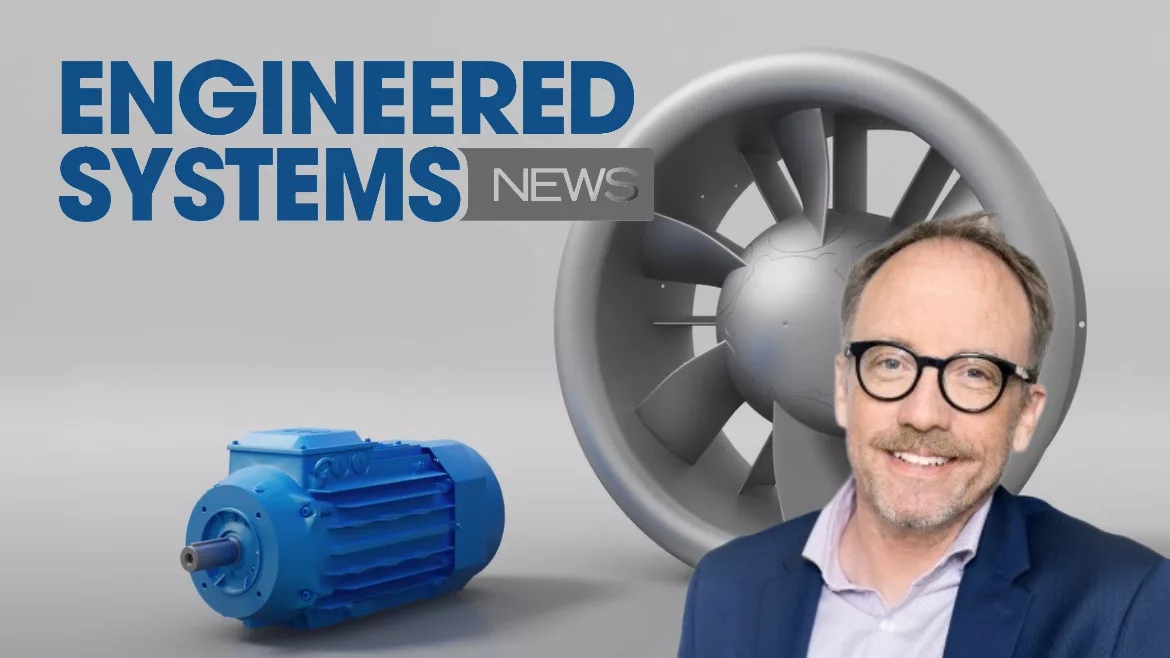
EC VS AXIAL: Ulrik Vadstrup, HVACR segment manager at ABB and guest columnist for ES News, shares insights on motor technology for HVAC.
Electronically Commutated (EC) fans have established themselves as a reliable route to energy efficiency in HVAC applications over the past decade. As HVAC technologies come under increasing scrutiny, Ulrik Vadstrup, HVACR segment manager at ABB, encourages designers to take a fresh look at axial-flow fan packages equipped with high-efficiency motors and variable speed drives (VSDs).
EC fans remain popular for a good reason. They’re compact, simple to install, and ensure dependable performance across diverse environments, from office buildings to data centers. In some applications, however, they may no longer be the optimal solution, as some designs can compromise airflow and overall efficiency, particularly when the motor sits inside the fan wheel.
In contrast, independent TÜV data shows that an axial fan package driven by a high-efficiency motor and VSD can achieve up to 85% system efficiency, around 15–20% higher than typical EC fan systems.
A standout example is Danish manufacturer Novenco’s high-efficiency ZerAx fan range. Designed as a fully integrated package, the ZerAx features precisely engineered blades with a minimal 0.7 mm tip clearance, far tighter than the typical “fingertip” gap found in many fans. Its jet engine-inspired hub design incorporates guide vanes that optimize laminar airflow while supporting the motor, removing the need for additional support rods.
When paired with high-efficiency motors and ABB’s ACH480 or ACH580 drives, ZerAx fans achieve efficiencies of up to 85%. As businesses intensify efforts to cut energy use and carbon emissions, many are now replacing their existing EC fan walls with high-efficiency fan packages. A large HVAC installation equipped with ZerAx fans can typically achieve a return on investment in under a year at today’s energy prices.
Why Part-Load Efficiency Makes a Major Difference
EC fans with brushless DC motors can achieve impressive efficiency at full speed, often exceeding the IE4 Super-Premium standard. That advantage fades quickly at part load, with efficiency potentially dropping below IE3 levels once operating speeds fall under 60%.
Since most HVAC systems run at speeds below 80% for most of their operating time, this loss of efficiency is significant. Pairing a high-efficiency motor with a drive provides a clear advantage, as it is able to maintain its efficiency even at lower operating speeds. In certain applications, it’s even possible to downsize the fan and use the drive to overspeed the motor during brief periods of peak demand – an advantage EC fans can’t offer.
An EC fan typically offers a service life of around 40,000 hours, compared to about 70,000 hours for a fan package running continuously. In real-world conditions, however, fan packages operating at part load can exceed 150,000 hours. This extended life reduces the total cost of ownership (TCO) significantly, as EC systems may require replacement twice during the same period.
When an EC fan fails, the entire sealed unit must be replaced – an expensive and time-consuming process, especially for fan wall configurations. According to ABB’s Value of Reliability survey (2023), such unplanned outages can cost over €120,000 per hour.
In contrast, modular fan systems with separate motor, drive, and fan components are easy to service, since maintenance teams can replace each part individually.
Stepping Up to Ultra-Premium Efficiency With IE5 SynRM Motors
Many fan systems still rely on traditional induction (IM) or permanent magnet (PM) motors, but a major performance boost is now possible with ABB’s IE5 synchronous reluctance (SynRM) motors. Delivering ultra-premium energy efficiency, these motors combine outstanding energy savings with reliability and low maintenance demands.
SynRM technology delivers the efficiency of a PM motor while retaining the simplicity and serviceability of an induction motor, without the use of rare earth materials. With no magnets or windings in the rotor, power losses are virtually eliminated, and servicing remains quick and straightforward.
Designing for Circularity
Circularity has now become a priority for industrial and building operators aiming to reduce waste and meet sustainability goals. One major drawback of EC fans is their sealed, molded construction, which combines multiple materials that are difficult to separate and recycle.
Conversely, modular fan and drive packages are designed for disassembly and reuse. These systems – particularly those built from highly recyclable materials – can achieve recycling rates of up to 98%, a significant advantage in densely populated regions with limited space, such as Singapore.
At ABB, sustainability drives both product design and customer support. To provide complete transparency, we supply Environmental Product Declarations (EPDs) for our products. These third-party-verified reports, based on comprehensive Life Cycle Assessments (LCAs), quantify environmental impacts from raw material extraction through to end-of-life.
We recently put our sustainability practices into action during the construction of ABB‘s new headquarters in Middelfart, Denmark. Determined to make it as environmentally friendly as possible, the team made a late decision to replace EC fans with Novenco ZerAx fans powered by ABB motors and drives. While improved energy efficiency was a key factor, the switch also focused on adopting a solution that delivers long-term sustainability and circularity.
By consolidating two older sites in Odense and Fredericia into the new Middelfart building, we have cut total energy use by 71%. Further efficiency gains, including the high-performance fan packages, have delivered an additional 42% reduction. With roughly the same building size, energy consumption has dropped from 2,215 MWh at the previous locations to just 647 MWh at the new site.
Raising the Bar for HVAC Efficiency
While EC fans have played a valuable role in improving HVAC energy performance, the next generation of axial fan and drive systems is setting a new benchmark in efficiency, reliability, and sustainability.
For organizations committed to lowering their environmental impact and operating costs, adopting these new technologies offers measurable benefits throughout the product lifecycle. A practical first step is to conduct an energy-efficiency survey to quantify potential savings and identify the fastest route to a strong ROI.
For further information: https://new.abb.com/drives/segments/hvacr
Looking for a reprint of this article?
From high-res PDFs to custom plaques, order your copy today!