The Heat Pump Push: 10 States Team Up to Electrify America’s Homes
Multistate plan targets 90% heat pump sales by 2040
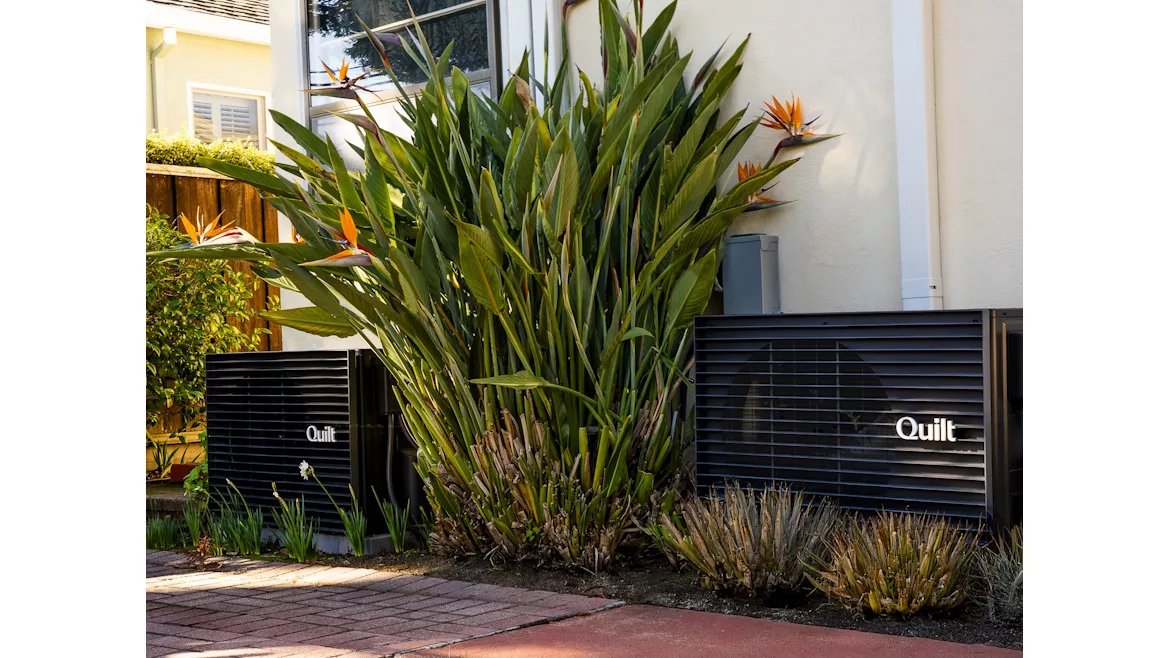
ELECTRIFICATION INITIATIVE: Two Quilt heat pump outdoor units outside a building. A new plan from the Northeast States for Coordinated Air Use Management envisions using more heat pumps for heating, cooling, and heating water in residential buildings in its 10 member states and the District of Columbia.
Ten states and the District of Columbia are uniting behind a new plan for speeding the decarbonization of residential buildings, and the HVAC industry can share in the work — and the opportunities — the plan’s proponents say lie ahead.
The Multistate Action Plan was developed by the Northeast States for Coordinated Air Use Management (NESCAUM) and sets out more than 70 specific recommendations that NESCAUM members can employ to steer residential buildings away from burning fossil fuels and toward building electrification, zero-emission technologies, and renewable energy.
NESCAUM is an association of air quality agencies in member states and Washington, D.C., and each member will decide which parts of the Multistate Action Plan to adopt, said Emily Levin, NESCAUM policy and program director and the leader of its building electrification initiative.
“It’s going to look a little different in every state, you know — their particular mix of policies and programs and investments to advance the residential market for zero-emission technologies,” Levin said recently. “So every state is going to figure out their own recipe, but no matter what they’re doing, we would stress that very proactive stakeholder engagement is important, and that definitely includes market actors, supply chain, manufacturers, distributors, contractors, installers.”
The NESCAUM members are Washington, D.C., California, Colorado, Maine, Maryland, Massachusetts, New Jersey, New York, Oregon, Rhode Island, and the state of Washington. NESCAUM’s goal is to have heat pumps make up 65% of residential heating, air-conditioning, and water-heating equipment sales, across its membership, by 2030, and 90% by 2040.
Buildings account for 13% of all greenhouse gas emissions in the U.S., and release more than 542,000 tons of nitrogen oxides each year, according to the U.S. Environmental Protection Agency (EPA). Because space and water heating make up the biggest proportion of those emissions, according to the U.S. Energy Information Administration, “transitioning these end uses to zero-emission equipment represents the highest-impact opportunity to reduce air pollution from buildings,” the action plan says.
“The action plan’s goal is to help states decarbonize their buildings in a way that grows their economies, creates local jobs, reduces energy costs, and delivers their residents comfortable buildings with modern, clean heating and cooling equipment,” said Matt Casale, managing director of states and regions at the Building Decarbonization Coalition, which helped NESCAUM develop the plan. “It is a great tool for states to use to take stock of the building decarbonization work they have done so far, and identify what policy and program options are available to them as they plan their next steps forward.”
Casale said the plan is a menu of options for advancing building decarbonization, and that NESCAUM members will pick the options that work best for them.
“If a state is trying to reduce upfront heat pump installation costs, the action plan has options for that,” Casale said. “On the other hand, if they need to grow their building electrification workforce, it has options for that as well.”
The plan’s recommendations are grouped under five subject areas: policy coordination and accountability, equity and workforce investments, carbon reduction, codes and standards, and utility planning and regulation.

DECARBONIZING HOMES: A residential neighborhood in Brooklyn, New York, with the Brooklyn and Manhattan skylines in the background. The state of New York is a member of the Northeast States for Coordinated Air Use Management (NESCAUM), which recently published an action plan for promoting zero-emission residential buildings. (Courtesy of Ryan Herron / iStock / Getty Images Plus)
Recommendations include forming stakeholder advisory boards to help governments design decarbonization policy; partnering with HVACR manufacturers, distributors, and contractors to promote technological education; forming committees to guide states on workforce needs, career pathways, and labor standards; and building networks of contractors working in building decarbonization to make it easier for customers to find them. Other recommendations include updating the definitions of zero-emission buildings to account for refrigerants, updating building energy codes, and enacting policies that help shift consumer purchases from central a/c units to heat pumps.
“There’s going to be a huge training need, but also a huge business opportunity for contractors working on zero-emission technologies like heat pumps,” Levin said.
Levin said it will be important for those implementing the action plan to maintain ties to the HVAC industry.
“The market’s dealing with tariffs and supply chain impacts, and there’s the refrigerant transition going on, and so just keeping in touch and hearing how things are going, and having a sense of all the other things that the industry is managing toward, is very helpful when designing policies and programs,” she said.
Mark Schmidt, chief revenue officer at heat pump manufacturer Quilt, said his company is ready to pitch in.
“Our team brings deep experience from Google, Apple, Nest, and Trane in creating smart home systems that customers embrace,” Schmidt said. “We’re eager to collaborate with utilities, contractors, and policymakers on pilot programs that demonstrate how modern heat pumps deliver both superior comfort and greater efficiency than average systems.”
Quilt, which was formed in 2024, has several initiatives for raising the public’s awareness of heat pumps.
“We’d be thrilled to expand these awareness programs in partnership with NESCAUM states, and our existing partners in those states have fully embraced them,” he said.
NESCAUM’s plan is being released at a time when the federal government is pulling back on some electrification incentives and the Trump administration is downplaying the role of renewable energy sources. Given political headwinds, the Multistate Action Plan is being released in “an uncertain operating environment for everybody, including industry,” Levin said.
But NESCAUM’s membership remains committed, she said. Since the governments of NESCAUM members signed onto the group’s work, she said, individual member approvals of the plan are not needed.
“They’re standing firm and moving forward. And that’s because they really believe this is the right thing to do, you know, not just to meet their climate and air quality goals, but because they want to help their customers transition to affordable, clean heat,” Levin said.
“State and regional initiatives like NESCAUM’s become even more important in this environment, creating sustained momentum independent of federal changes,” said Schmidt. “OEMs should double down on partnering with local installers, utilities, and state programs while continuing to improve product economics through innovation rather than relying solely on subsidies. The energy transition in homes will ultimately succeed because modern heat pumps offer a better experience, not just because of policy support.”
Looking for a reprint of this article?
From high-res PDFs to custom plaques, order your copy today!