How TDIndustries Is Cutting Clutter with Ancillaries
By swapping physical joints for digital metadata, TDIndustries is making fabrication models easier to manage

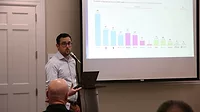
INNOVATION: David Ronson shares TDIndustries’ streamlined approach to joint tracking during his session at Stratus Innovate, highlighting how digital ancillaries are cutting through the clutter in fabrication models.
In the world of large-scale mechanical contracting, efficiency isn't just a buzzword, it's survival. For Texas-based TDIndustries (TD), a nearly billion-dollar contractor with offices in Dallas, Phoenix, Denver, and across Texas, the relentless push for smarter workflows has led to a quiet but powerful shift in how they calculate a crucial metric: diameter inches.
At a recent industry event, David Ronson, director of construction technologies at TDIndustries, peeled back the curtain on a workflow developed by TD colleague Lyle Janda, manager of construction technologies, that’s transforming how joint metrics are handled in complex fabrication projects. The key? Leveraging “ancillaries” – metadata, not physical parts – attached to connectors within models, eliminating unnecessary clutter and reducing headaches for detailers and project managers alike.
Traditionally, calculating diameter inches – the productivity metric multiplying a pipe’s nominal diameter by its number of joints – meant modeling every joint, weld, solder, no-hub and additional connections as physical parts. This practice, widespread in the industry, brought a host of problems: ballooning file sizes, slower Stratus publish times, over-complicated connectivity logic, and invisible “phantom” parts that could haunt models for months.
“You end up with these tiny, hard-to-see things just floating around,” Ronson explained. “They don’t help coordinate space, but they do make your models larger and harder to manage.”
The Ancillary Solution
Inspired by how sheet metal fabrication models handle gaskets – not as modeled elements, but as rule-based metadata – TDIndustries shifted to using ancillaries for joint tracking. Ancillaries live in the background, attached to connectors, and follow rules based on pipe size and type. They’re flexible, centrally controlled, applied passively and invisible in the model.
Setting up the system required some forethought: consistent naming conventions for reporting, breakpoint tables for every needed size, and careful attention to how data is entered. For example, TD’s team enters data as decimal values instead of fractions, a lesson learned after trial and error.
Once in place, as the detailers coordinate, ancillaries are quietly applied, capturing joint metrics without cluttering the digital workspace. Kits can be built to include not just joints, but consumables like gas and wire, providing a full material and labor snapshot with every report.
Challenges and Opportunities
There are still limitations. Stratus, for example, stores ancillary data in a delimited format that complicates reporting, and weld tracking is still tied to physically modeled welds – ancillaries can’t yet be used for tracking welder IDs. Even so, the gains in simplicity and performance have been significant, especially for teams managing large, complex projects.
As the conversation in the room turned to labor tracking and cost estimating, Ronson pointed out that while hyper-detailed consumable tracking can become unwieldy, rolling costs into a single metric per joint or diameter inch keeps things manageable. Labor tables can be aligned with the Mechanical Contractors Association of America (MCAA) work activity method (WAM), letting companies project shop and field work with more confidence – even if they aren’t using ESTmep as their takeoff solution in preconstruction.
The presentation wound down with candid shop talk: war stories about database setups gone wrong, the headaches of weld offsets, and the constant dance of balancing field and shop labor metrics. But Ronson’s message was clear – by removing unnecessary modeled parts and embracing smarter, data-driven tools, contractors can unlock new levels of speed, accuracy and insight.
As the construction tech landscape evolves, TDIndustries’ experience offers a roadmap for firms looking to streamline their digital workflows. “It’s not complicated,” Ronson concluded, “but it does take a shift in thinking. If I can drop some ideas out there that spur others to rethink how we do this work, then that’s a win for everyone.”
Looking for a reprint of this article?
From high-res PDFs to custom plaques, order your copy today!