University of Utah Study Reveals HVAC Systems’ Role in Letting Wildfire Smoke Indoors
Wildfire smoke’s fine particles can invade indoor spaces, new University of Utah research shows
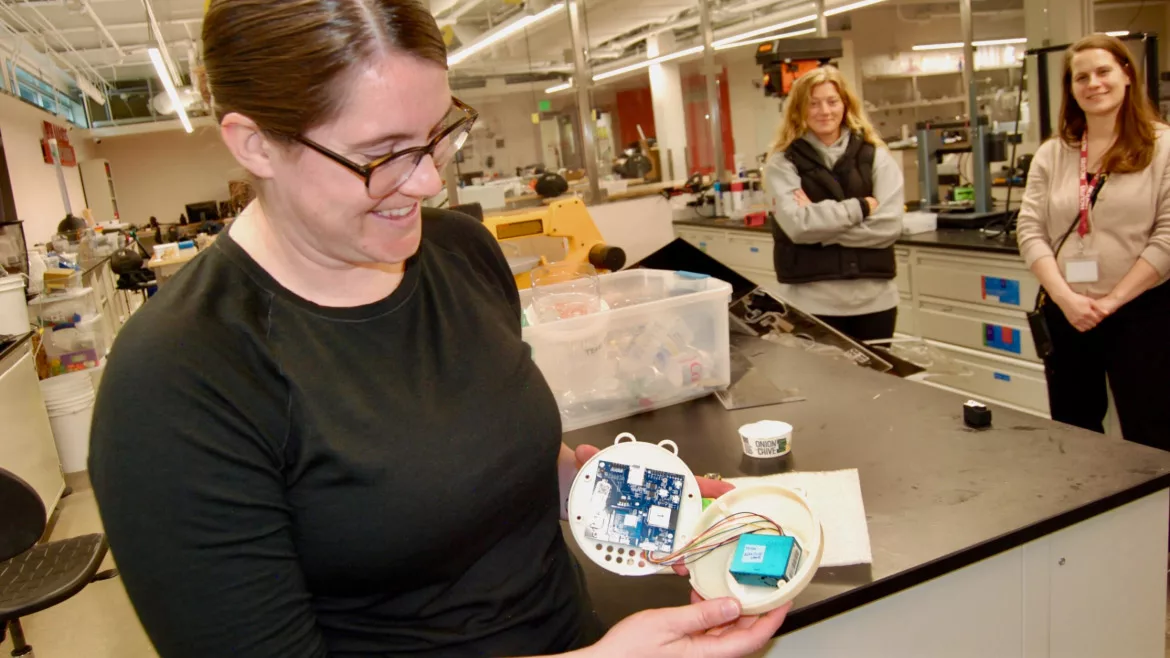
SCIENCE: Tristalee Mangin, chemical engineering graduate student, opens a compact, low-cost air quality sensor developed by University of Utah engineers. (Brian Maffly)
Most people assume that closing the door on outside air protects them from pollution, but new research from the University of Utah reveals it’s not that simple – especially when wildfires burn nearby. The team’s findings, published this week in Building and Environment, suggest that what you breathe indoors can depend just as much on your building’s HVAC system as on what’s happening outside.
“We typically spend 80% of our time indoors,” said Tristalee Mangin, the graduate student who led the study. “But the quality of the air inside is shaped by a mix of factors: indoor sources, outdoor sources, and the systems that move air through the building.” The study used the University of Utah’s own Salt Lake City campus as a “living laboratory,” with researchers from engineering, facilities management and occupational health teaming up to uncover how outdoor particulate pollution – especially PM2.5 – finds its way inside.
PM2.5, or fine particulate matter, is a notorious health hazard, linked to everything from respiratory problems to heart disease. The study focused on three types of pollution events common in Utah: wind-driven dust storms, winter inversions, and wildfire smoke. All three bring unique mixtures of PM2.5, but, as the research found, not all are equally likely to end up inside.
Using a network of low-cost, wireless air quality sensors – designed by electrical engineering professor Pierre-Emmanuel Gaillardon and commercialized by the UU startup TELLUS – the team measured air at 17 indoor and two outdoor campus locations. The sensors, about $450 each, are a fraction of the price of traditional compliance-grade equipment, allowing for large-scale monitoring.
“We looked at the ratio of indoor to outdoor particulate matter,” Mangin said. “If that ratio gets close to one, it means most of what’s inside is coming from outside.” The researchers then compared those numbers across buildings with different HVAC systems, particularly those using air-side economizers—systems that draw in outdoor air when conditions are favorable to reduce energy use.

The results were illuminating. “Wildfire smoke had four to five times more PM2.5 infiltration into buildings than pollution from inversions and dust events,” Mangin said. “But only in buildings with air-side economizers did we find rare instances where indoor pollution exceeded international health guidelines.”
Professor Kerry Kelly, who oversaw the research, explained why wildfire smoke behaves differently: “Economizers are a great way to save energy. But if the outside air is smoky, you can end up pulling in that pollution, and some particles make it past the filters.” While the system’s energy efficiency is a plus, there’s a hidden cost during wildfire season. Most buildings on campus maintain good indoor air quality, but the “challenge,” Kelly noted, is managing systems that have evolved over decades and now include a patchwork of technologies.
So why are dust and inversion events less of a problem indoors? Dust particles, Kelly said, are larger and heavier than smoke and tend to get trapped in filters or settle out of the air before they can travel far. Inversions, which trap pollution low to the ground during Utah’s winters, are dominated by ammonium nitrate. “At indoor temperatures and humidity, those particles turn into a gas phase. So, during an inversion, most of the stuff that’s a particle outside is not a particle when it gets inside,” Kelly explained. “It kind of disappears.”
The study’s 18-month window, which ended in April 2024, collected data during every major pollution event in the region. The ongoing research project continues to monitor air quality and aims to help campus facility managers make operational improvements, especially as wildfires become more frequent and intense.
Sean Nielson, an engineer with the university’s Sustainability and Energy group, pointed out that “every building and system has unique features.” The study’s findings defy a one-size-fits-all solution. “Looking at buildings and systems individually is something we’re going to consider in the future and see what we can do to modify that system,” Nielson said. Adjustments won’t be as simple as just closing dampers during smoky days. “You still have code minimum requirements for a certain amount of outside air that must be provided,” he noted, explaining that outside air is necessary to dilute and flush out indoor contaminants.
One tool that often works is “applying higher-rated MERV air filtration,” Nielson said. But he cautions that even the best filters have limits, especially when retrofitting older equipment.
Despite the rare exceedances, the vast majority of buildings on campus kept indoor air quality within healthy ranges. Portable air filters, Kelly said, are a “very solvable” solution for problem areas, and even simple interventions can make a difference.
The University of Utah’s ongoing study offers a roadmap for other large campuses and building operators facing similar challenges as wildfire smoke becomes a seasonal threat. As the project continues, researchers hope to refine their understanding of how buildings and their systems can work together to keep the air we breathe safe – no matter what’s happening outside.
Looking for a reprint of this article?
From high-res PDFs to custom plaques, order your copy today!