After Wildfire Smoke Event, Lawmakers Renew Push to Improve Air Quality in Federal Buildings
Advocates say many federal facilities still rely on outdated HVAC systems
BIPARTISAN: A new bipartisan bill, the Airborne Act, aims to reward commercial building owners with tax breaks for upgrading indoor air quality. Plus, read about proposed legislation on federal building IAQ.
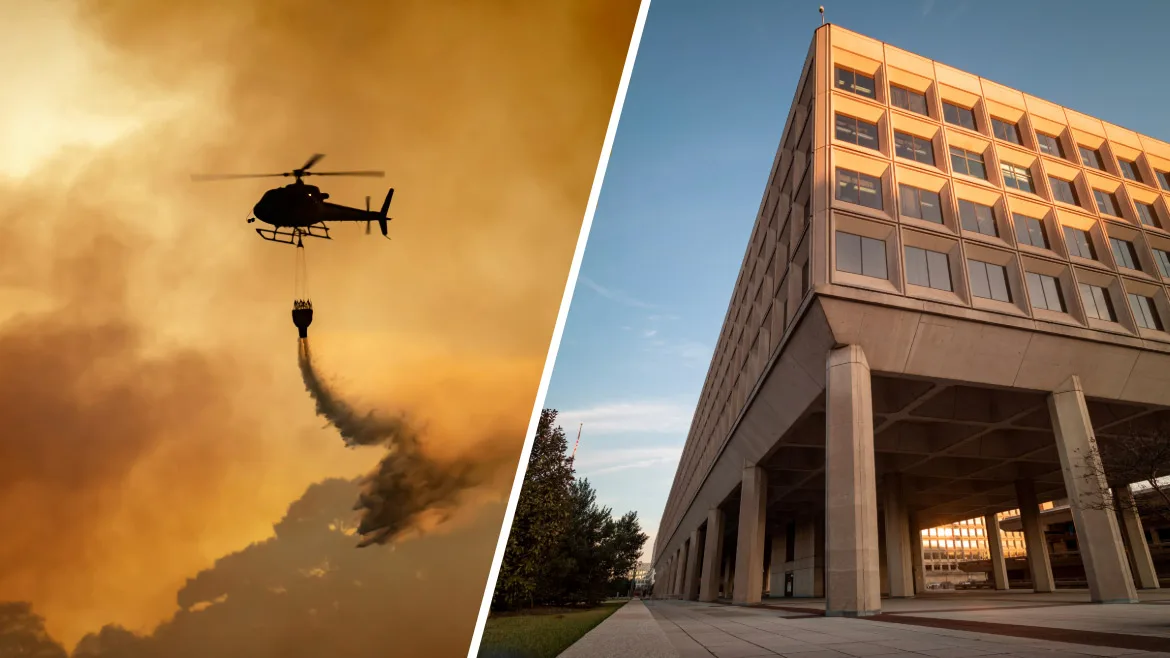
Washington's recent brush with hazardous wildfire smoke is giving new momentum to a growing bipartisan effort to improve indoor air quality in schools, workplaces, and federal facilities.
Just days after smoke pushed portions of the Washington region into "Code Purple" air quality conditions, Rep. James Walkinshaw (D-Va.) introduced the Federal Facilities Indoor Air Quality Assessment Act, legislation that would direct the Government Accountability Office to conduct a comprehensive review of ventilation, HVAC performance, and indoor air quality conditions across the federal government's vast real estate portfolio.
The bill marks the latest development in what appears to be an expanding congressional focus on indoor air quality – an issue that gained prominence during the COVID-19 pandemic but is now being tied to workforce health, federal building modernization, energy efficiency, and infrastructure investment.
"We need to know exactly where each of them stands in terms of the systems that are inside of them," Walkinshaw told attendees at the Sheet Metal and Air Conditioning Contractors' National Association (SMACNA) Legislative Conference in May, referring to the federal government's inventory of buildings. "Many of those buildings are old, inefficient and, quite frankly, they're failing the dedicated public servants who work in them every day."
From NDAA Amendment to Standalone Legislation
The idea of a federal review of indoor air quality first surfaced earlier this year as a potential amendment to the National Defense Authorization Act. Lawmakers raised it at the SMACNA Leadership Conference, but the Senate declined to include the language. Supporters then opted to pursue the proposal as standalone legislation.
Backing quickly materialized from a wide coalition: SMACNA, the International Association of Sheet Metal, Air, Rail and Transportation Workers (SMART), the American Society of Heating, Refrigerating and Air-Conditioning Engineers (ASHRAE), and the American Federation of Government Employees (AFGE).
SMACNA, which has been vocal on the issue, said the bill would help pinpoint weaknesses in federal buildings and improve protections for workers and the public. “This is innovative and long overdue legislation,” said Stan Kolbe, SMACNA’s executive director of government and political affairs.
A Massive Federal Building Inventory
The scale of the challenge is substantial. According to Walkinshaw, the federal government owns or leases approximately 350,000 buildings totaling roughly 2.9 billion square feet of space.
Many facilities were constructed decades before modern ventilation and filtration standards became commonplace.
As drafted, the legislation would require GAO to examine:
- Whether federal buildings meet applicable indoor air quality and ventilation standards.
- How agencies monitor and test indoor air quality.
- The frequency and causes of HVAC and air-quality deficiencies.
- The effectiveness of current remediation and oversight practices.
- The qualifications and certifications of workers performing HVAC installation, testing, balancing, commissioning, and maintenance work.
The bill specifically references ASHRAE standards and would require agencies identified as having material indoor air quality deficiencies to develop corrective action plans after GAO completes its review.
Supporters argue that obtaining a complete picture of federal building conditions is the necessary first step before broader modernization efforts can begin.
"The point of that inventory is to figure out which HVAC systems, which ventilation systems, are beyond their useful life," Walkinshaw said. "Then we can decide what investments we should be making in those buildings."
Indoor Air Quality Gains Broader Attention
At the same SMACNA conference, Rep. Don Beyer (D-Va.) discussed the Airborne Act, legislation that would encourage indoor air quality improvements in commercial buildings through tax incentives.
Beyer described indoor air quality as a long-standing public health challenge that received renewed attention during the COVID-19 pandemic.
"COVID woke us up to the danger of aerosolized viruses," Beyer said.
Citing decades of EPA research, Beyer noted that Americans spend roughly 90% of their time indoors and are frequently exposed to higher concentrations of pollutants indoors than outdoors.
"We also know that if we can do indoor air quality a lot better, many fewer sick days, a cleaner, more comfortable work environment, smaller risks of long-term health conditions – and all this is good for business," he said.
His proposal would provide tax incentives for indoor air quality assessments, filtration upgrades, and HVAC improvements in commercial buildings.
Meanwhile, Rep. Paul Tonko (D-N.Y.) is backing the Indoor Air Quality and Healthy Schools Act, legislation designed to strengthen EPA's role in indoor air quality research, guidance, and technical assistance programs.
Speaking on Tonko's behalf, Deputy Chief of Staff Brendan Larkin said the legislation seeks to establish a stronger federal framework for indoor air quality science while avoiding contentious regulatory mandates.
"We've had a Clean Air Act," Larkin said. "There's been nothing ever similar enacted for our buildings, for our indoor air quality."
The measure places particular emphasis on school buildings, many of which rely on aging ventilation systems that struggle to meet modern standards.
Workforce and Construction Implications
For HVAC and sheet metal contractors, the legislation carries significance beyond public health.
Walkinshaw and other supporters view federal building modernization as a substantial infrastructure opportunity that could generate demand for skilled labor, advanced HVAC systems, and specialized commissioning and testing services.
"Every tax dollar that we put into modernizing those buildings should be, and can be, $1 that goes to American manufacturing and American skilled labor," Walkinshaw said.
The measure's language also highlights workforce qualifications, including professional certifications, testing and balancing credentials, fire and smoke damper expertise, commissioning practices, and the role of registered apprenticeship programs.
Those provisions reflect increasing attention on ensuring that ventilation and indoor air quality improvements are performed by qualified workers using recognized industry standards.
Looking Ahead
Passage remains uncertain. Like many standalone infrastructure and building-performance bills, the legislation faces a challenging path through Congress. But supporters point to growing bipartisan interest in indoor air quality, heightened public awareness following wildfire smoke events, and increasing concern about the condition of federal facilities.
The current bill's immediate objective is relatively modest: gather data, identify deficiencies, and establish accountability.
Yet supporters believe the findings could lay the groundwork for future investments in ventilation, filtration, and building modernization across one of the nation's largest real estate portfolios.
As concerns about wildfire smoke, airborne contaminants, and workplace health continue to grow, indoor air quality is steadily evolving from a niche HVAC issue into a broader policy discussion on Capitol Hill. And for lawmakers, contractors, and federal agencies alike, the conversation appears to be just getting started.
Looking for a reprint of this article?
From high-res PDFs to custom plaques, order your copy today!