Troubleshooting Air Conditioning Transformers
Troubleshooting air conditioning transformer issues requires a methodical approach.
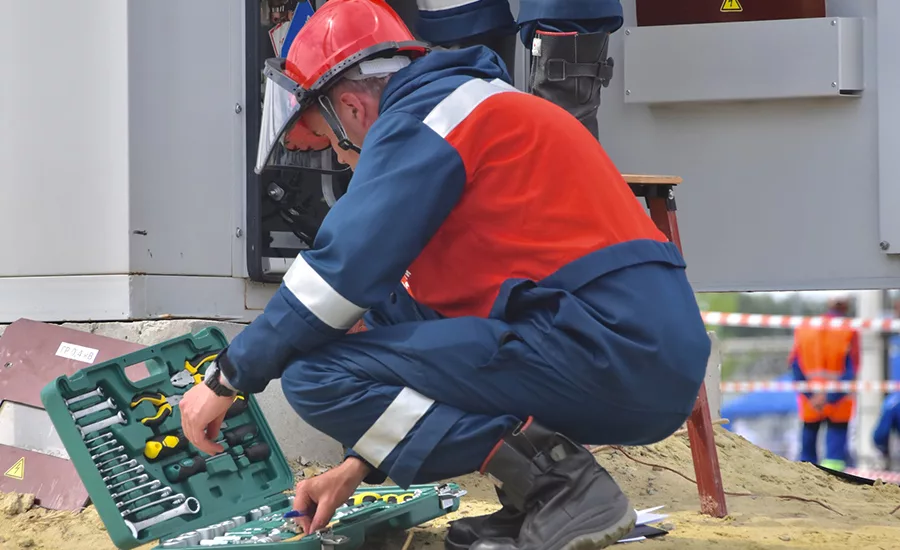
FIGURE 1. After removing the wires, turn the transformer on and use the VOM to check for voltage between the screw terminals.
Air conditioning transformers are essential components for proper system function. They power the thermostat and regulate the current sent to it. That’s essential because a current that’s too high could damage the system, but the air conditioner won’t get enough power to function if it's too low. Troubleshooting air conditioning transformer issues requires a methodical approach. Here are some things to consider when doing it.
Check That the Transformer Is Giving Power
The transformers used for air conditioners are the low-voltage variety. One of the first steps is to see whether power is reaching the faulty transformer. Technicians can do that with a volt-ohm-milliammeter (VOM), which measures the voltage, resistance, and current. The transformer should get 12-24 volts of alternating current at its output screws.
The first step is to remove all the low-voltage wires from the screws at the top of the transformer. There are usually small red and white wires connected under two screws on the transformer’s top. However, if the transformer sends power to more than two thermostats in the HVAC system, it will likely have several sets of connected wires to take off.
After removing the wires, turn the transformer on and use the VOM to check for voltage between the screw terminals. One scenario indicating a problem is if the transformer is getting power, but there’s no power between the transformer’s voltage output screws.
Ask for Maintenance Records
It’s also helpful to request relevant details about the air conditioning system’s upkeep. If people fail to maintain it properly over the years, such shortcomings can cause transformer failures. Excessive moisture can shorten a transformer’s life span. However, natural ester transformer oils are 10 times more effective at pulling out moisture than mineral-based ones.
Thus, knowing about the maintenance practices can help people identify the sources of air conditioning transformer problems. Perhaps a particular component with a five-year lifespan was replaced 18 months ago. It’s then easier to justify initially turning one’s attention elsewhere because it’s less likely for that part to fail so much earlier than expected.
Troubleshooting air conditioning transformer abnormalities is also more manageable if people ask whether clients use smart maintenance practices to inform their strategies. Advanced algorithms can establish baselines for machine performance then flag people about deviations. Such real-time data can give prompt warnings, reducing the chances transformer problems go unnoticed for too long.
Perform a Winding Resistance Test
Winding resistance tests occur during transformer manufacturing as part of quality control efforts. However, they can also happen in the field to diagnose problems like loose connections or broken conductor strands.
The current voltage method is one widely utilized way to carry out this test. However, people should only attempt it once the transformer is off for at least three to four hours. That timeframe ensures the transformer has equal oil and winding temperatures.
This assessment involves sending a test direct current into the winding and measuring the corresponding amount of voltage drop across it. The test current must not exceed 15% of the rated current for the winding. Otherwise, it could make the winding too hot, changing its resistance.
People should only take readings once the voltage and current are at steady state values, which could take several minutes. Next, they must compare the resistance per phase and the measured resistance, which varies depending on the transformer winding type.
Perhaps it’s a delta-connected three-phase winding. Then, the per-phase resistance should be 0.67 times the amount of resistance measured for the transformer’s line terminals. No matter what kind of winding the transformer has, technicians should repeat this test at each pair of line terminals at each tap position.
Measure the Total Harmonic Distortion
Troubleshooting air conditioning transformer abnormalities is more straightforward when people rely on relevant power quality measurements. Getting the results from a faulty transformer and comparing them to the ideal measurements is one best practice for narrowing down the issues.
Total harmonic distortion is one power quality measurement closely related to transformer performance. As the name suggests, it measures all of an asset’s combined harmonics. Minor harmonic distortion is a normal occurrence. However, measurements of more than 5% on any phase require further investigation. That’s because they can cause transformers to run hot or make them less efficient.
However, people can prevent those issues by taking baseline readings of transformer current levels and temperatures. Internet of Things sensors can help clients become aware of problems sooner than they otherwise would, allowing them to alert technicians more promptly.
Test for Shorts in the Windings
An excessively large primary current is one of the telltale signs of a short in a winding. If people believe a short caused a transformer fault, they should begin troubleshooting by disconnecting the transformer from the source and testing the primary current with an ohmmeter.
The ohmmeter should show 0 Ω if a transformer winding has a short. However, when operating an ohmmeter, a person must take care to select a low enough meter scale because the resistance of the measured direct current may be less than 0 Ω. People can use this same method to test for shorts in the transformer’s secondary windings, again being sure to choose a low enough scale for the meter.
It’s also useful to check for partially shorted windings by paying attention to the transformation ratio — the ratio of the output voltage to the input voltage of the transformer. A partially shorted winding changes the transformer’s transformation ratio. Measuring the primary and secondary alternating currents with a voltmeter can help determine if the transformer’s problem is a partial short in a winding.
Conduct a Transformer Criticality Assessment to Determine Whether to Repair or Replace
After troubleshooting air conditioning transformer problems, technicians will need to help a customer decide whether to proceed with a repair or budget for a replacement. One way to start the process is to perform a transformer criticality replacement.
Clients will initially assert that all their transformers are critical, which is an understandable perspective. However, it’s valuable to carry out a more granular assessment by considering the potential ramifications of an air conditioner transformer’s failure.
A straightforward approach is to create a five-point scale for the transformer, where five indicates the most considerable risk and one represents the smallest one. Then, apply the points system to determine the likely adverse effects of a transformer failure, assuming a maximum score of 40:
- Maintenance history: Consider the transformer’s age and its previous upkeep.
- Mission impact: Ask whether a failing transformer would disrupt a company’s daily and urgent operations.
- Overall reliability: Find out whether the transformer has generally operated reliably over time.
- Lead times and spare parts: Learn how long it would take to get new parts or if the client has spares.
- Environment: Determine if a transformer failure would harm the environment.
- Customer impact: Evaluate how a failing transformer would negatively affect a company’s clients.
- Safety: Study whether a faulty transformer would risk people’s lives and well-being.
- Replacement costs: Assess whether replacing a transformer is more cost-effective than repairing it.
Diving into a transformer’s criticality details can also help clients realize they must act quickly to approve any repairs or replacements. Otherwise, a catastrophic failure could occur and have ripple effects on a business.
Troubleshooting Air Conditioning Transformer Problems Aids in Decision-Making
A problem’s symptoms and when they started can significantly impact how a professional proceeds when troubleshooting air conditioning transformer abnormalities. However, the tips above give some excellent starting points for solving the problem and getting the transformer back to standard functionality as quickly as possible.
Additionally, skillful troubleshooting of air conditioning transformers can help people decide replacing a faulty transformer may be better than repairing it. That is particularly true if it has had ongoing problems or is no longer as efficient as many newer models.
Looking for a reprint of this article?
From high-res PDFs to custom plaques, order your copy today!