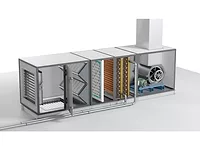
Filters for Ventilation Systems
Filters installed in the supply and exhaust air ventilation system are divided into types in accordance with their design features.
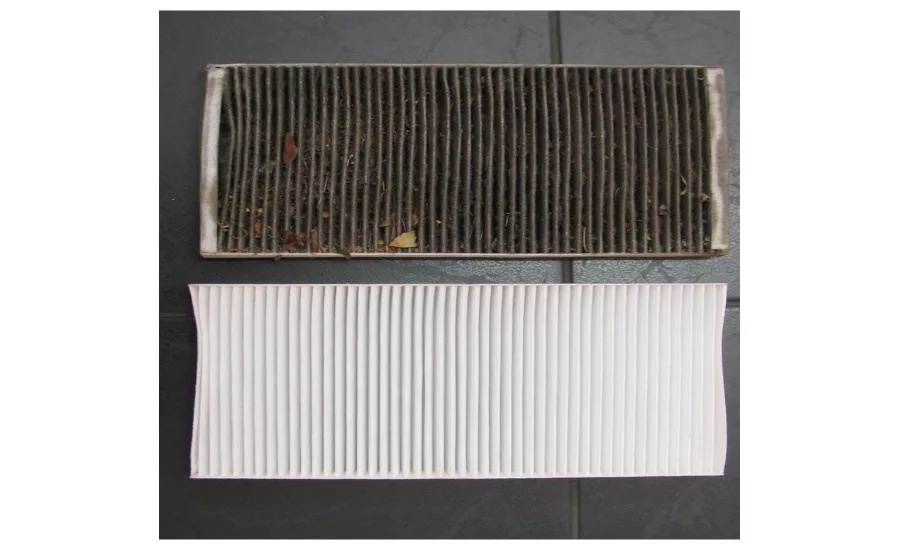
A filter is an indispensable part of any ventilation system. A filter is a device designed to clean the air from various kinds of impurities, dust, dirt, grease, and odors. The ventilation system guarantees a favorable microclimate in any room.
This filtration system:
- Prevents stagnation of air masses in living rooms,
- Prevents the spread of unpleasant odors in the room, and
- Avoids stuffiness in the bathroom.
The choice of a particular type of filter for the ventilation system depends on the following indicators:
- Performance of the ventilation system,
- Temperature of the air passing through the filter,
- Type of ventilated room, and
- Size of the ventilation ducts.
The main characteristic parameters of any filter for supply ventilation are:

- Breakthrough ratio: represents the ratio of the downstream particle concentration to the upstream particle concentration (in percent).
- Efficiency is the ratio of the difference between the concentration of particles before and after the filter device and the concentration of particles before the filter (expressed as a percentage).
- The size of the smallest particles captured.
- Dust holding capacity of the filter - the maximum
- Amount of dust that the filter can accumulate before failing.
- Productivity is the volume of air passing through the filter per unit of time.
- Aerodynamic resistance is the pressure drop in the airflow before and after the filter at a given performance.
Filters installed in the supply and exhaust air ventilation system are divided into types in accordance with their design features. The most common are:
- Bactericidal,
- Cassette (corrugated),
- Electrical (electrostatic),
- Coal, and
- HEPA filters.
Bactericidal filters are devices that have an antimicrobial effect on the air passing through them. They are used for cleaning supply and circulating air. This type of filter is installed in rooms that require a high degree of air purity.

The principle of operation of this type of filters is based on the harmful effects of ultraviolet radiation on various bacteria and microorganisms. UV radiation is electromagnetic radiation whose wavelengths lie between the visible spectrum and X-rays. A quantum of energy of UV radiation damages its DNA getting into a molecule of a bacterium. It leads to its further death. Bactericidal filters are installed for ventilation in medical, educational, industrial, and other institutions in order to carry out epidemiological and preventive measures. It reduces infectious microorganisms in the room. Each bactericidal filter has a certain power of UV radiation, which is selected in accordance with the volumetric bactericidal dose of the room.
Cassette Filters
The ventilation cassette filter is one of the most common types of filters: It can be used in almost all air-purification and air conditioning systems. It is used in single-stage and multistage cleaning systems for primary air purification. Cassette filters have a high dust-holding capacity.
These filters are disposable: The fabric for this ventilation filter cannot be regenerated. The materials used for the manufacture of cassette filters are harmless. Therefore, the filter is disposed of as construction waste at the end of the service life.
Electric Filters
The principle of operation is quite simple: suspended particles (aerosols) acquire a charge passing through the electrostatic field between the metal plates. Then, charged aerosols under the action of electric forces move in the airflow. They are deposited on the electrode, having the opposite electric charge (located in the deposition unit).
Electric (or electrostatic) filters are particularly fine filters. Its advantages include:
- Low noise during operation, and
- Multiple cleaning (dust collector - metal plate).
However, this type of filter also has disadvantages:
- First, they do not guarantee 100% removal of "dirty" particles from the air, and
- Second, ozone is formed in the process of air purification with an electrostatic filter which is a substance hazardous to human health even in small doses.
Carbon Filters
You can also ensure the cleanliness of the air in the room with the help of a ducted carbon filter for ventilation: It is able to not only remove harmful impurities but also to eliminate unpleasant odors.

The filter material is activated carbon in this filter, which is known to be one of the most effective adsorbents.
The air to be cleaned passes through a scattering of cylindrical granules of activated carbon. At the same time various harmful substances and unpleasant smelling compounds are absorbed by particles of the adsorbent. The carbon filter is capable of high-quality air purification even with a relatively low density of the bulk material. It contributes to the appearance of a low aerodynamic resistance of the airflow when it passes through the filter.
Carbon filters are disposable filters; the filter material does not have a regenerative capacity. As soon as the maximum dust saturation is reached, the filter can be disposed of as construction waste since it does not contain toxic or toxic materials.
HEPA Filters
HEPA filters are widely used and can remove various fine impurities from the air. They are usually used for fine and especially fine air purification.

A popular misconception among the people is that HEPA is the name of a particular company or brand of a filter manufacturer. Indeed, the acronym HEPA (High Efficiency Particulate Arrestance) refers to a type of high-efficiency air filter. HEPA filters for supply ventilation are a "network" of randomly placed fibers. The thickness ranges from 0.5-5 microns. The question arises: How do HEPA filters retain particles with a size of 0.1 microns.
The principle of operation of these filters is based on three physical processes: diffusion, inertia, and entanglement.
The effect of inertia is responsible for the deposition of fine aerosols. Particles with a small mass perform chaotic oscillations during their movement. They come into contact with the surface of the fibers. The effect of inertia allows larger particles to be caught. Due to relatively large mass, these particles are unable to bend around obstacles in their path and "crash" into the HEPA fibers.
HEPA ventilation filters are both disposable and reusable. This is due to the filter material. Disposable HEPA fibers are made of paper or fiberglass; reusable ones are made of fluoroplastic (it is more durable and can also be washed).
Our health directly depends on what we breathe. The problem of air pollution is one of the most acute problems of modern mankind. Unfortunately, cleaning the air in the street is an insoluble task for us. However, it is in our power to make the air of the premises in which we are as clean as possible. Supply ventilation equipped with high-quality air filtration helps us: It helps to eliminate various contaminants and dust from the air masses that could settle in our lungs.
In conclusion, I would like to add that the standard filtration system (without special requirements) for objects, such as homes, offices, industries, warehouses, etc., takes up a negligible share in relation to the cost of the entire ventilation of the object. But, at the same time, it is one of the most important components.
Looking for a reprint of this article?
From high-res PDFs to custom plaques, order your copy today!