The Energy-Saving Role of Heat Recovery and Recirculation in Ventilation Systems
Air recirculation in ventilation systems is essentially the mixing of a certain amount of exhaust air into the supply air. This process provides a reduction in energy consumption when heating fresh air in the winter season.
Heat recovery in ventilation is a method of transferring heat energy from the exhaust airstream to the supply airstream. Heat recovery is used when there is a temperature difference between the extract air and the supply air in order to increase the fresh air temperature. This process does not imply the mixing of airstreams, and the process of heat transfer takes place through any material.
Heat recovery ventilation is the most common way to use heat recovery. The main element of this system is the air-handling unit, which includes a heat exchanger or regenerative recuperator. The device of the air supply unit with a recuperator allows to transfer to the heated air up to 80%-90% of the heat, which significantly reduces the power of the air heater. The supply air is heated in the event of a lack of heat flow from the recuperator.
The main difference between recuperation and recirculation is the absence of mixing air from the room to the outside. Heat recovery is applicable in most cases while recirculation has a number of limitations, which are specified in the regulations of the government.
Recirculation is limited in rooms:
- Where air consumption is determined based on the emitted harmful substances;
- Where there are pathogenic bacteria and fungi in high concentrations;
- Indoors with the presence of harmful substances sublimated upon contact with heated surfaces;
- In which work is carried out with harmful or flammable gases and vapors; and
- Where flammable dust and aerosols can be emitted.
Recirculation in air-handling units is actively used more often with high productivity of systems when air exchange can be from 600-900 cfm to 6,000-9,000 cfm. The removed air carries a large supply of thermal energy mixing it into the outside flow. The removed air allows increasing the temperature of the supply air thereby reducing the required power of the heating element. But in such cases, the air must go through a filtration system before re-entering the room.
Recirculation ventilation increases energy efficiency and solves the problem of energy savings in the case when 70%-80% of the exhaust air enters the ventilation system again.
Air-handling units with recuperation can be installed at almost any air flow rate (from 115 cfm to several thousand cfm), both small and large. Recuperation also allows the transfer of heat from the extract air to the supply air reducing the energy requirement for the heating element.
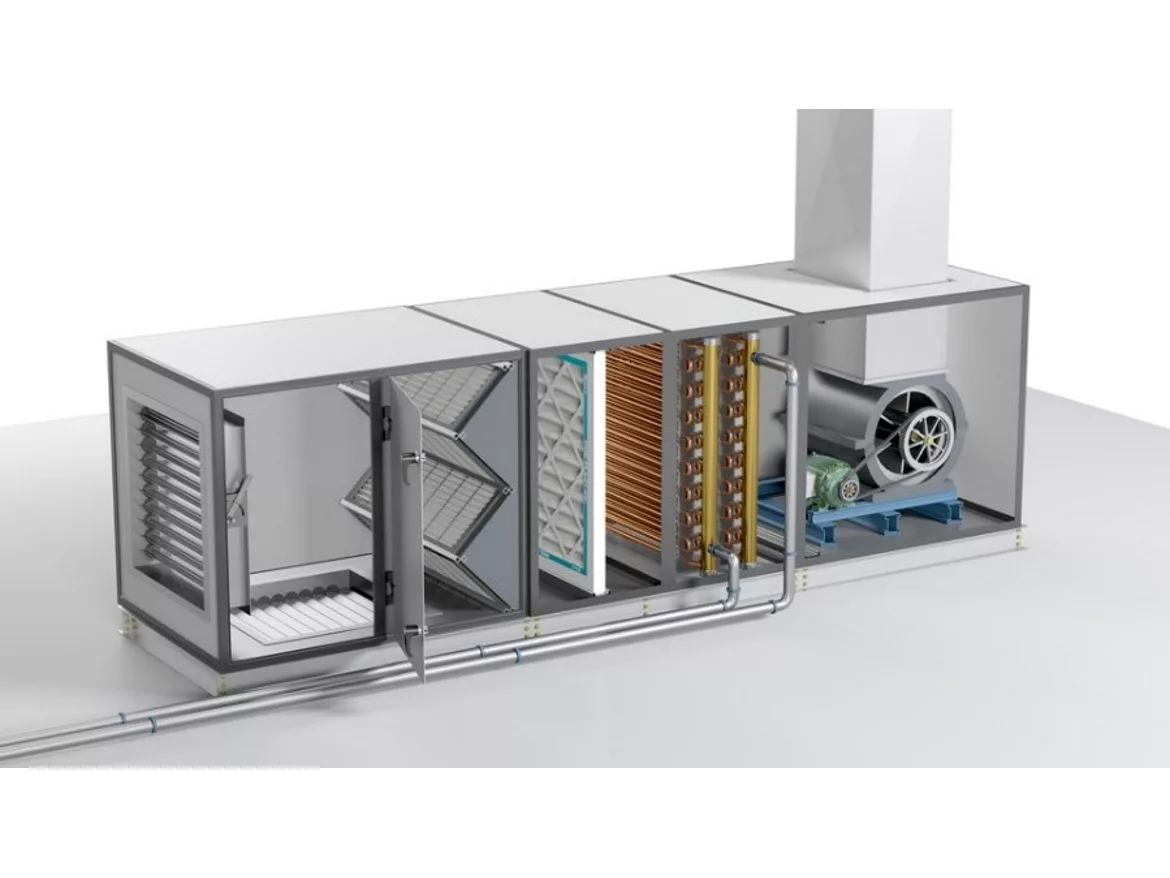
An air-handling unit with recovery or recirculation is always a complex organism that requires highly organized management. The air-handling unit hides behind its protective box such main components as:
- Two fans of different types that determine the performance of the installation according to the flow rate;
- A heat exchanger recuperator, which heats the supply air by transferring heat from the exhaust air;
- An electric heater, which heats the supply air to the required parameters in case of a lack of heat flow from the extract air;
- An air filter, which controls and cleans the outside air as well as treats the exhaust air in front of the recuperator (in order to protect the heat exchanger);
- Motorized air dampers can be installed in front of the air outlet ducts for additional air flow control and to close the duct when the equipment is turned off;
- Bypass dampers that direct airflow past the recuperator in the warm season, thereby not heating the supply air but supplying it directly to the room; and
- Recirculation chamber that provide a mixing of the removed air into the supply air ensuring the recirculation of the airflow.
In addition to the main components of the air-handling unit, it also includes a large number of small components, such as sensors, an automation system for control and protection, etc.
All constituent elements of the air-handling unit must be correctly integrated into the operating system of the unit and perform their functions to the proper extent. The task of controlling the operation of all components is solved by an automated process control system. The installation kit includes sensors that analyse their data. The control system adjusts the operation of the necessary elements. The control system allows to smoothly and competently fulfil the goals of the air-handling unit solving complex problems of interaction of all elements of the unit with each other.
In conclusion, the use of units with recuperation or recirculation in ventilation systems allows the system to use the energy of the exhaust air. This process makes it possible to reduce the energy costs related to heating the supply air and the cost to operate the ventilation system. The use of the heat of the exhaust air is a modern energy-saving technology. It allows contractors to approach the “smart home or building” model in which any available type of energy is used most efficiently and to its fullest.
Looking for a reprint of this article?
From high-res PDFs to custom plaques, order your copy today!