Can Building Air Filtration Protect Me from Getting COVID-19?
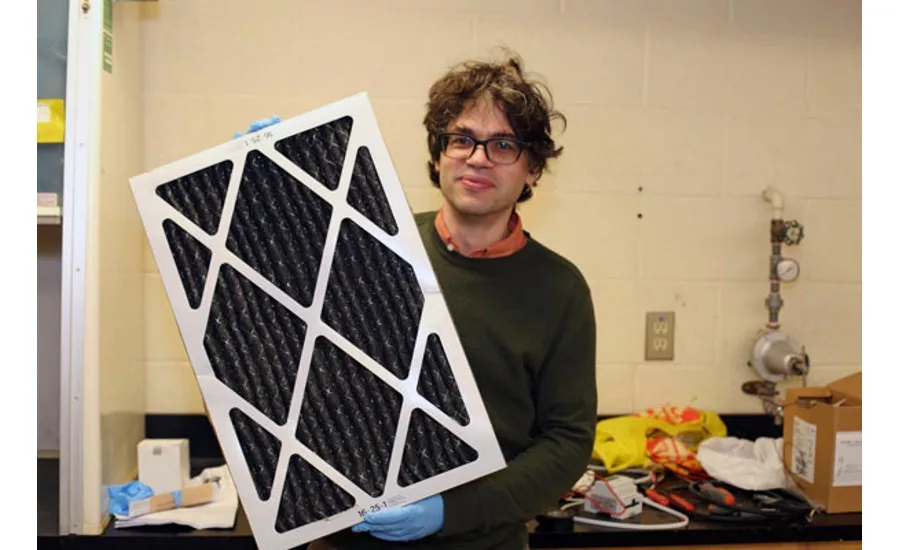
Many individuals are spending most of their time indoors as they practice self-isolation in a bid to reduce transmission of the virus that causes COVID-19. While social distancing and hand-washing are still the best ways to prevent the spread of the virus, some are raising questions about the role of indoor air-filtration systems and the efficacy of air filters in protecting from the virus.
“It is important for people to understand how air-filtration systems are supposed to work,” said Jeffrey Siegel, a professor in the department of civil and mineral engineering at the University of Toronto and an expert in indoor air quality. “Some may be frightened with the situation we are all facing right now, but the best way to protect ourselves, our families, and our communities is with evidence-based information.”
Can building air filtration protect me from getting COVID-19?
Filtration in building HVAC systems can be a part of an overall risk mitigation approach but is not generally regarded as solution by itself. There is no direct scientific evidence of benefit, but some reduced exposure can reasonably be inferred based on the ability of some filters to remove relevant-sized particles and droplets.
In order for air filters to have any impact on infectious disease transmission, transmission has to occur through the airborne route, filters have to be properly installed and maintained in appropriate systems to treat recirculated air, and filters have to be appropriately designed for the building in which they are used.
More importantly, in most buildings and situations, filters may not be as effective as other infection control measures, including social distancing, isolation of known cases, and hand-washing.
What filter should I use to protect those in my building from COVID-19?
There is no obvious answer to this question given unknowns about the nature of SARS-CoV-2 containing particles and droplets.
We do know that low efficiency filters (e.g., less than MERV 8 according to ASHRAE Standard 52.2 or less ePM1050% according to ISO 16890-1:2016) are very unlikely to make a difference.
Properly installed, higher efficiency filters can remove particles of a relevant size depending on their installed capture efficiency, but current information does not allow for specific recommendations.
Why shouldn’t I just use the highest-efficiency filter that I can find?
High-efficiency filters may be appropriate for your building, but they can also be counterproductive. A high-efficiency filter may have a high initial pressure drop and/or accumulate dust and particles very quickly, thus requiring frequent filter changes.
A high pressure drop filter (either because it is that way when it is new or because it is heavily loaded with dust) can also cause more air to bypass the filter if it is not properly installed and well-sealed. Depending on the design of your system, a high pressure drop filter can also diminish the amount of air supplied into the environment, making the filter less effective as well as causing other problems with other parts of the HVAC system.
Most importantly, in many residential and some light commercial systems, the fan in the system does not run very often, and the efficiency of the filter may not be as important as it could be.
I know that hospitals have good filtration. Why don’t we all just use systems like these?
Hospitals have specially designed mechanical systems that can accommodate the levels of filtration that they need. They often rely on other systems and control strategies (e.g., UV lamps, humidity control, and airflow management) to maximize the benefit from filtration. Most importantly, they have dedicated staff who operate and maintain this equipment so that it provides the most possible protection.
What about ultraviolet (UV) lamps? Do they work?
A properly designed and maintained UV system, often in concert with filtration, humidity control, and airflow management, has been shown to reduce infections from other viruses.
However, the details of the system are very important (e.g., design of fixtures, lamp type, lamp placement, airflow amount and mixing, etc.). Simply adding UV to an existing system without consideration of these factors has not been demonstrated to have a benefit.
What about ionizers, ozone generators, plasma, and other air cleaning technologies?
None of these technologies have been proven to reduce infection in real buildings, even if they have promise based on tests in a laboratory or other idealized settings. Some of them have substantial concerns about secondary issues (such as production of ozone, a respiratory irritant).
What about portable air cleaners?
Similar to building filtration, there is no direct clinical evidence of the benefit of portable air cleaners for reducing infectious disease risk, but some benefit can be reasonably inferred for portable HEPA filters, provided they are appropriately sized (i.e., their removal rate is appropriate for the size of the room), maintained, and operated. As with building filtration, the details are important, such as the efficiency and airflow rate of the air cleaner, sizing, and placement within the space, maintenance, and filter change, and the nature of space that is being cleaned. As with building filtration, they are only likely to be effective in concert with other measures.
Doesn’t filtration require that the droplets that cause COVID-19 be airborne? I have heard that it is spread through large droplets.
Most public health guidance suggests that COVID-19 transmission is predominantly associated with large droplets. This is why air filtration is only a small part of a solution, as it does not address transmission from surface contact or from close contact between individuals.
However, the distinction between droplet transmission and airborne transmission is due to particle size — if droplets are small enough, they can become airborne and even remain so for hours under the right conditions. Also, droplets change size based on a number of factors, including their composition and the relative humidity of the air around them: Low relative humidity will generally cause droplets and particles to become smaller. DNA and RNA from other viruses that are generally associated with droplets have been found on used air filters.
What precautions should I take when changing filters?
In general, it is wise to assume filters have active microbiological material on them. Whether this represents an important infectious disease risk from viruses is not known, but the precautionary principle would suggest that care should be taken.
This becomes particularly important in any building (including a home) where there are known or likely cases of any infectious disease, including COVID-19, and also extends to portable air cleaner filters and vehicle cabin air filters. Filters should be changed with the system turned off, while wearing gloves, with respiratory protection if available, outdoors if possible, and disposed of in a sealed bag.
Jeffrey Siegel is a professor in the Department of Civil & Mineral Engineering at the University of Toronto and an expert in indoor air quality. His research has looked at a wide variety of airborne particles and air cleaning approaches, however, he has not specialized in infectious diseases or viruses.
This information is meant to supplement data coming from global, national, and local health authorities and is specifically meant to address an issue that is not currently well-addressed. Professor Siegel is grateful for review and comments from several leading experts, including the following individuals. — their review does not imply endorsement by any individual or institution — William P. Bahnfleth, The Pennsylvania State University; Brent Stephens, Illinois Institute of Technology; Michael Corbat, Rensa Filtration; Paolo Tronville, Politecnico di Torino; Tom Justice, National Air Filtration Association; Pawel Wargocki, Technical University of Denmark;
Yuguo Li, The University of Hong Kong; Wei Ye, Tongji University; Shelly Miller, University of Colorado Boulder; andMarwa Zaatari, enVerid Systems.
This article originally appeared in the University of Toronto’s Engineering News. See the original post here: https://news.engineering.utoronto.ca/air-filtration-and-covid-19-indoor-air-quality-expert-explains-how-to-keep-you-and-your-building-safe/
Looking for a reprint of this article?
From high-res PDFs to custom plaques, order your copy today!