search
Ask ACHR NEWS AI
cart
facebook twitter instagram linkedin youtube
  • Sign In
  • Subscribe
  • Sign Out
  • My Account
  • NEWS
  • TECHNOLOGY
    • Heating & Boilers
    • Cooling & Chillers
    • Pumps & Flow Controls
  • SECTORS
    • Commercial
    • Health Care
    • Data Center
    • Educational Facilities
  • DESIGN | CONSTRUCTION
  • OTHER TOPICS
    • High-Performance Buildings & Automation
    • Ventilation and IAQ
    • Commissioning
    • HVAC Retrofits
  • TODAY’S BOILER
    • Today’s Boiler Archives
    • Today’s Boiler Digital Edition
  • MORE
    • Case Studies
    • Podcasts
    • Videos
    • Directory
    • Webinars
    • ES NEWS Store
    • White Papers
  • SIGN UP
  • Back to The NEWS
Engineered Systems NEWSVentilation and IAQ

Looking Inward to Guide Building Air Management in the Days of COVID-19
By Stephanie Taylor, M.D., M. Arch, CIC
IAQ
A brief snapshot of the sequence of air management steps in the human body.
July 30, 2020

As we move through summer and toward the winter heating season, infectious disease experts forecast a gloomy upward trend for COVID-19 cases.  

When the infectivity of SARS-CoV-2 became clear earlier this year, we were told to vacate our offices, schools, and fitness centers and stay at home. The clear message was that occupied indoor environments could hasten to the spread of the virus through one transmission route or another. As public buildings now tentatively open up, engineers and building managers suddenly find themselves adding “public health protectors” to their job descriptions and “testing and balancing” humans to their skill sets.  

The active debate about how to best manage IAQ to contain COVID-19 disease will only become more urgent when cold outdoor temperatures create a ventilation versus energy use debate. We need help combining outdoor air ventilation, recirculation and filtration, pressurization, humidification and air-cleaning technologies, and guidance on the optimal sequence of these HVAC interventions to create both safe and energy-efficient buildings.  

Where can we look for energy-efficient models of air handling to help protect building occupants from this new viral strain? The human respiratory system is a good place to start. The “design and operation” requirements of human respiration are exacting, because inhaled ambient air must be conditioned to meet exact parameters before it reaches our vulnerable lung tissues. Before this air reaches the lungs, it must be at body temperature; saturated to 100% relative humidity; and free of particles, harmful viruses, bacteria, fungal organisms, and dissolved compounds. The partial pressure differentials of oxygen and carbon dioxide between circulating blood and lung air sacs (alveoli) results in the proper delivery of oxygen to red blood cells and the removal of the waste gas (carbon dioxide). The load of air that must be conditioned perfectly, no matter the quality of ambient inhaled air, is huge. The average person breathes approximately 13 million cubic feet of air in their lifetimes at a rate of seven to 17 pint-sized breaths a minute. The daily requirements of 5,000 gallons of air are transported through an average of 15,000 miles of airway channels during inhalation and that distance again during exhalation. How do our bodies accomplish this amazing feat in an energy-efficient and effective way?  

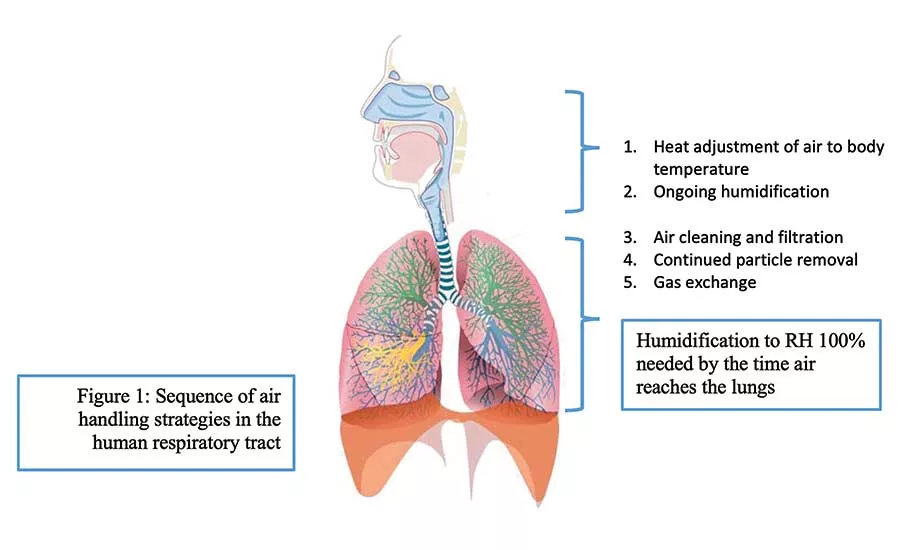
Our respiratory system uses the same strategies that are available to HVAC systems in carefully sequenced steps from inhalation to gas exchange in the lungs to exhalation. First, heat is added or removed to match the temperature of our body. Humidification begins immediately to optimize the subsequent air cleaning by sticky mucus in our noses, sinuses, and throats, which traps particles and microbes. Meanwhile, tiny hairs (cilia) wave upward, continually washing the trapped particles away from our lungs. Scavenger cells provided by our immune systems continue to clean the air and airways with antimicrobial chemicals. Water vapor is progressively added from surrounding tissues until the mandatory 100% saturation needed for gas exchange is achieved prior to inhaled air reaching deep lung regions. Upon exhalation, this water vapor evaporates into the ambient air. In buildings with low indoor relative humidity (< 40%), the respiratory tissues can lose more than 3.5 ounces per hour, leading to harmful drying of airway mucus and impaired immune protection. 

The sequence of events is important to notice and try to utilize in our HVAC designs because often one step optimizes the effectiveness of the next.  

As we debate about the relative benefits of outdoor ventilation, recirculation and filtration, humidification, UVGI, bi-polar ionization, and other technologies, we can turn to the mammalian respiratory tract for guidance. Clearly, this is a viable strategy, or we would not be here today.   

Share This Story

Looking for a reprint of this article?
From high-res PDFs to custom plaques, order your copy today!


Dr. Stephanie Taylor is the president and founder of Building4Health Inc. After working as a physician for many decades, Dr. Taylor obtained a Masters in Architecture as well as Infection Control certification. Her lifelong commitment to patient care includes focusing on improving the healthcare physical environment and clinical work processes to help patients heal quickly and save hospitals valuable dollars. Dr. Taylor is a graduate of Harvard Medical School (MD), and Norwich University (Masters Architecture). She has numerous research publications in Nature, Science, and other peer-reviewed journals. She can be contacted at stephanie@b4hinc.com or (860) 501-8950.

Recommended Content

JOIN TODAY
To unlock your recommendations.

Already have an account? Sign In

  • HVAC-enrollment

    The Trades Are Back: HVACR Programs See Nearly 30% Enrollment Spike

    A new wave of future technicians is entering the pipeline.  
    Training and Education
    By: Matt Jachman
  • 2025 Top 40 Under 40

    2025 Top 40 Under 40 HVACR Professionals List

    The 11th annual Top 40 Under 40 list highlights those...
    HVAC Contracting
    By: Hannah Belloli-Oster
  • LG Ductless Mini-Split Systems

    The 9 Types of Heat Pumps

    As the U.S. moves toward electrification, heat pumps are...
    Heat Pumps
    By: Joanna R. Turpin

More Videos

Today's Boiler

Spring 2026 Issue

Today's Boiler - Spring 2026 Cover

Read More from Today's Boiler

Case in Point Logo

Smarter Hydronic Design for Data Centers - Free Webinar - January 22, 2026

Related Articles

  • Commercial Air-Handling Unit

    Circulation of Conditioned Air in the Era of COVID-19

    See More
  • General Contractors

    Adapting Construction Practices to Protect Workers and the Public in the Age of COVID-19

    See More
  • Why HVAC Maintenance in the Time of COVID-19 is Important for Indoor Health.

    Why HVAC Maintenance in the Time of COVID-19 is Important for Indoor Health

    See More

Related Products

See More Products
  • quick guide.png

    Quick Guide to Refrig Cycle, Refrigerants, Components

  • EHEP002028.jpg

    Principles of Heating, Ventilation, and Air Conditioning in Buildings, 1st Edition

  • ac.png

    Air Conditioning Service Guide R-410A and R-22 Systems 2nd Edition

See More Products

Events

View AllSubmit An Event
  • October 30, 2025

    The HVAC Contractor’s Guide to AI-Driven SEO

    On Demand We will provide a clear, actionable roadmap for HVAC contractors to enhance their online visibility, dominate local search results, and adapt to the new era of AI-driven customer inquiries. Learn how to turn clicks into profitable calls and secure your position as the go-to HVAC provider in your area.
View AllSubmit An Event
×

Sign Up. Stay Informed.

The #1 trusted source for the HVACR industry since 1926

SUBSCRIBE
  • RESOURCES
    • Advertise
    • Contact Us
    • Advisory Board
    • Classifieds
    • Submit a Letter
    • Directories
    • Store
  • ACCOUNT CENTER
    • Create an Account
    • Start a Subscription
    • Manage My Account
    • Sign Up for Newsletters
    • Visit Customer Service
    • Update Preferences
  • SERVICES
    • Marketing Services
    • Reprints
    • Market Research
    • List Rental
    • Survey/Respondent Access
  • STAY CONNECTED
    • LinkedIn
    • Facebook
    • Instagram
    • YouTube
    • X (Twitter)
  • PRIVACY
    • PRIVACY POLICY
    • TERMS & CONDITIONS
    • DO NOT SELL MY PERSONAL INFORMATION
    • PRIVACY REQUEST
    • ACCESSIBILITY

Copyright ©2026. All Rights Reserved BNP Media, Inc. and BNP Media II, LLC.

Design, CMS, Hosting & Web Development :: ePublishing