Adapting Construction Practices to Protect Workers and the Public in the Age of COVID-19
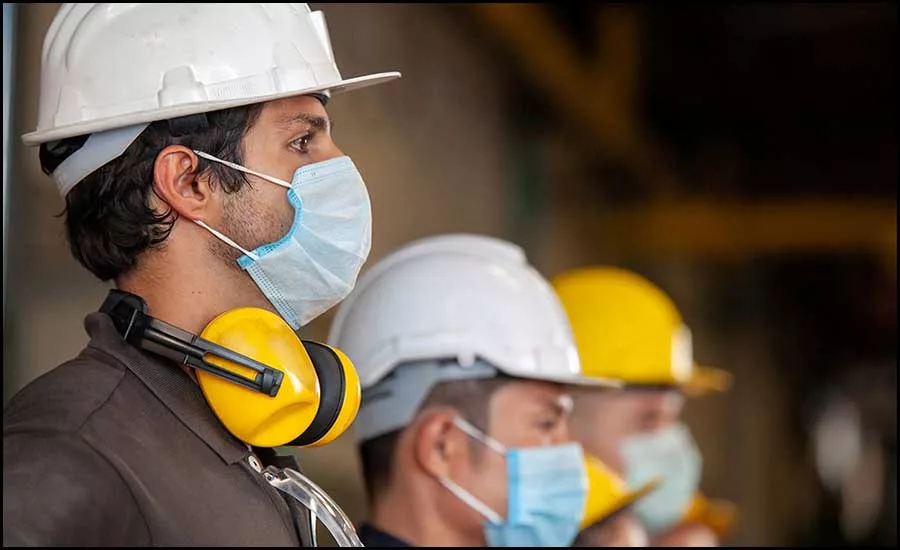
The response from general contractors varied greatly from region to region, and we had to adapt to the shifting terrain.
The COVID-19 pandemic shutdowns and restrictions impacted dozens of major sectors in the U.S. economy this year — airlines, restaurants, entertainment venues, schools, and most retail businesses. The construction industry took its own hits with projects coming to a screeching halt for months before they could slowly begin implementing safe procedures to get back to the work site. The stalled projects meant lost revenues and wages in the short term but the added costs of implementing strict protocols (up to $30,000 a month for our organization) will continue to impact construction schedules and budgets for some time.
Preservation of affordable housing had multiple developments and renovations in progress when the pandemic hit and we’ve had to adjust how we do construction projects to make sure our contractors, staff, and residents remain safe. This meant coordinating processes with a range of contractors across multiple states and dealing with a patchwork of local compliance orders in a staggered sequence.
States Reacted on Different Timelines
The shutdown orders came down earlier on the east coast than in the Midwest — two geographies where we had major projects — and we didn’t know if, and when, they would happen at all in Florida, where we were also planning new housing. But the Preservation of Affordable Housing (POAH) development team knew it had to have a plan to deal with all the potential scenarios. Even before the orders were issued, POAH began internal discussions on how we would address work delays or new protocols to protect management staff, the families and seniors who live in our communities, and on-site construction workers. Our top priorities were:
- Protect people: workers, residents, and staff;
- Manage the evolving circumstances around the pandemic;
- Negotiate with partners to establish expectations;
- Communicate/mitigate concerns; and
- Keep the projects moving.
The Protocols
COVID-19 site protocols for new construction and renovations were generally the same and included:
- PPE (personal protective equipment);
- Cleaning (disinfectant);
- Screening (residents, workers, consultants);
- Separation of work areas;
- Elevator limitations;
- Virtual job meetings; and
- Virtual inspections.
The first step was to get ahold of the multiple state shutdown orders and guidelines that were issued from different municipalities and understanding how they would affect construction. Boston came down with more conservative rules and regulations, shutting down construction completely, while Chicago shut down some businesses but didn’t include construction projects, and Florida was not putting any restrictions in place.
We were nearing the end of construction on our resident-occupied renovation project in Chicago (Johnson Butler-Lindon Apartments) with only 14 units and some common areas left to renovate. Even though the construction was exempt from the shutdown order, POAH decided to stop work anyway in order to put in place the new protocols.
The team had developed baseline COVID-19 safety measures that we felt would keep the workers, residents, and staff safe for the duration of the renovation. The process of shutting down, establishing and reviewing guidelines, and issuing them to the general contractor took about two weeks, but it was time well spent and just the start of what was to come.
In Boston, there were two projects underway, one in a suburb 14 miles from Boston (Bedford/447) and one in the heart of the city (Flat Nine at Whittier Phase I). With little work remaining, POAH was up against the calendar to complete Bedford to avoid financial repercussions, but the contractor stood firm that no worker would enter any occupied unit unless it had been vacant for 14 days.
Working collaboratively with the contractor, POAH hired DKI Services consultant to create a solution — a containment process through which negative pressure was created by installing fans to exhaust the air in targeted spaces to the exterior. This “negative pressure with fogging” mists a space with cleaning materials that spread on all surfaces, creating an isolated path from the front door to the work area through which a worker could proceed in a bubble of filtered air/purified air.
The project was back on track.
Our other Massachusetts project, Flat Nine at Whittier, was fortunately at the punch list stage. Those items as well as the spring landscape work could stay on hold until the city of Boston allowed construction to start again with a submitted COVID-19 plan inspectional services.
General Contractor Responses Varied
The response from general contractors varied greatly from region to region, and we had to adapt to the shifting terrain. But all of them stepped up to the plate and took the challenge of ensuring safety seriously.
POAH’s contractor in Massachusetts also works on our projects in Florida, and they were able to implement the protocols down the East Coast. Another Massachusetts contractor had more stringent protocols than the towns were enforcing, so we had to adapt to their procedures and yet another created a robust plan that they allowed us to share with nonprofit developers in the Washington, D.C./Virginia/Maryland area.
Our contractor in Michigan is nationwide and had many unique ideas to deal with the construction challenges, switching crew times and work hours to name a few and another national company had a boiler plate protocol they were able to quickly implement into our demolition work in Washington, D.C.
In Chicago, a well-established contractor provided a sophisticated and detailed Covid-19 plan, including a flow chart diagram showing a response and action plan for responding to cases in the field and individual safety protocols.
In addition to establishing the site protocols, POAH has had to rewrite contract language that, again, varies from contractor to contractor based on their comfort level with risk and liability. In Chicago, the contractor added minimal language only reserving the right to ask for schedule extensions if there are COVID-19-related shutdowns and providing for compensation for the extensions. On the other end, another general contractor was more adamant about adding protections to cover material supply issues, labor shortages, and the like.
The situation gets more complicated when lenders want input into contract language that can be very difficult to mitigate timely. And as a sign of just how complicated this pandemic has made our lives, it became nearly impossible to put a dollar value on potential risk for which no one had any frame of reference. Big allowances were created and allocated usage of contingency was agreed to as well as shared costs between POAH and the general contractor if other funds get exhausted.
Apart from the vendor relationship, occupied buildings present the vexing concern of having residents in place while construction is happening around them. In those instances, additional separations between residents and contractors may be added, more hospitality suites may be needed for residents to maintain safe distances, additional cleaning may be required in units and common areas, and screening of both residents and contractors may be necessary. All told, the potential impact of additional COVID-19 measure in new construction can be anywhere from $25,000-$30,000 a month and $700-$2,000 per day for renovation projects, but affordable housing developers, like us, as well as others must be prepared to make this commitment to ensure the safety of workers and the public at large.
The lessons we learned these past six months:
- Be prepared to respond to the situation as it evolves based on conditions region by region;
- Communication with partners is key to controlling cost and liability; and
- Prepare for labor shortages, supply chain impacts, and new shutdowns as a second wave of the virus is predicted.
And on that last point, health experts predict a continuing, if not worsening, health crisis lasting a year or more, so it will be necessary to adapt these procedures, look for more ways to ensure worker and residents’ safety, and create new strategies. Builders and developers can learn much from each other, and POAH is committed to continuing to provide our insights and experience with other industry leaders as we all look to do business in a responsible and conscientious manner.
Looking for a reprint of this article?
From high-res PDFs to custom plaques, order your copy today!