Radiant Design: The Future of School Classrooms
Exploring the benefits of a radiant heated and cooled slab with a low energy/low pressure drop DOAS ventilation system.
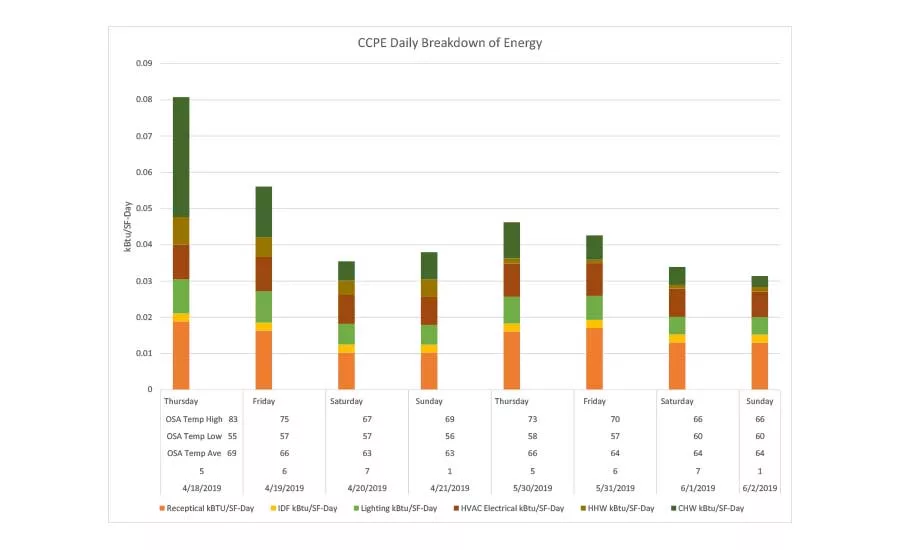
FIGURE 1. A daily breakdown of the facility’s energy use.
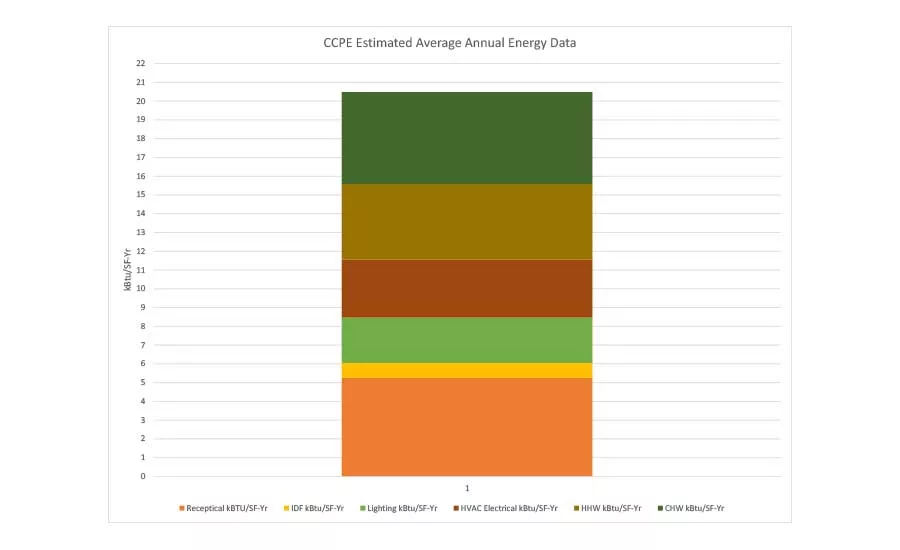
FIGURE 2. Estimated annual consumption.
In my May 2016 article, “The Radiant Roads to School Design,” I was in the middle of designing a building with a radiant heated and cooled slab with DOAS/openable windows for ventilation for the College of Continuing and Professional Education (CCPE) at CSU Long Beach (CSULB). I suggested that this direction would be better for a learning environment, but, at the time, I didn’t have any actual feedback from students or faculty in the building as to whether the system performed as expected.
In researching for this article, I found many references that link student performance to sound, comfort, and indoor air quality. Here is an excerpt from a Penn State University article, “The Importance of School Facilities in Improving Student Outcomes,” from the Center for Evaluation and Education Policy Analysis, College of Education:
“A growing body of research has found that school facilities can have a profound impact on both teacher and student outcomes. With respect to teachers, school facilities affect teacher recruitment, retention, commitment, and effort. With respect to students, school facilities affect health, behavior, engagement, learning, and growth in achievement. Thus, researchers generally conclude that without adequate facilities and resources, it’s extremely difficult to serve large numbers of children with complex needs.
“According to the U.S. General Accounting Office (GAO), almost three-fourths of existing U.S. schools in 1996 were constructed before 1970. Of these schools, about one-third of them needed extensive repair or replacement and almost two-thirds had at least one inadequate building feature, such as substandard plumbing, roofing, or electrical systems. Moreover, 58% had at least one unsatisfactory environmental condition, such as inadequate ventilation, acoustics, or physical security.”
Now that the building is constructed and has been occupied for almost a year, I will say this should be the future of classrooms. In personally reviewing the built environment of the CSULB CCPE building, the spaces are quiet, comfortable, and fresh feeling. Feedback from students and faculty is that the facilities are the best spaces to teach and learn on campus. One of the students stated that the space is so quiet they can hear other student’s conversations that normally would not be heard.
The Systems in CCPE
CCPE is designed to be a 35,000-square-foot net-zero classroom building. The main source for heating and cooling of the classrooms is the radiant slab that is heated and cooled from the campus central plant providing chilled and heating hot water through a CHW and HHW heat exchanger that protects the piping and tempers the water to an acceptable level for the slab (mid 50°F to room temp for cooling, and mid 90° to room temperature for heating).
When conditions are right, there are manual and manual-electrically actuated windows for ventilation. Only the first-story windows for the conference center are automatically controlled. The manual windows are operated by the user though a red-light-green-light system — when the conditions are favorable, the light turns green to indicate to the occupant to open the windows. At that point the ventilation system for that zone would close. If CO2 in the space is above 900 ppm, it will be assumed that the windows are closed so the zone ventilation would open and restart the ventilation flow.
The mechanical ventilation system consists of 100% OSA AHUs (DOAS) — one for the first floor, which serves a multipurpose conference area, and a second unit that serves the classrooms on the second and third floor. The distribution system was designed with very low pressure drop. The VAV boxes were constructed from low-pressure, airfoil-opposed blade dampers with a hot wire anemometer for flow measurement. The ductwork did not reduce in size for airflow monitoring with a standard pitot tube arrangement, but, instead, all the ductwork was sized based on the maximum of 1,000 fpm or 0.08 inch w.c./100 foot loss. Both systems’ design external static was 0.7 inch w.c. at the AHU, but the max in testing the required differential pressure was only 0.5 inch w.c. at design conditions. The mechanical ventilation system was also designed to provide supplemental heating or cooling, if it’s ever needed. None of the zones have reheat coils, but the supply air temperature can be reset.
The most energy-intensive HVAC system in the building is the chilled water fan coils that serve the IDF rooms. The two-pipe ECM variable flow fan coils usually consume more energy than the two DOAS units that serve the ventilation for the building.
Energy Consumption
Even though the building has been operational for almost a year, unfortunately the data collection still has issues to this date. It may be archiving, but we do not have access yet.
We can access the chilled and heating hot water data from today to mid-January of this year, but for electrical data, we only can go back four days. This year, California has been experiencing unusually cooler temps with only mildly warmer days.
Based on the data we do have, the building has an energy use index (EIU) of 20 kBtu/square foot for the energy use at the site with no multipliers for the central plant or source.
See Figures 1 and 2 for more detailed energy use information.
Lessons Learned
First and foremost, prior to selecting actuators for automated windows, one must hear them in operation. The ones selected for the project were a noisy distraction when automated, which resulted in an operational decision to actuate only every 45 minutes if the position was required to change on the first floor and if the supplied air volume has increased or decreased.
The second lesson learned: Regardless of whether there is a budget for automating windows, find money to automate the windows. Do not rely on a red-light-green-light system and human intervention to operate windows. Windows have been open during unfavorable heating and cooling periods, when the temperatures are hot and humid or very cold allowing the heat to escape. This occurs even with training and reminders.
The third lesson learned: What is good for a data center (hot and cold isle containment) is also good for a telecom inter distribution frame (IDF) in cooling fan energy. Most of the time the IDF is operating, the fan energy of the fan coils is greater than the fan energy of the DOAS units serving the OSA to the building. The reason for this is the hot air from the telecom equipment and the cold air from the fan coil mix, which causes the system to run longer to cool and satisfy maintaining the load, more of an on/off function at near full-load operation. By directing all the hot air to the return of the fan coil and the supply air to the space, the discharge temperature could be a higher temperature while also supplying the flow at lessor rate while maintaining the load. Over time the electrical load as metered doesn’t change while the cooling load is fluctuating — much like operating a fan coil in a meeting room based on the thermostat instead of resetting the supply air temperature based on the offset of the room temperature to the set point temperature.
The fourth lesson learned is to stay on top of the progress of trending setups and validate the energy reporting systems.
Conclusion
Based on the life of a K-12 school or a college classroom building, a radiant heated and cooled slab with a low energy/low pressure drop DOAS ventilation system is the only way to go. It provides a comfortable learning environment for students that is very quiet. The system could also last 40 years or more with minor replacement of equipment and provides low-energy use for the lifetime of the project, both enhancing owner savings.
Looking for a reprint of this article?
From high-res PDFs to custom plaques, order your copy today!