search
Ask ACHR NEWS AI
cart
facebook twitter instagram linkedin youtube
  • Sign In
  • Subscribe
  • Sign Out
  • My Account
  • NEWS
  • TECHNOLOGY
    • Heating & Boilers
    • Cooling & Chillers
    • Pumps & Flow Controls
  • SECTORS
    • Commercial
    • Health Care
    • Data Center
    • Educational Facilities
  • DESIGN | CONSTRUCTION
  • OTHER TOPICS
    • High-Performance Buildings & Automation
    • Ventilation and IAQ
    • Commissioning
    • HVAC Retrofits
  • TODAY’S BOILER
    • Today’s Boiler Archives
    • Today’s Boiler Digital Edition
  • MORE
    • Case Studies
    • Podcasts
    • Videos
    • Directory
    • Webinars
    • ES NEWS Store
    • White Papers
  • SIGN UP
  • Back to The NEWS
Engineered Systems NEWSHVAC Engineering SectorsVentilation and IAQHealth Care HVAC

Using Mnemonics to Eliminate Incorrect Assumptions

Don’t overthink a cost-effective HVAC diagnosis.
By Stephanie Taylor, M.D., M. Arch, CIC
Using Mnemonics to Eliminate Incorrect Assumptions
April 10, 2019

When a building is found to be consuming excess energy, the next step is usually an energy audit followed by retro-commissioning of the HVAC system. If available, an infrared scan of the building exterior might follow. Perhaps these steps will quickly pinpoint the problem. While these tools are great to have, consulting engineers should not forget that their experience and thought processes are the most valuable tools for accurately diagnosing and fixing the problem.

When you are called by the building owner or manager to figure out the source of the energy “leak,” how can you ensure your differential diagnosis will be complete and your final report accurate? While it might be easy to rely on building information systems to identify the problem, what will you do if this technology is not present or functional? Even when automated systems are in place, valuable time and dollars can be wasted on non-specific tests that may not be necessary. Instead of taking a rote approach, you can use complete yet flexible thinking to rapidly diagnose and correct the problem.

Front-line physicians and other clinicians are faced with this same challenge when they are required to accurately diagnose patients prior to treatment. A misdiagnosis could mean lost time and incorrect treatment for the patient as well as wasted clinical resources and possibly a human life. The clinician who starts with a broad differential diagnosis to ensure that unusual illnesses are not missed and yet maintains a cost-effective path to reach their final, accurate diagnosis is an invaluable colleague. Too many clinicians evaluate a sick patient by simply ordering a barrage of blood tests and imaging studies rather than performing a careful physical exam and thinking deeply about possible causes for signs and symptoms. While this approach may seem protective for the clinician in our litigious era, it can be inaccurate and is unnecessarily expensive.

An excellent emergency medicine physician who has saved many patient lives by using his agile thinking recently told me about a mental framework he uses when evaluating a new patient. This approach helps him think comprehensively, examine the patient proactively, and order only tests that are truly necessary. 

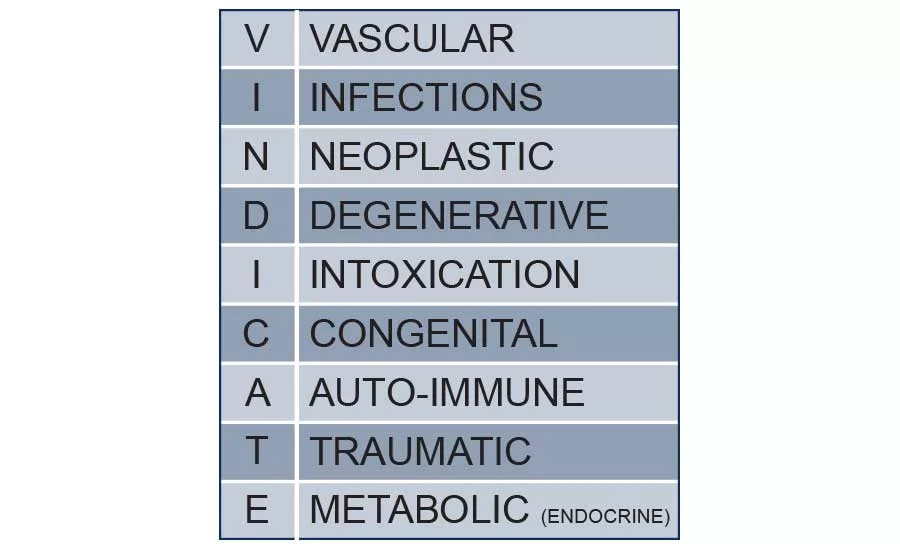
This strategy, familiar to medical students from memorizing excruciatingly long lists of cranial nerves, arterial branches, wrist bones, and more, is not a step-by-step guide about what to do; rather, it’s a guide for targeted evaluations. The not-so-secret secret is to use a mnemonic that will remind you to consider all the categories of possible defects and then to actively search for evidence that allows you to narrow your list. While this approach might sound overly simplistic, it does effectively prevent one from thinking narrowly and making incorrect assumptions.

For example, the ED doc referenced uses the word VINDICATE to remind him to think about all the organ systems, not just the obvious ones, which might be causing the problem his patient is experiencing. 

What mnemonic do you use when considering HVAC malfunctions or end-user mistakes that might be causing the energy losses you were called on to diagnose and treat?

Share This Story

Looking for a reprint of this article?
From high-res PDFs to custom plaques, order your copy today!


Dr. Stephanie Taylor is the president and founder of Building4Health Inc. After working as a physician for many decades, Dr. Taylor obtained a Masters in Architecture as well as Infection Control certification. Her lifelong commitment to patient care includes focusing on improving the healthcare physical environment and clinical work processes to help patients heal quickly and save hospitals valuable dollars. Dr. Taylor is a graduate of Harvard Medical School (MD), and Norwich University (Masters Architecture). She has numerous research publications in Nature, Science, and other peer-reviewed journals. She can be contacted at stephanie@b4hinc.com or (860) 501-8950.

Recommended Content

JOIN TODAY
To unlock your recommendations.

Already have an account? Sign In

  • HVAC-enrollment

    The Trades Are Back: HVACR Programs See Nearly 30% Enrollment Spike

    A new wave of future technicians is entering the pipeline.  
    News
    By: Matt Jachman
  • 2025 Top 40 Under 40

    2025 Top 40 Under 40 HVACR Professionals List

    The 11th annual Top 40 Under 40 list highlights those...
    HVAC Contracting
    By: Hannah Belloli-Oster
  • LG Ductless Mini-Split Systems

    The 9 Types of Heat Pumps

    As the U.S. moves toward electrification, heat pumps are...
    HVAC Residential Market
    By: Joanna R. Turpin

More Videos

Today's Boiler

Spring 2026 Issue

Today's Boiler - Spring 2026 Cover

Read More from Today's Boiler

Case in Point Logo

Smarter Hydronic Design for Data Centers - Free Webinar - January 22, 2026

Related Articles

  • A Physical View IAQ

    Using the Indoor Environment to Contain the Coronavirus

    See More
  • A Physical View IAQ

    All Bacteria, Viruses, and Fungi Are not Detrimental to the Indoor Environment

    See More
  • A Physical View IAQ

    The Key to HVAC Design: Just Follow Your Nose

    See More

Related Products

See More Products
  • Using Schematic Diagrams to Troubleshoot HVAC/R Electrical Circuits

  • drafting.gif

    Sheet Metal Drafting Using Solidworks, 1/e

  • Uncomplicating The Heat Pump: Refrigeration & Air Flow Systems DVD

See More Products

Related Directories

  • Alliance to Save Energy

    Coalition of business, government, environmental, consumer leaders promoting the efficient and clean use of energy worldwide to benefit consumers, the environment, the economy, national security.
  • A to Z Sales & Marketing

    We strive to revolutionize indoor living through innovative solutions that improve air quality, enhance comfort, and promote sustainable living for people around the world.
  • North American Sustainable Refrigeration Council

    An action-oriented environmental nonprofit working with the grocery refrigeration industry to eliminate barriers to natural refrigerants and enable their widespread adoption across U.S. grocery stores.
×

Sign Up. Stay Informed.

The #1 trusted source for the HVACR industry since 1926

SUBSCRIBE
  • RESOURCES
    • Advertise
    • Contact Us
    • Advisory Board
    • Classifieds
    • Submit a Letter
    • Directories
    • Store
  • ACCOUNT CENTER
    • Create an Account
    • Start a Subscription
    • Manage My Account
    • Sign Up for Newsletters
    • Visit Customer Service
    • Update Preferences
  • SERVICES
    • Marketing Services
    • Reprints
    • Market Research
    • List Rental
    • Survey/Respondent Access
  • STAY CONNECTED
    • LinkedIn
    • Facebook
    • Instagram
    • YouTube
    • X (Twitter)
  • PRIVACY
    • PRIVACY POLICY
    • TERMS & CONDITIONS
    • DO NOT SELL MY PERSONAL INFORMATION
    • PRIVACY REQUEST
    • ACCESSIBILITY

Copyright ©2026. All Rights Reserved BNP Media, Inc. and BNP Media II, LLC.

Design, CMS, Hosting & Web Development :: ePublishing