Relative Humidity's Role in Occupant Comfort, Health
Building materials can help manage IAQ
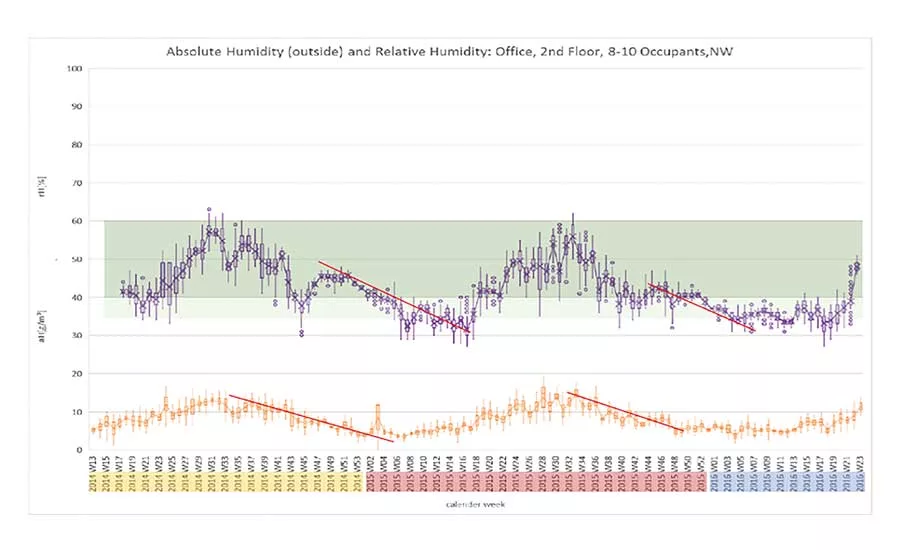
FIGURE 1. Relative indoor humidity (violet) and absolute exterior humidity (orange) displayed over 26 months. For the majority of winter months, rh ranged between 35 and 60 percent.
In modern construction, architects and engineers tend to design the building structure and mechanical systems independently. While a passive structure creates the outside facade and interior spaces, while energy-powered mechanical systems are primarily responsible for IAQ. Designers of vernacular architecture have known for centuries that this separation can be bridged if we let building materials join mechanical systems in creating healthy IAQ.
One unintended consequence of conven-tional mechanical heating is dry indoor air, especially pronounced in the heating season in cold climates. Without clear and universal-ly applied strategies for providing healthy lev-els of indoor water vapor, or relative humidity (rh), we have now created health and infec-tious disease problems from “Dry Building Syndrome” (DBS).
Discussing indoor water vapor can feel like saying the W-word, because so many build-ing problems have been incorrectly linked to even moderate indoor rh levels. Some examples of this are mold growth, legionella, odors, and overall “sick building syndrome.” Most of these problems are from water in the liquid state and not from water in the gas state. When water vapor condenses to the liquid phase in unintended building spaces, the problem is a lack of proper insulation or envelope design. Lowering indoor rh to try to prevent water in interstitial spaces is not only ineffective, it is dangerous to living building occupants, such as humans.
We have overlooked the health detriments of dry indoor air for several reasons. First, humans do not have skin sensors for dry-ness, so we are unaware of the immediate consequences of low rh. Second, the health problems that are associated with dry air occur from hours to days after our exposure, so it’s difficult to link the exposure and consequence without prolonged data collection. Third, building professionals worry that maintain-ing rh in the healthy zone of 40-60 percent will increase energy consumption and require hours of labor for cleaning humidifiers.
Thankfully, there are now both low energy and hygienic adiabatic humidification systems avail-able. In addition to these very effective systems, there are hygroscopic brick and other bitumi-nous building materials often found in ver-nacular designs that passively modulate indoor rh. These structural materials draw water vapor molecules into their microscopic pores when indoor rh rises and subsequently release the molecules when the ambient rh falls.
Mike Scofield, P.E., in California is well aware of the role of building materials in IAQ. In his words: “Night-time building temperatures are allowed to drop to 60ºF or lower at night or over weekends to save heating energy. What is often forgotten is that during extreme dry ambient conditions at night, moisture migrates out of the building, and the indoor room relative humidity is often below 20 percent during the morning warm-up control sequence.”
He also explains that this moisture may be restored during the morning warm-up cycle with either intentionally added rigid media in adiabatic humidifiers or in hygroscopic mate-rials in building materials. These materials store water molecules in the vapor state when humidity rises and releases the molecules when the indoor rh falls. Thus, the indoor humidity may be maintained at a much more stable level during occupancy with no external fuel consumption. When workers or students arrive, the building environment is much more healthy and comfortable with room conditions between 70º-75ºF and rela-tive humidity’s between 40-50 percent rh.
There is more good news about the struc-tural materials. Because the microscopic sizes of their pores are much smaller than micro-bial cells, repulsive surface-bacteria charges are created that impair attachment of any microbes. These forces prevent biofilm adhesion (the first step in mold growth) and therefore biofilm growth.
Let’s look at an example of IAQ in a building envelope that com-bines high moisture storage capacity structural walls with porous plaster interior coverings, allowing heat and water transfer between the interior air and wall. In this building, the central station AHU was programed to start at 6 a.m. to pre-heat the building by warming recirculated air until the return air reached 70º-75º, which is consid-ered suitable for occupancy.
Clearly, water vapor at the molecular level can be provided indoors through low energy and hygienic strategies. Maintaining indoor rh between 40-60 percent will improve occupant health through pre-venting dangerous consequences of DBS.
Looking for a reprint of this article?
From high-res PDFs to custom plaques, order your copy today!