Health Care Compliance For Life Safety And Related Systems
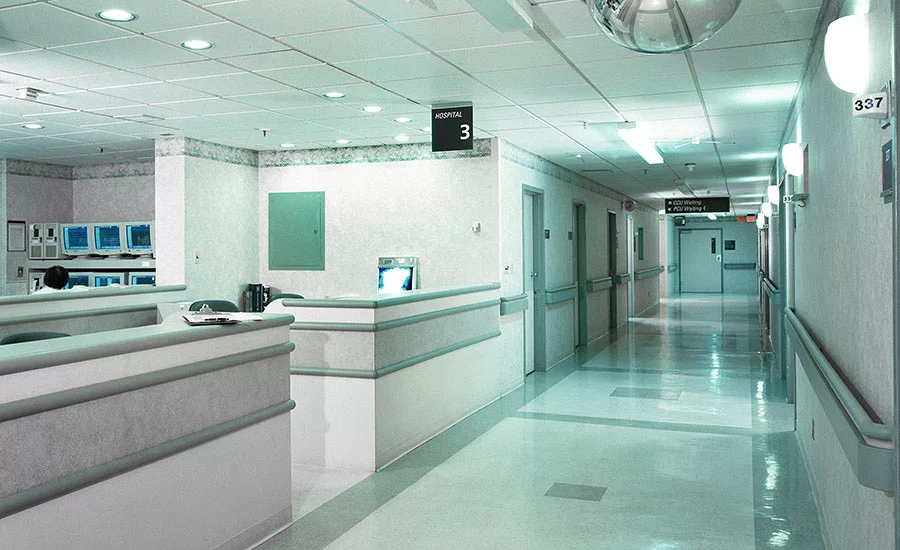
The health care environment is one of the most heavily regulated and technically challenging for project systems designers. Hospitals are the primary care provider for the critically ill. Life safety approach and systems are unique to the health care setting. Major governing agencies include the local Building and Fire Departments, state health care licensing, and Center for Medicare and Medicaid Services (CMS). CMS compliance may be evaluated by The Joint Commission, Det Norske Veritas (DNV), or other deemed status organizations. Here, we’ll look at concepts for life safety systems and compliance with the various regulatory requirements.
Evolution of Causes and Codes
Health care trends over the past 30 years have affected life safety systems and approaches. The goal from the currently applicable NFPA 101-2000 edition is to protect the persons not intimate with the fire. This goal has been consistent over the past 30 years, and it is reflected in current editions of NFPA 101. Hospitals have trended towards more single-patient rooms, and the patient population over the past 30 years has trended towards more acute care. Keeping highly mobile patients in hospitals is rare today.
In addition, fire ignition risk has changed drastically over the past 30 years. Comparison of the fire ignition sources between fire data collected from 1981 to 1986 and data from 2006 to 2010 show a major shift in ignition sources in hospital fires. Smoking and smoking materials were cited as causes in 30.6% of the reported fires in the 1981 to 1986 data. Smoking and smoking materials dropped to 7% of reported fires in a later study. This shift can be attributed to smoking policies being established. Cooking equipment caused 58% of reported fires in the 2006 to 2010 data. This is the leading cause of fires in the current data.
Another life safety trend has been increased use of automatic sprinklers in hospitals. In 47% of the fires in hospitals from 1980 to 1984, automatic sprinklers were present. This increased to 64% in the 2006 to 2010 data. The number of reported hospital fires and value of the fire damage has also been reduced over the past 30 years.
Codes and reference standards in health care have been updated continuously over the past 30 years. For example, automatic sprinkler protection for all new construction was a major mandate that occurred in the early 1990s. CMS is considering an update to the 2012 edition of NFPA 101 with updated reference standards. The 2012 edition of NFPA 101 would apply to new and existing construction. There is also a new 2015 edition of the International Building Code that has updated health care requirements to more closely align with NFPA 101 criteria for new construction and rehabilitation.
Managing smoke zones
While the fire record has improved over the past 30 years, the fire safety challenge remains. Due to the lack of mobility of many patients, health care life safety code compliance has adopted the Defend in Place approach. It was recently defined in NFPA 99 – Health Care Facilities Code as:
“Section 3.3.33* Defend in Place. The operational response to an emergency in a building, in which the initial action does not involve evacuation of the building occupants.”
Defend in place life safety approach depends on compartmentation, staff response, fire alarm, and fire suppression. Patients are considered incapable of self-preservation. In most cases, the patient is considered not mobile or requiring a wheelchair, gurney, or other method of transport. These methods of moving patients will facilitate horizontal movement of patients away from the compartment of fire origin. However, movement of patients vertically by manual means is very difficult and requires significant manpower to move and, where needed, sustain a patient.
Corridor walls are considered the first compartment barrier for protecting the patients not intimate with the fire, or those not located in the room of origin. In non-sprinkler protected hospitals, the corridor wall requires a one-hour fire resistive rating with a 20-minute or equivalent door. In sprinkler protected facilities, the wall is not rated. The local Authority Having Jurisdiction (AHJ) may have additional criteria for this wall to have one or both sides of the corridor gypsum board to extend to the underside of the floor above. Requirements for fire and smoke dampers will also be a local AHJ criterion. Corridor doors are not required to have a self-closer or automatic closing device. Staff is trained to close the corridor doors as one of the first responses to a fire alarm.
The next compartment barrier considered for defend in place is the smoke barrier wall. For new construction, this wall is one-hour fire resistive rated with 20-minute or equivalent doors with vision panels. Cross-corridor doors must be opposite swing, and must be self-closing or automatic closing. They are not required to latch. The smoke barrier wall must extend from outside wall to outside wall, smoke barrier to smoke barrier, and floor slab to underside of floor slab above. All other openings must be protected. HVAC duct openings in fully ducted systems in buildings with quick response automatic sprinklers may omit the smoke dampers in the smoke barrier, depending on the local AHJ and the local adopted codes. Editions of IBC prior to 2015 had limited allowances for omission of smoke dampers. Since most jurisdictions have yet to adopt the 2015 IBC, check with the local AHJ for smoke damper requirements in hospital smoke barriers.
The smoke barrier creates a smoke zone. Smoke zones have limits to the area and maximum travel distance. Currently, smoke zones cannot exceed 22,500 sq ft. The travel distance from any point in the smoke zone to smoke zone barrier doors is 200 ft. This provides staff with options if a fire continues to endanger patients, guests, and staff in the area of fire origin. Movement horizontally to an adjacent smoke zone is a key element of the defend in place concept. Therefore, the proper design and construction of the smoke barrier is critical to the defend in place concept.
Protection of hazardous areas is required to limit the exposure within a smoke zone to potential fire exposures. Both NFPA 101 and IBC list areas considered a higher hazard than general health care areas. Based on the type of hazard either a one-hour separation with 45-min self-closing doors, or one-hour separation with 45-min automatic closing doors, or automatic sprinkler protection is required. In higher hazard areas, both separation and automatic sprinkler protection are required. Local AHJ may require fire dampers on HVAC duct penetrations or higher fire resistive ratings based on their local criteria.
Training and System Integration
Staff training is also a critical element of the defend in place approach. The hospital staff training addresses fire, weather, health, security, and other emergencies as determined by the hospital operator. Communicating with the staff during an emergency is key. The fire alarm system is the primary method of communication for fire emergencies. While a voice communication system is not required in non-high-rise buildings, voice communication will provide information needed to aid the staff in a quick and accurate response to a fire alarm.
Zone delineation for the input devices such as smoke detectors or heat detectors is relatively easy with a fully addressable fire alarm system. Each device can be programmed with a unique response. Water flow devices, however, will require coordination with the automatic sprinkler design. If automatic sprinkler zones correspond to the smoke barrier zones, the water flow switch will correctly identify the smoke compartment of water flow origin. If the automatic sprinkler system does not correspond to the smoke barrier zones, multiple smoke barriers must receive the fire alarm message and determine the area of fire origin independent of the fire alarm system. Each facility will have emergency action responses predetermined based on the unique configuration of the building and automatic sprinkler system. Non-voice systems can use a coded alarm tone to alert the staff to the area of alarm origin. These codes are posted or listed for easy access by the staff.
Fire alarm output for voice alarm signaling should be zoned by smoke barrier zone. This will allow proper notification messages to be sent to the zone of fire origin and a different message sent to the adjacent zones. The adjacent zones should be notified of the fire emergency so they can prepare to receive patients if required. Maintaining the coordination of the voice alarm zoning and smoke compartmentation during future renovations is often overlooked. If the fire alarm output zones do not correspond to the smoke barrier zones, voice messages must address multiple smoke zones and their preparations for a fire emergency.
NFPA 101-2012 edition update being considered by CMS references the 2012 edition of NFPA 99. Chapter 15 of NFPA 99 requires smoke zones and automatic sprinkler zones to align. If they do not align, then fire alarm response must be in accordance with the facility fire response plan. The facility fire response plan describes the staff response to fire emergencies in the building. This plan is designed based on coordination to the fire alarm and automatic sprinkler zoning. Fire detection and alarm may be zoned by one or more smoke zones in accordance with the facility fire response plan. Automatic sprinkler designers and fire detection and alarm designers should be familiar with the facility fire response plan for existing buildings. For new facilities the zoning of the automatic sprinkler, fire detection, and fire alarm should align with the smoke barrier zone delineation.
Fire detection and alarm design in hospitals with defend in place design can use private mode operation for the fire detection and alarm system. NFPA 101 and NFPA 72 allow the use of private mode in facilities where the occupants are incapable of evacuating themselves. Private mode allows the alarm to be sent to alert the staff involved with the emergency response. This should include the nursing staff, support staff for transport, and facility engineering support staff. Reduced sound pressure levels for the fire alarm output are allowed in private mode operation. Also, visual alarms in patient sleeping and treatment areas are not required. Use of private mode and omission of visual alarms require coordination with and approval from the local AHJ.
Standpipe systems are required by the building code. The CMS update to NFPA 101–2012 edition will require standpipes for high-rise hospitals. NFPA 14 addresses installation criteria for new standpipe systems. One coordination item to consider is standpipe outlet locations for horizontal exits. Horizontal exits are two-hour fire barriers extending from outside to outside wall and floor slab to underside of floor above. If these are used as part of the egress system of the building, standpipe outlets are required at horizontal exit doors. IBC allows use of standpipes within stair enclosures if they are close to the horizontal exit. NFPA 101 and NFPA 14 do not have an allowance for the standpipe in the stairs to be used. The AHJ enforcing NFPA 101 and NFPA 14 should be consulted to determine if they will allow an equivalency or waiver based on IBC criteria.
Hospital design for fire and life safety is a challenge. Coordination of rated wall construction, HVAC wall penetrations, fire and smoke dampers, fire response plans, fire alarm zoning, automatic sprinkler zoning, and standpipe locations are critical to the defend in place protection method used in today’s hospitals. ES
Looking for a reprint of this article?
From high-res PDFs to custom plaques, order your copy today!