search
Ask ACHR NEWS AI
cart
facebook twitter instagram linkedin youtube
  • Sign In
  • Subscribe
  • Sign Out
  • My Account
  • NEWS
  • TECHNOLOGY
    • Heating & Boilers
    • Cooling & Chillers
    • Pumps & Flow Controls
  • SECTORS
    • Commercial
    • Health Care
    • Data Center
    • Educational Facilities
  • DESIGN | CONSTRUCTION
  • OTHER TOPICS
    • High-Performance Buildings & Automation
    • Ventilation and IAQ
    • Commissioning
    • HVAC Retrofits
  • TODAY’S BOILER
    • Today’s Boiler Archives
    • Today’s Boiler Digital Edition
  • MORE
    • Case Studies
    • Podcasts
    • Videos
    • Directory
    • Webinars
    • ES NEWS Store
    • White Papers
  • SIGN UP
  • Back to The NEWS
Engineered Systems NEWSHVAC Engineering SectorsHVAC Design/Construction ProcessVentilation and IAQHealth Care HVAC

IAQ: A PHYSICIAN'S VIEW

When I Get Sick, Please Admit Me To A Data Center

With health on the line, medical facilities must follow a stringent monitoring plan.
By Stephanie Taylor, M.D., M. Arch, CIC
.
April 1, 2015

Critical facility HVAC and indoor air management is not all alike! In doing my homework for writing this column on critical facilities, I have been struck by the precision of IAQ monitoring in data centers.

The care with which operators monitor each data center’s part of our electronic culture’s “neural network” increased in 2006 when, following a clear connection between lead exposure and human brain toxicity, the use of lead in circuit boards was restricted. This awareness of lead toxicity led to new standards that restricted the use of lead-containing solder and mandated switching to copper-tin-silver solder. An unforeseen consequence of the transition to these less toxic metals was that serious corrosion occurred in the presence of sulfur and other gaseous contaminants. In locations where outdoor air contains sulfur pollutants, “creeping corrosion” failures have become a big problem.

Inarguably, when corrosion interferes with the accessibility of critical data from hard disk drives, or damages graphic cards, motherboards, capacitors, and transistors there can be devastating consequences. Problems with data storage and transmission can threaten essential security, monetary, and life-sustaining infrastructures we depend on. So it is understandable that data center specifications include strict limits and real-time monitoring for particulate matter contamination and temperature and relative humidity measurements.

As a consequence of the vulnerability of these new metals, IAQ as well as air temperature and RH are carefully controlled and monitored. HEPA filtration to remove dust, the dry and wet bulb measurements to monitor RH, room seals, and careful placement of intake air sources are all aimed to decrease pollution that could cause corrosion, as well as to allow proper heat dispersion.

As a physician and infection control professional, I am envious of the careful monitoring and precautions in place in these data centers. In hospitals, patients can suffer or die from the consequences of indoor air contamination. Most people are aware of the burden of healthcare-associated infections (HAIs) on in-patients and hospital budgets. Too many patients are harmed or die from infections they acquired during their hospitalization. Airborne viruses, infectious aerosolized droplets, and very dry room air can harm a patient’s respiratory tract, increasing the risk of a HAI. And yet, hospital IAQ monitoring is not nearly as precise or consistent as that of these spaces.

Understanding the role of IAQ and HVAC systems on patient HAIs is difficult for many reasons. The lack of clear causality between IAQ and patient illness can create an “out of sight, out of mind” mentality for healthcare professionals and building managers. Nevertheless, enough is known about the importance of IAQ on patient outcome that we should learn from air management in mission critical centers.

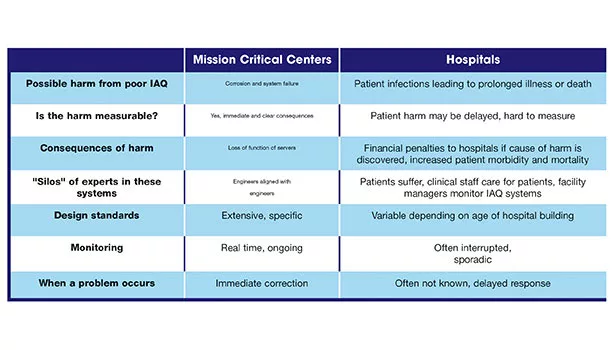
Let’s compare some of the factors in mission critical centers and in hospitals and see how we can improve the in-patient experience. What are some of the differences between IAQ management in mission critical centers and in hospitals?

Like data center operators, hospitals must take actions to eliminate airborne contaminants that are harmful to patients. These steps include:

1. Best practice design standards based on data-backed solutions

2. Ongoing environmental monitoring with real-time feedback

3. Keep historical records for alignment with patient problems

 4. Incentives should be positive rather than negative (i.e. use the carrot rather than the stick.)

Share This Story

Looking for a reprint of this article?
From high-res PDFs to custom plaques, order your copy today!


Dr. Stephanie Taylor is the president and founder of Building4Health Inc. After working as a physician for many decades, Dr. Taylor obtained a Masters in Architecture as well as Infection Control certification. Her lifelong commitment to patient care includes focusing on improving the healthcare physical environment and clinical work processes to help patients heal quickly and save hospitals valuable dollars. Dr. Taylor is a graduate of Harvard Medical School (MD), and Norwich University (Masters Architecture). She has numerous research publications in Nature, Science, and other peer-reviewed journals. She can be contacted at stephanie@b4hinc.com or (860) 501-8950.

Recommended Content

JOIN TODAY
To unlock your recommendations.

Already have an account? Sign In

  • HVAC-enrollment

    The Trades Are Back: HVACR Programs See Nearly 30% Enrollment Spike

    A new wave of future technicians is entering the pipeline.  
    Training and Education
    By: Matt Jachman
  • 2025 Top 40 Under 40

    2025 Top 40 Under 40 HVACR Professionals List

    The 11th annual Top 40 Under 40 list highlights those...
    HVAC Light Commercial Market
    By: Hannah Belloli-Oster
  • LG Ductless Mini-Split Systems

    The 9 Types of Heat Pumps

    As the U.S. moves toward electrification, heat pumps are...
    Ground Source Heat Pumps
    By: Joanna R. Turpin

More Videos

Today's Boiler

Spring 2026 Issue

Today's Boiler - Spring 2026 Cover

Read More from Today's Boiler

Case in Point Logo

Smarter Hydronic Design for Data Centers - Free Webinar - January 22, 2026

Related Articles

  • server room

    Designing a Data Center with Computer Software Modeling

    See More
  • A Physical View IAQ

    Is Your Hospital a Transfer Site for Antiobiotic-resistant Genes?

    See More
  • A Physical View IAQ

    We Can Learn a Lot from Our Bodies When it Comes to Efficiently Cooling Buildings

    See More

Related Products

See More Products
  • air came to a stop.jpg

    The Air Came to a Stop

  • Lessons Learned in a Boiler Room: A common sense approach to servicing and installing commercial boilers

See More Products

Events

View AllSubmit An Event
  • June 24, 2025

    Regional Considerations in Data Center MEP Design: From Desert to Coast

    On Demand Join ES NEWS' Editor Austin Keating and the panel for an expert examination of regional data center design strategies. They will be joined by data center commissioning experts and manufacturer representatives.
  • March 11, 2026

    Insulating the Cloud: Insulation Solutions for Data Center Demands

    On Demand Gain practical insights into material selection, efficiency optimization, and real‑world challenges faced in fast‑growing data‑center environments. Join us to elevate your understanding of high‑performance mechanical insulation strategies.
View AllSubmit An Event

Related Directories

  • A to Z Sales & Marketing

    We strive to revolutionize indoor living through innovative solutions that improve air quality, enhance comfort, and promote sustainable living for people around the world.
×

Sign Up. Stay Informed.

The #1 trusted source for the HVACR industry since 1926

SUBSCRIBE
  • RESOURCES
    • Advertise
    • Contact Us
    • Advisory Board
    • Classifieds
    • Submit a Letter
    • Directories
    • Store
  • ACCOUNT CENTER
    • Create an Account
    • Start a Subscription
    • Manage My Account
    • Sign Up for Newsletters
    • Visit Customer Service
    • Update Preferences
  • SERVICES
    • Marketing Services
    • Reprints
    • Market Research
    • List Rental
    • Survey/Respondent Access
  • STAY CONNECTED
    • LinkedIn
    • Facebook
    • Instagram
    • YouTube
    • X (Twitter)
  • PRIVACY
    • PRIVACY POLICY
    • TERMS & CONDITIONS
    • DO NOT SELL MY PERSONAL INFORMATION
    • PRIVACY REQUEST
    • ACCESSIBILITY

Copyright ©2026. All Rights Reserved BNP Media, Inc. and BNP Media II, LLC.

Design, CMS, Hosting & Web Development :: ePublishing