We Can Learn a Lot from Our Bodies When it Comes to Efficiently Cooling Buildings
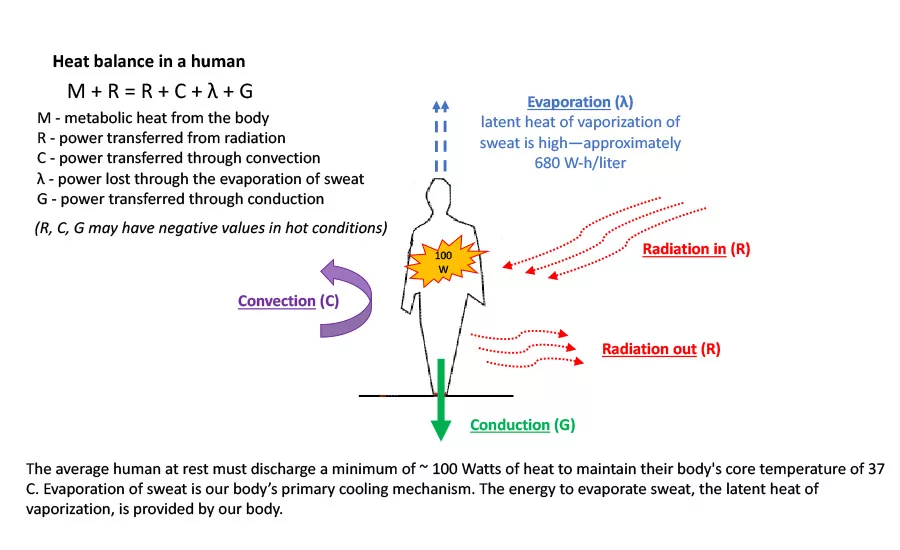
The average human at rest must discharge a minimum of ~ 100 Watts of heat to maintain their body's core temperature of 37 C. Evaporation of sweat is our body’s primary cooling mechanism. The energy to evaporate sweat, the latent heat of vaporization, is provided by our body.
As many of us struggle through a very hot summer, we try to stay cool in the most energy-efficient way. This is key not only for our comfort but also for our very survival.
Humans are in a very precarious position when it comes to thermoregulation. We need to maintain our core temperature within a one-degree range of 36.5°-37.5°C or we will die an unpleasant death through either hypothermia or hyperthermia. To further challenge our thermal equilibrium, ambient temperatures outside of our bodies as well as the amount of heat we generate from within (metabolism and organs) can vary wildly. Our bodies are very inefficient machines with only 25 percent of our food going into usable energy (the phosphate bond that generates adenosine triphosphate, or ATP) and the remaining 75 percent discharged as heat. Our sensitive and demanding cores are therefore caught between unpredictable internal and external temperatures. Clearly, human bodies must have some amazing strategies to maintain thermal equilibrium, or we would be extinct.
The hypothalamus, located in the brain, is our thermostat responsible for maintaining a constant core temperature. Heat receptors located throughout our body report to our hypothalamus, which in turn triggers physiological adjustments to meticulously balance heat gain and heat loss.
Because it is summertime, let’s focus on getting rid of excess heat. To do this, two physiological strategies are used. The first system uses our circulation to move heated blood from our core to our skin’s surface. The second system uses evaporation of sweat to cool the blood in our skin vessels prior to its return to deep body tissues. This is a very effective strategy for heat dissipation because the latent heat of vaporization of water is high, approximately 680 W-h for every liter of sweat evaporated.
An inactive adult male must dissipate heat generated (approximately 90 W) by the metabolism of calories eaten (approximately 2,000 calories). In addition, when the ambient temperature is higher than 37°, thermal energy absorbed by the body must also be compensated for. For example, at 45º, evaporative cooling over the body surface area of approximately 2 m2 must maintain the skin at 37° by creating a net outward flowrate of energy to compensate for the 90 W of metabolic heat plus approximately 109 W from external heat. In addition, during moderate steady-state work utilizing oxygen at 1 l/min, approximately 350 W of heat are generated. Even at this moderate work intensity, our core temperature would rise approximately 1° every 15 minutes if we did not have an efficient means of heat dissipation.
Let’s now turn our attention to energy-efficient cooling in buildings. Architects and engineers have used evaporative cooling for centuries. Because the process is most effective in non-humid climates, the introduction of refrigerant cooling largely replaced evaporative cooling because it could provide cooling in almost any climate. Unfortunately, this technology comes with additional costs.
The price of refrigeration equipment is considerably more than its evaporative cooling counterpart. Mechanical chillers, involving heat exchangers with an intermediate refrigerant cycle, cost approximately five times as much as evaporative systems. Thanks to the high latent heat of vaporization, 22.7 liters of water evaporation has the same cooling effect as a typical 3.5-ton-hour home central air conditioner.
In addition to reduced equipment and energy costs, evaporative cooling systems can create healthier indoor air for several reasons. Good ventilation is required, so doors and windows can be open rather than recirculating room air inside a sealed building. Unless outdoor pollution is high, this creates improved indoor air quality.
Secondly, evaporative coolers add water vapor into the air, so hydration of skin, eyes, and protective respiratory mucosal barriers are maintained. Conversely, refrigerant air conditioning removes moisture from the air and can result in drying of these tissues.
While evaporative cooling systems are not ideal for climates with high humidity year-round, they do offer excellent cooling in geographies with dry seasons. In addition, these systems can be seen as low-energy humidifiers with an extra benefit of cooling.
Once again, the human body has modeled for us an effective and energy-efficient strategy for living in our varied environment!
Looking for a reprint of this article?
From high-res PDFs to custom plaques, order your copy today!