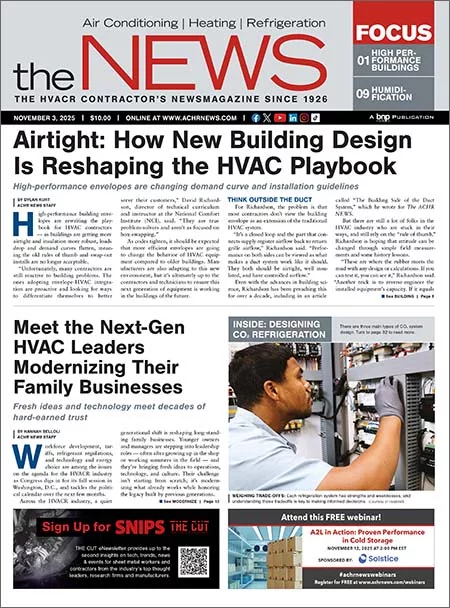
High-Rise Overhaul
McGuire's analysis revealed that the building’s occupancy only actually requires two of its three existing chillers. With one chiller already in working order, only one additional chiller would need to be replaced. But first, McGuire suggested another analysis to determine the costs associated with upgrading the entire chiller plant to work better at partial load.
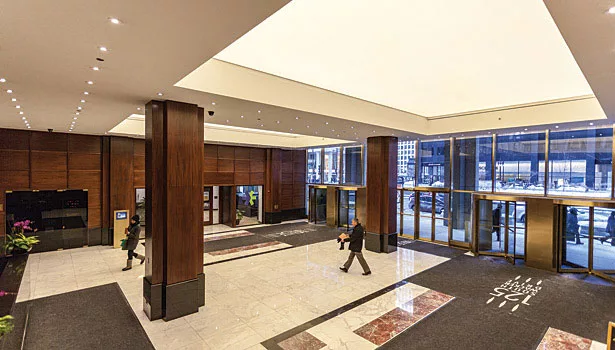
Aimed at creating a clear division of responsibility between the owner and tenants, a benchmark across the building's MEP systems will be used for maintenance and future upgrades as well as helping tenants migrate to their new space.
When a large Fortune 500 company purchased the 125 S. Wacker high-rise in the heart of Chicago’s Loop business district as part of a sweep of new portfolio investments in the Second City, it knew MEP renovations were in order to restore the building’s assets to meet the needs of current and future tenants. New property manager Jones Lang LaSalle (JLL) would need to create a capital plan that could both appeal to short- and long-term tenants and meet the new owner’s long-term energy expenditure goals.
Originally built in 1974 for a single tenant, the 575,897-sq-ft, 31-story high-rise features small floor plates, making it ideal for smaller tenant demising and positioning it as a niche property in downtown Chicago, where most highrises can’t accommodate small tenant divisions. But because the building’s base-line Energy Star rating was so low when JLL took it over in 2012 — over 65% of its neighboring high rises were more efficient — 125 S. Wacker needed almost a complete MEP infrastructure makeover.
Creating tenant flexibility by designing a more robust base building was a primary goal for JLL, as the requirements of each tenant space will fluctuate based on individual corporate environments. The property manager knew this was sure to demand creative engineering, well beyond the typical upgrade. JLL set this challenge in front of local MEP consulting firm McGuire Engineers, asking them to take 125 S. Wacker and transform it into a world class investment property.
“We needed to partner with a firm that looked at the building holistically, not project by project,” said Mason Taylor, vice president of leasing at JLL. “How do you take a building that’s a poor performer energy wise and modify it in the correct order? We don’t have endless capital, so we have to be cognizant of where we want to spend our money and where our return is going to be from that investment.”
Teaming with JLL’s local engineering services division, McGuire employed software analysis, including financial modeling; a full energy simulation and audit; and a calibrated energy model to determine what would be the best solution for the MEP systems as a whole. Instead of just changing out each piece of equipment or system for its most updated version, McGuire laid an upgrade path for the renovations. The plan was based on a cascading return on investment (ROI) so that each successive project could build on the one before, enabling the team to set annual performance improvement goals and monitor the energy performance improvement one step at a time.
The result was a five-year master plan for 125 S. Wacker that included maximizing outside money available from local utility rebates for an investment in MEP building technology to increase its appeal while reducing its operating costs. Ultimately, these upgrades will also reduce the energy expenditure of the building by 50% over the course of the five years — all while fully occupied.
Controls
The first initiative at 125 S. Wacker was updating the building’s controls, which included installing a new DDC control system. It was chosen as the initial upgrade for its ability to take better control of all the existing equipment during future upgrades and because a new BAS would aid in new equipment and systems integration thanks to updated protocols and new computer interface and software. McGuire and JLL made sure that system selection and installation was driven by the building’s current operators.
“The more knowledgeable the building operators are of the BAS tool, the more they’re going to use it to continue to drive our desired outcomes: a comfortable work environment for our tenants and achieving additional energy efficiency from the operation of the system. Together, these outcomes will allow us to attract Class A tenants to our Class A office building,” said William Schuch, senior vice president, Midwest regional engineering manager, JLL. “In addition, understanding the BAS will provide our engineers with the ability to re-engineer ways and control strategies to operate the building even better over time.”
The BAS upgrade alone will save over 2,000,000 MWh/year, which translates to $200,000 in annual utility cost savings. This, calculated with the first cost capital investment of $190,000, led to a simple payback of just under one year.
Boiler Plant
While half of the building’s existing boilers had already been replaced, the other 900kW boilers were at the end of their useful service life and needed to be replaced. The modeling analysis revealed that converting the building to natural gas boilers would have added the benefit of further reducing the carbon footprint and operating costs (because half of the boilers had already been replaced in kind). However, the cost of the gas infrastructure and the flues with only half the building made the economics of this possibility unworkable. Instead, new electric boilers were specified that were more efficient with superior part-load performance, which significantly reduced startup time and therefore improved performance.
Chiller Plant
The high rise had always employed three chillers to service its 31 stories. However, McGuire’s modeling analysis revealed that the building’s occupancy only actually requires two chillers. With one chiller already in working order, only one additional chiller would need to be replaced.
But before they replaced in kind, McGuire suggested another financial analysis to determine the costs associated with upgrading the entire chiller plant to take advantage of the building’s current loads and design a system that works better at partial load.
The result was a chiller plant upgrade, including new plant controls and optimization. This led to the installation of a 1,100-ton maglev Smardt Chiller, conversion of the existing AHU to two-way pressure independent control valves, and replacement of VFDs. A bridge pipe was placed between the chilled water supply and return headers to create a primary-secondary pumping loop system that increased reliability and efficiency. New secondary pumps were installed, along with more efficient primary pumps.
The AHU, VFD, and motor conversions led to a savings of almost 800 MWh/year and a corresponding $45,000+ savings in annual utility costs. With a first-cost investment of $900,000, the equipment payback is just under 20 years.
The chiller plant upgrade and new equipment resulted in 900 MWh/year and over $75,000 in annual utility costs. With a first-cost investment of just over $1 million, the simple payback will be in just over 15 years.
VAV System
One of the biggest opportunities to optimize the occupant comfort and energy performance at 125 S. Wacker was converting the building to a VAV system. Made possible by the new, robust BAS, chiller plant upgrades and AHU upgrades, the VAV terminals are being installed throughout the building in each office, allowing smaller spaces to control their own temperature.
Wireless thermostats are being installed throughout the building for easy touch-point access, making renovations due to future tenant turn over easier, as VAV terminal units can be left where they are while the wireless thermostats can be relocated as needed without any necessary construction.
The full VAV savings potential came to 9,000 MWh/year or $500,000. With a capital cost of approximately $2 million, the simple payback is just five years away.
Cooling Tower
The building’s existing 3,660-ton, three-cell cooling tower featured one cell that was recently winterized, while the other two were nearing the end of their useful service life and replacement was a given. Again, McGuire suggested an analysis of the whole cooling tower before an in-kind replacement was made.
The result is a plan to replace and upgrade the other two cells in the cooling tower as well as the optimization of chiller controls during the second half of the master plan upgrade.
Lighting Fixtures and Controls
The existing lighting controls at 125 S. Wacker were not integrated with each other, and the system lacked automatic controls with occupancy sensors, a key component of an energy-efficient building. With the addition of integration, controls, and sensors, the building’s engineering staff will be able to program lighting schedules with better flexibility for weekends and off-hour use.
The lighting fixtures and controls upgrade are estimated to save the building 100 MWh/year, or $7,000 in utility costs annually. Due to other electrical relay work the building needed as well, the simple payback for this upgrade is just under 39 years. However, the increased energy efficiency of new lighting systems with each new tenant renovation continues to have a significant impact on the building’s overall Energy Star score.
Tenant Standard
Due to the unique layout of 125 S. Wacker and its ability to accommodate smaller tenant divisions, the building experiences many tenant upgrades, both from tenant growth and turnover. This led to the creation of tenant standards, outlined by McGuire in partnership with JLL and the building’s operating engineers during the larger MEP upgrade. Aimed at creating a clear division of responsibility between the owner and tenants, a benchmark across the building’s MEP systems will be used for maintenance and future upgrades as well as helping tenants migrate to their new space to build out their individual offices more efficiently. The tenant standard covers everything from the allowable construction and MEP systems scope of their upgrade to the specific equipment and systems that are compatible with the new building upgrades, while also offering pre-negotiated prices and a list of local contractors for the tenant’s use.
Currently being phased in, these tenant standards have helped JLL meet their desired building goals — occupant comfort and energy efficiency.
“If we’ve upgraded the base building heating and cooling to really achieve our savings, we also need to upgrade the heating and cooling within the tenant-occupied spaces,” said Schuch. “By putting the technology and upgrades above the ceiling, we have more control over the tenant spaces, so we can monitor and control their environment more accurately and more efficiently than before. This allows us to stay competitive in the marketplace by operating the systems more efficiently.”
Conclusion
Currently, two years into the five-year strategic plan, 125 S. Wacker has raised its Energy Star rating by 12% and counting. As was the case with the majority of MEP systems upgrades at 125 S. Wacker, moving beyond the basic and go-to in kind replacements and actually taking the time to conduct the necessary analysis helped meet the long term goals of the building’s owners and operators, including promoting energy efficiency and performance improvement, tenant flexibility, and a cascading ROI.
“It’s really about understanding the building as the asset of our client. We needed to bring in the appropriate tools, technologies, and mechanical systems to achieve that,” said Schuch. “Tying that all together with a global vision will help them achieve where they want this asset to be in five to seven years: to be fully leased and to be energy efficient, comparable to other buildings of its type. Together with McGuire, the leasing team, and the management from JLL, we put that together for the ownership, and today that’s what we continue to drive home.”
Looking for a reprint of this article?
From high-res PDFs to custom plaques, order your copy today!