Back 2 Basics
Building Program to Basis of Design for an Assisted Living Building Renovation Project
At some point in time, most building owners make the business decision to build, renovate, or expand their facilities. A complete Building Program (BP) will be the cornerstone for investing in an HVAC design and eventual construction of HVAC systems to meet the Building Program requirements.
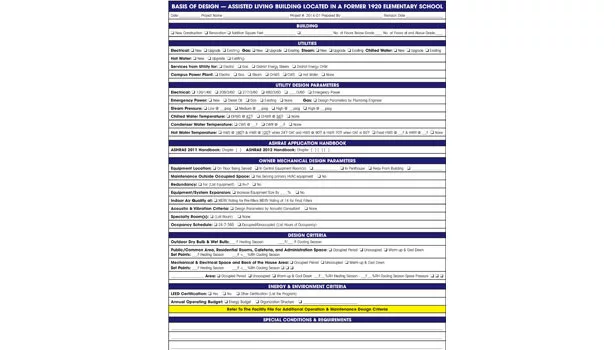
For the HVAC engineer, he will take the program information and craft a Basis of Design (BofD) using the suggested BofD template on Page 2 of this B2B. For this month’s test, we have documented the BP for an assisted living building renovation. On page 2 of this B2B, the reader shall complete the BofD by filling in the pertinent data, drawing upon the BP information provided and upon pertinent reference documents such as local weather data design criteria. The answers to the BofD can be found on the www.esmagazine.com web site.
The building is to be a renovation of a 48,000-sq-ft, 2-story abandoned elementary school circa 1920 in Greenville, SC. The occupants will require some assisted living in-house aid, but for the most part, these occupants are mobile and free to come and go on a daily basis. Utilities will be provided by the city’s electric, gas, and water departments, and a new HVAC system shall be provided based on referencing the ASHRAE Handbooks.
Local utility companies have agreed to bring in a new 480-3-60, 2000 amp electrical service, while the gas company will replace an old service with a new 3-in low-pressure gas line. City water will be upgraded to meet the new occupant’s requirements and local plumbing code.
The HVAC electrical requirements shall be 120/1/60 for motors less than 0.50 hp, and 480/3/60 for motors larger than that. The gas shall serve a new 3,450-MBH condensing hot water boiler providing hot water heating to the individual room fan coil units and to VAV terminals providing HVAC to the occupants. A central AHU will have enthalpy airside economizer, MERV 8 pre-filters and MERV 14 final filters, chilled water coil, and VFD fans to provide supply air to the building occupied spaces. There is no requirement for standby capacity and no system/equipment spare capacity for BP growth.
The HVAC design of this building renovation shall be based on State and local codes, as well as on the design engineer referring to the basis of design requirements in the ASHRAE 2011 Application Handbook chapter 8 Health-Care Facilities. The design engineer will draw upon the ASHRAE Standard 170, Facility Guidelines Institute for Design and Construction of Health Care Facilities for more specific design requirements.
When beginning to shape the BofD, the engineer should take into account the ASHRAE recommended HVAC system analysis and selection process found in chapter 1 of its 2012 Systems and Equipment Handbook, and then continue on with the BofD data collection by reviewing chapter 2 Decentralized Cooling and Heating and/or chapter 3 Central Cooling and Heating to determine the optimum HVAC systems for this BP.
The design engineer, in conjunction with the building owner and the architect, has finalized the HVAC system to include a closed-loop hot water heating system; a closed-loop chilled water cooling system with a high-efficiency boiler located in a boiler room; and a central AHU and air-cooled chiller both located outdoors and a minimum of 20 ft from any occupant’s room.
While the HVAC system could be designed for occupied-unoccupied modes of operation, the owner has requested that these systems operate 24 hrs/day, year-round. The hot water heating system shall be an outdoor temperature-compensated system (160˚F HWS and 120F HWR at 24˚F outdoors, and 90F HWS and 70˚F HWR when greater than 60˚F outdoors). The chilled water system shall be 42˚F CHWS and 56˚F CHWR when outdoor temperature is greater than 60˚F outdoors). Occupied space shall be maintained at 74˚F with no humidity control in the heating season, and 78˚F and a not-to-exceed 60% rh during the air-conditioning season. Equipment room and back-of-the-room support areas will be maintained at 68˚F with no humidity control in the heating season, and at 78˚F and a not-to-exceed 65% rh during the air conditioning season, while these support areas will be maintained at 0.005 negative pressure.
There will be no specialized energy and/or environmental program criteria, and the owner has not requested any other special conditions as part of the BP. The reader is directed to the Facility Files for the Owner’s Building Program Annual Operating Budget and Operating Program.
As the design phase for this BP goes forward, the B-of-D should be routinely referenced and updated based on changes in the BP, as well as to reflect changes and/or enhancements to the HVAC design.
Looking for a reprint of this article?
From high-res PDFs to custom plaques, order your copy today!