BACK 2 BASICS
Building Program To Basis Of Design For A Treatment Clinic Within An Existing Hospital Building Project
At some point in time, most healthcare system building committees are given the responsibility to establish a building upgrade program to enhance their healthcare services and to contribute to the local community needing convenient health care treatment. When the team is ready, a Building Program (BP) is created, and this document will be the cornerstone for investing in an HVAC design and eventual construction of HVAC systems to meet the Building Program requirements.
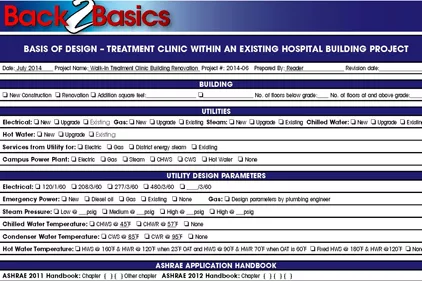
For the HVAC engineer, he will take the program information and craft a Basis of Design (BofD) using the suggested BofD template here. For this month’s test, we will document the BP for a renovation of an existing hospital space and convert the space into a walk-in treatment space in Topsham, ME. On page 2 of this B2B, the reader shall complete the BofD by checking the correct boxes from the multiple choice selections based on the BP information provided and from pertinent reference documents, such as local weather data design criteria for this town. The answers to the BofD can be found here.
The renovated building space is 2,400 sq ft, located on the first floor of the three-story structure. The building’s BP will require a special infection control (IC) plan in preparation for construction, and then the IC process will be completed during construction by a third-party IC commissioning consultant. The hospital’s IC policy and procedure manual will be updated as part of the commissioning process. An existing security system will be integrated with the HVAC system for smoke control, as well as with security TV cameras at strategic locations. Existing utilities from the building’s boiler and chiller equipment will provide chilled water cooling and hot water heating along with the other mechanical, electrical, and low-voltage systems necessary to support the new walk-in treatment center.
Electrical, plumbing, fire protection, telecommunication, and security consultants will work in sync with the HVAC design team to provide a complete mechanical-electrical installation per state and local codes.
The HVAC electrical will remain 120/1/60 for motors less than .5 hp and 480/3/60 for motors .5 hp and larger. The building’s central hot water system shall provide 200 MBH heating capacity to the new central air-handling unit preheat coil and to individual room VAV terminal heating coils and fan-powered terminal heating coils. The HVAC central AHU will have enthalpy airside economizer with prefilter, preheat coil, and chilled water cooling coil upstream of the supply air fan, and a final filter on the fan discharge. The BP will also require enhanced air filtration, with the pre-filter being a combination of MERV 8 rated pleated filters upstream of MERV 10 cartridge filters. The final filters will be MERV 16 cartridge type.
Fan motors shall be VFD fans to provide supply air VAV to the building occupied spaces. Each room shall be capable of automatically and/or manually being commanded to unoccupied mode, along with morning warm-up and morning cool-down sequences of operation. There is no requirement for standby capacity and no system/equipment spare capacity for BP growth.
The HVAC design of this building renovation shall be based on ASHRAE 2011 Application Handbook, chapter 8, “Health-Care Facilities” for basis of design requirements. The design engineer will also draw upon the ASHRAE Advanced Energy Design Guide for more specific energy conservation design opportunities.
When beginning to shape the BofD, the engineer should take into account the ASHRAE recommended HVAC System Analysis and Selection process found in chapter 1 of its 2012 Systems and Equipment Handbookand continue on with the BofD data collection by reviewing chapter 2, “Decentralized Cooling and Heating,” to determine the optimum HVAC systems for this BP. It is always a good refresher to also read chapters 4 and 5 of the Systems and Equipmentmanual, as well as other equipment-specific chapters and the 2011 HVAC Application Handbookchapters 36 through 43 in the Building Operation and Management section of this handbook.
The HVAC system will be designed for occupied-unoccupied modes of operation Monday through Friday, with manual override as needed. The building’s hot water heating system is a fixed hot water supply temperature system set at 180?F, operating 24/7/365. The existing chiller operated from May 15 to September 15, providing 45?F CHWS & 57?F CHWR. Occupied space shall be maintained at 72?F with no humidity control in the heating season, and 76?F with a maximum 60% relative humidity during the air conditioning season. The new central AHU shall be located in the basement, and the air terminals shall be located above the treatment clinic first-floor ceiling, requiring access in the occupied area.
There will be no LEED certification requirement or any specialized energy/environmental program criteria. The design engineer will refer to Standard 170 –Ventilation of Health Care Facilities for additional information and BP recommendations. The reader is directed to the “Facility Files” for the Owner’s Building Program Annual Operating Budget and Operating Program.
As the design phase for this BP goes forward, the BofD should be routinely referenced and updated based on changes in the BP, as well as in response to changes and/or enhancements to the HVAC design.
Looking for a reprint of this article?
From high-res PDFs to custom plaques, order your copy today!