Energy audit, personal guarantee sell management on booster system retrofit

|
|
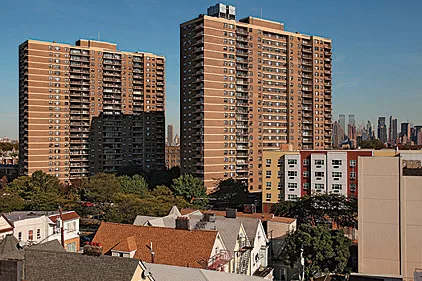
A new pump system reduced power consumption by 92% at this apartment complex. |
“We had absolutely no doubt that we could slash half of the operating costs of a commercial domestic water boosting application by using intelligent, demand-based pump technology,” recalls the 32-yr industry veteran and president of West Orange, NJ, Evco Mechanical. “The problem, however, was convincing a price-conscious customer to invest in new technology instead of rebuilding the decades-old pressure boosting pumps and motor drives.”
The application supported the domestic water delivery system for half of the Parkview Towers, a 684-unit affordable housing complex in West New York, NJ. Built in 1974, and located blocks from the Hudson River, the pumping station delivers domestic water to one of the twin 24-story apartment building towers.
“In recent years, VFD technology has become more affordable and critical in bringing intelligent speed control to a number of commercial pumping applications, including domestic water boosting,” explains Peter Frangiskou, vice president of Dolphin Equipment Corporation, an independent manufacturer’s agent based in Haworth, NJ. “The ability to scale output based on demand was the primary reason we knew we could significantly reduce energy consumption for this building.”
Convincing the enduser was not as clear cut, however.
“We were initially skeptical of the recommendation to completely replace the system because it was still viable,” recalls property manager Blanca Alvarez, CPO, FHC. “It’s hard to justify capital investments, especially in this economy, for replacing equipment that is operating as designed.”
“I told the building owner that if the new boosters didn’t reduce energy consumption by 40% to 50%, they didn’t have to pay me a dime,” says Samouhos, who concedes he had achieved similar head-turning results since he began using the preconfigured boosting stations in 2007.
CONTROL THE FLOW
Demand for water in multi-story buildings, such as the Parkview Towers can vary significantly throughout the day, and this unpredictable flow places extraordinary demands on pumping equipment. High-rise buildings — including hotels, multifamily, office and other institutional applications –— require pressure boosting equipment to raise incoming municipal water pressure to serve the top floors.
Samouhos, a licensed plumbing, electrical, and HVAC contractor serving metropolitan New York, recommended replacing the single building’s existing water pressure boosting system to overcome two system shortcomings: 1) the frequent malfunction of mechanical pressure regulating valves that were prone to clogging; and 2) the inability to match pump/motor output with flow demand.
He turned to Dolphin Equipment to help identify an option that would efficiently meet system demand.
Samouhos installed the Grundfos BoosterpaQ Hydro MPC, an integrated pressure boosting system that offers up to six vertical multi-stage CR pumps in parallel operation designed to optimize pumping efficiency over a range of flow rates. Ideal for water supply systems as well as industrial and irrigation applications, these integrated pumping systems utilize an advanced controller that along with VFD-controlled motors, adjust pump speed and number of pumps in operation to meet frequently changing system demand.
Instead of using constant speed pumps regulated by maintenance-prone pressure reducing valves, the new system would deliver the minimal pump output necessary to achieve optimal performance — all without direct human intervention.
REDUCING CONSUMPTION
The tower’s original pressure boosting system utilized three constant-speed pumps: two 40 hp pumps and a 20 hp backup pump. With no pump-sequencing software in place, the two primary 40 gp pumps operated continuously unless alternated manually by the building engineer during periods of low demand. The new boosting station employs two 15 hp pumps with VFD-controlled motors. A single 15 hp pump is designed to handle the tower’s full pressure load; but if demand exceeds this capacity, the second pump will provide additional pressure. In addition to matching pump output to flow demand, the new duplex boosting station, yielded significant energy savings.
“In calculating the flow rate requirements for the building, we determined that we could not only eliminate an entire pump, but also downsize the remaining two — from 100 total hp to 30 hp, without sacrificing performance,” reports Samouhos. “Despite removing 70 hp from this system, the computerized control, demand-based performance of the new pumping station averages just 30% capacity.”
Nonetheless, upon seeing the reduced specifications, building management doubted the system could perform as designed.
To illustrate the savings of moving from a constant speed pump to a variable, demand-based platform, Dolphin Equipment commissioned an energy audit of both apartment towers. The audit would compare the power used by the duplex boosting station against the conventional triplex system installed in the companion building.
The audit, paid for by Grundfos and Dolphin Equipment, bore out Samouhos’ original intuition, and helped to justify his replacement-versus-repair recommendation.
“Our team recorded a 92% drop in power consumption in the building that was fitted with the energy-efficient boosting station over the conventional system installed in the building’s other tower. If we extrapolate the energy used during this one-week period, this level of savings would yield approximately 121,067 kWh annually, or an annual utility cost reduction of nearly $18,160, based on an average area utility rate of $0.15 per kWh, said Tony Sinacore, applications engineer with the energy audit firm SDM Metro, based in Ramsey, NJ.
Sinacore estimates that the total project savings over a 15-yr average pump lifespan are just under $275,000. The level of savings, in fact, was so dramatic that the contractor installed similar VSDs in the companion tower to begin matching pump output with demand.
“Building management was stunned that we could deliver the same level of performance using just one-third the pumping horsepower of the old system,” recalls Samouhos. “Every day the engineers would come in to see if the system was collapsing under the crushing demand, only to find the Grundfos booster station barely breaking a sweat.”
Looking for a reprint of this article?
From high-res PDFs to custom plaques, order your copy today!