CASE IN POINT
Texas bank cashes in with VRF system retrofit
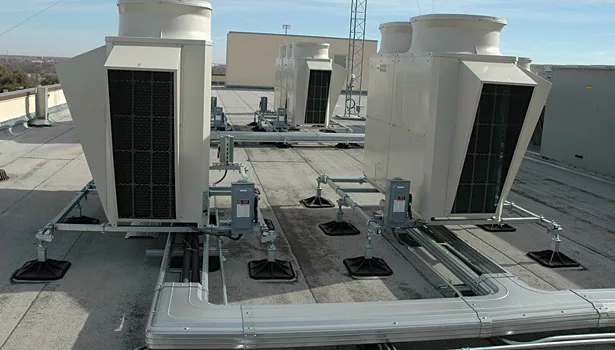
As VRF systems gain popularity in the U.S., some designers are customizing them to outperform other HVAC technologies in energy efficiency and function. The design and installation of a recent HVAC retrofit of the four-story Texas State Bank in San Angelo, TX, is one such example. However, there were challenges.
One challenge was concealing and protecting VRF linesets, which can look unsightly and fail prematurely when exposed to the elements, according to Cecil Sain, president of Air Dynamics in San Angelo.
The company specified the RD-Series, a VRF-specific lineset protection duct product line by RectorSeal. The corrosion and scratch resistant ZAM (zinc/aluminum/magnesium) coated metal duct installed on TSB’s roof protects and preserves linesets from 17 rooftop City Multi Series VRF condensers manufactured by Mitsubishi Electric Heating & Cooling.
The RD-Series comes with a full line of fittings, adaptors, and couplings, such as the 45-degree and 90-degree elbows that Air Dynamics used in connections to building lineset chases.
“The building owners are very pleased with how the roof looks neatly laid out and professional in appearance, which also reflects on our overall design and Air Dynamics’ installation,” said Paul Wilkerson, P.E., owner of Power Systems Inc. and the TSB project’s consulting engineer.
The 37-year-old facility was one of the nation’s first commercial heat pump applications that recovered heat from lighting and converted it into energy for the chilled water loop system consisting of a chiller, cooling tower, boiler, and air handlers. While it was state-of-the-art in 1977, the aging system’s escalating expenditures for cooling tower chemicals, repairs, and general system maintenance surpassed $10,000 annually. Replacement parts also became problematic, according to Sain.
TSB opted for the inevitable retrofit. An 84-ton Mitsubishi system was specified because it represented no downtime for tenants and its cost was competitive with other HVAC alternatives when accounting for VRF’s expedited labor advantages. Operating expenses are expected to be approximately 30% lower while providing zoned temperature control for occupants versus the previous system.
“We’ve noticed a definite indoor comfort improvement with the VRF system,” said David Harrison, executive vice president of TSB.
The building’s original three air handlers were replaced with 32 Mitsubishi VRF-based fan coil units in zones fed by two branch circuit controllers/per floor. Eighty percent of the building’s original supply ductwork was re-used for air distribution at a great savings. The VRF equipment’s sizing was determined by the building’s peak north side heating load. Sain and Wilkerson’s VRF calculations were assisted by Andy St. John, commercial sales manager at Mitsubishi distributor Robert Madden Co., and verified by Power Systems’ in-house computer modeling.
Sain also wanted to find a quality mounting system for the rooftop condensers and discovered Big Foot Systems rooftop equipment mounts, also available through RectorSeal. Instead of the conventional poured rooftop concrete pads and the inherent roofing costs associated with them, Sain specified Big Foot Systems, which are tubular, corrosion-resistant, hot dipped galvanized modular steel support frames. The frames were designed by RectorSeal’s in-house engineering team and assembled onsite in various configurations by Air Dynamics’ crew to custom-fit the condensers.
The supports were also recommended for their sound and vibration attenuation. Previously, Sain had not been completely satisfied with noise abatement attempts of previous mechanical rooftop systems set on I-beams, even when used with anti-vibration pads.
The mounting system features adjustable legs and 12-in by 12-in-sq anti-vibration nylon feet. When the building is re-roofed someday, roofing can be replaced underneath one leg at a time while the units and piping stay connected and functional.
The system also includes nylon-footed H-shaped stands for the lineset ducting. Sain found the mounting systems’ under-unit access convenient for expedited refrigeration and electrical hookups. The system’s conduciveness to attaching appendages, such as electrical conduit with common hardware clamps, encouraged Sain to support each condensing unit’s electrical disconnect boxes to the mounting frame.
Another energy saving built into the design was a 10-ton, 2,000-cfm DOAS by Desert Aire. Previously, space humidity was controlled strictly with air conditioning, which on hot West Texas summer days is inefficient and costly in electricity. The DOAS provides outdoor air dehumidification and conditioning, but also recovers 95% exhaust air energy. The unit also includes an integral back-up gas-fired heater for additional heating capacity.
To support Sain’s request for VRF, Wilkerson performed a cost analysis comparing it to conventional chiller, rooftop DX, and split DX systems and found that its higher capital equipment costs were offset by a reduction in labor and installation expenses. The real advantage Wilkerson found in the VRF installation was minimal downtime or tenant space disruption.
“My cost comparison analysis found that all the HVAC methodology choices for the TSB, including VRF, were within a few percentage points of each other in price,” Wilkerson said.
Looking for a reprint of this article?
From high-res PDFs to custom plaques, order your copy today!