Single-Zone AHU Trend Analysis
On to a new case after solving a museum mystery …
Last month’s trend graph was 24 hrs in the life of a large museum AHU in a northern climate. The constant volume system delivered constant 55°F supply air to terminal reheat coils serving multiple temperature control zones. These temperature control zones were primarily art galleries open to the public during the day. The AHU consisted of a mixing box with airside economizer, heating hot water preheat coil, chilled water coil, humidifier, and supply fan.

|
The trend graph showed two distinct operating modes: the left side of the graph was in occupied mode when the fan was on, and the right side of the graph was in unoccupied mode when the fan was off. The system clearly went into a shutdown mode between 8:30 p.m. and 6:30 a.m., with the outside air dampers fully closed and the return air, mixed air, and discharge air temperatures essentially equal to each other. Both the heating and cooling coils were commanded closed. All of that was very good from an energy perspective, although the practice of turning off air-handling equipment at any time in a museum is suspect from a collections preservation perspective.
During occupied hours, the most distinctive and dismaying feature of the trend graph was the cycling of the heating and cooling valve control signals. This was illustrated by the sawtooth pattern in the red (heating) and blue (cooling) trend lines. In its attempt to maintain a 65° discharge air temperature setpoint, the hot water valve modulated fully open such that the discharge air temperature rose to 75° to 80° before the valve was signaled to close. The high discharge air temperature then caused the chilled water valve to modulate fully open to try to lower the temperature to 65°. The cooling valve opened too quickly and resulted in the discharge air temperature dropping below 55° before being signaled to close. This restarted the cycle with the hot water valve modulating open again.
This trend represented a classic out-of-tune control loop that is extremely easy to see in graphical format but very difficult (or painfully time-consuming) to observe in the field. The reheat coils downstream of the supply fan and the large gallery spaces receiving the supply air dampened the effect of the wide swings in discharge air temperature such that space temperatures and relative humidities remained relatively steady. Those were the most important performance requirements of the museum HVAC system and, thus, it was assumed to be working well.
The problem uncovered by this trend graph analysis was an insidious type of simultaneous heating and cooling. Every time the heating valve opened too far and overheated the supply air, the cooling valve compensated to remove that excess heat and ended up overcooling the supply air. With outside air temperatures between 50° to 60° during the occupied trend period, the airside economizer should have been able to provide the 65° discharge air without any mechanical heating or cooling at all. When the temperature control loop was retuned via software, the elimination of unnecessary heating and cooling resulted in an estimated $12,500/yr in energy savings.
NEW SYSTEM
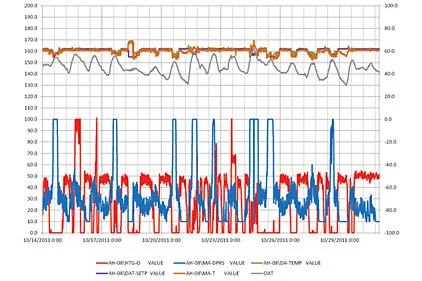
This month’s trend graph is of a single-zone, constant volume, mixed AHU with airside economizer, heating hot water coil, and chilled water cooling coil for discharge air temperature control. The discharge air temperature setpoint is reset based on space temperature setpoint. This graph has a selected number of points with two different vertical axes (one on the left and one on the right) to help see and evaluate the pertinent points more easily than with a single shared axis.
TRENDS
The BAS was used to trend the following sensor and device data at 15-min intervals for a little more than two weeks in the fall of 2011:
Left Hand Vertical Axis:
• Mixed air (outside air) damper command (blue)
• Heating valve command (red)
• Outside air temperature (gray)
• Mixed air temperature (orange)
• Discharge air temperature setpoint (purple)
• Discharge air temperature (green) ES
Looking for a reprint of this article?
From high-res PDFs to custom plaques, order your copy today!