Making time to improve your shop's operations
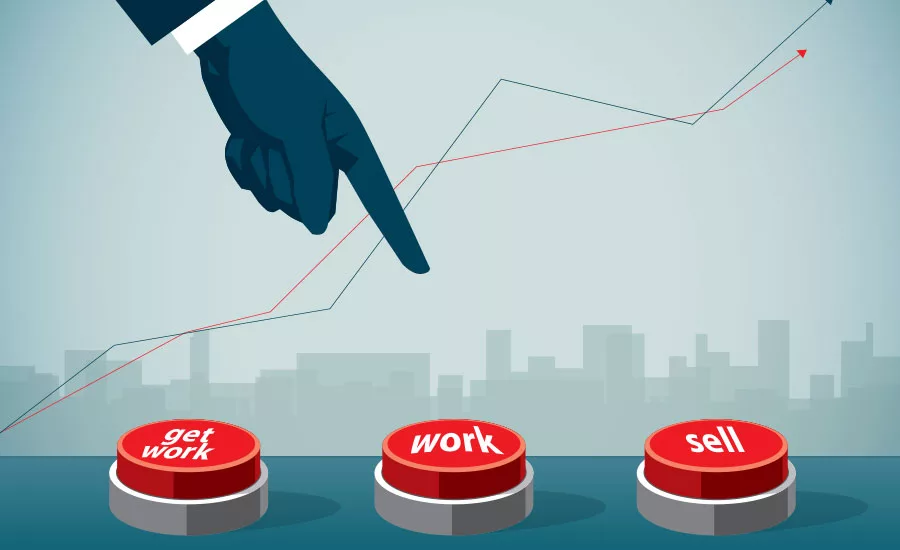
Most contractors find themselves operating in two work modes: Get work. Do work. As the economy stands now, many shops are in the do work phase. But, the problem is, neither mode allows time for an improve work phase. Consider this tale from the children’s story, “Winnie-the-Pooh” by A. A. Milne:
Here is Edward Bear, coming downstairs now, bump, bump, bump on the back of his head, behind Christopher Robin. It is, as far as he knows, the only way of coming downstairs, but sometimes he feels that there really is another way, if only he could stop bumping for a moment and think of it.
Even with so much new technology and techniques, busyness can stand in the way of some much-needed self-improvements. That being said, here are a few principles that can guide your company to some important “me” time.
Teach your leaders the priorities of management
#1. Meet more than the customer’s needs. The install crews are your most expensive per-hour work unit and should always be installing value-added work. All support functions efforts should be focused on supporting this priority.
#2. Reduce inventory. Because of the hidden costs of inventory, you want to reduce work-in-progress and inventory as much as possible without impacting priority the value-added priority. Store as little of finished product at the shop, in trailers, or at the job site as possible. The better you can flow the work to meet need-dates, the less inventory you need to store.
#3. Reduce other costs. Seek ways to save money in how you purchase, store, fabricate, ship and record parts and material as long as it does not interfere with the first priority.
The lean concept of “Go and See” is always useful
Instead of theorizing what and how things need to improve, go to the work area and watch how the work is being done. Take note of how material is fabricated, transported, stored and installed. Watch what tools are needed and they are used. Most of all, watch what obstacles keeps the work from flowing. See the barriers. Look for the wastes of motion — including people and material movement.
Look for best practices on the job
If two or more people do the same task differently, one will always be better than the others. Watch and analyze which process is better. Then make that process the standard. This also presents an opportunity to talk with your employees about the work and find any barriers to productivity. Ask them for their ideas and listen to understand, not to reject or disagree.
Work Wastes
Defects: Fabricating bad product and or installing it incorrectly is waste. Punch lists at the end of a job can highlight detected defects, but defects happen at any point in the fabrication and install process.
Over-production of goods: Fabricating or ordering material too early, and stockpiling material either in the shop, in a warehouse, or at the job site causes waste, including fabricating material at a faster rate than it can be installed.
Inventory: Any material not yet installed — including un-fabricated material, works-in-progress, and finished fabrications — is waste. Some inventory is usually needed to ensure that the work is performed in a timely manner to avoid the waste of “waiting.” This is “necessary” inventory. But this type of inventory still should be considered waste and is to be reduced as much as possible.
Inventory: Any material not yet installed — including un-fabricated material, works-in-progress, and finished fabrications — is waste. Some inventory is usually needed to ensure that the work is performed in a timely manner to avoid the waste of “waiting.” This is “necessary” inventory. But this type of inventory still should be considered waste and is to be reduced as much as possible.
People Movement: “Treasure hunts” happen when workers go looking for tools, material, parts, or information. No value is added while walking around. We add value with our fingers, not legs.
Material Transportation: This waste happens when material is moved, loaded, hauled to the job site and unloaded or brought back to the shop. Although moving material is necessary, it is not value added and should be minimized.
Waiting: Any time workers wait for work, or work waits for workers, it is waste.
Build a company culture of improvement.
Set a “True North” for your company’s mission and stick to it. Encourage your team to deliver value to the customer and teach them to hate waste and inefficiency. Remember, there are seven basic types of wastes in a production process (arrow to sidebar), and your shop should always be actively working to eliminate or minimize them all.
Teach and demonstrate how to test possible improvements
You can’t hit the ball if you don’t swing. Great baseball players bat in the 300’s. That means they only get hits about a third of their times at bat. In the same vein, some improvement ideas will strike out. But it’s important to inspire your employees to keep trying. Most improvements do not come out of scientific research or universities, but from workers trying to find better ways. Follow the steps of plan, do, check and act:
- Plan what you think will be a better way.
- Do it.
- Check the process by asking two questions: “Did we follow our plan?” And, “Is it a better way?”
- Take action to make it the standard way of doing things.
- Then repeat the steps until you find a better process.
There may be numerous ways to improve your shop’s processes, but they can’t work for you if you don’t make the time to test them out and follow through with necessary changes. To relate it back to “Winnie-the-Pooh,” take small steps to stop bumping your head now so your business won’t be faced with a big headache later.
Work Wastes
Defects: Fabricating bad product and or installing it incorrectly is waste. Punch lists at the end of a job can highlight detected defects, but defects happen at any point in the fabrication and install process.
Over-production of goods: Fabricating or ordering material too early, and stockpiling material either in the shop, in a warehouse, or at the job site causes waste, including fabricating material at a faster rate than it can be installed.
Inventory: Any material not yet installed — including un-fabricated material, works-in-progress, and finished fabrications — is waste. Some inventory is usually needed to ensure that the work is performed in a timely manner to avoid the waste of “waiting.” This is “necessary” inventory. But this type of inventory still should be considered waste and is to be reduced as much as possible.
Inventory: Any material not yet installed — including un-fabricated material, works-in-progress, and finished fabrications — is waste. Some inventory is usually needed to ensure that the work is performed in a timely manner to avoid the waste of “waiting.” This is “necessary” inventory. But this type of inventory still should be considered waste and is to be reduced as much as possible.
People Movement: “Treasure hunts” happen when workers go looking for tools, material, parts, or information. No value is added while walking around. We add value with our fingers, not legs.
Material Transportation: This waste happens when material is moved, loaded, hauled to the job site and unloaded or brought back to the shop. Although moving material is necessary, it is not value added and should be minimized.
Waiting: Any time workers wait for work, or work waits for workers, it is waste.
Looking for a reprint of this article?
From high-res PDFs to custom plaques, order your copy today!