HVAC
HVAC Plays Central Role in Achieving Net Zero Energy Buildings
Between shipping, manufacturing, and construction, climate change is fueled in large part by the building sector. In fact, the building industry is responsible for 40% of the world’s carbon emissions.
To address the issue, nations across the world have pledged to meet the goals of the Paris Agreement. Specifically, all buildings must meet net zero carbon emissions by 2050. This is a daunting task, but a necessary one.
The HVAC industry plays a major role in this needed shift. Heating and cooling a building takes too much energy, and net zero is the answer to that problem. Luckily, the HVAC industry has countless answers themselves, which include everything from renewable energy solutions to quick efficiency fixes.
HVAC technicians carry enormous weight and power when it comes to the efficiency of a building. And, with continuing knowledge and a clear goal, the HVAC industry can lead the change that the world needs.
What is a Net Zero Building?
A net zero building produces zero emissions. It achieves this by reducing its energy usage and by incorporating renewable energy sources.
A net zero building is completely efficient; it only uses the energy it needs. Anything extra, including the energy it produces itself, is sent back into the grid. This helps to power other buildings, which then increases their efficiency. And the cycle continues. In short, net zero buildings:
- Produce as much energy as they consume
- Use efficient and automated building systems
- Focus on efficiency and functionality together
- Integrate renewable energy systems, including solar and geothermal
Through these qualities, buildings are beginning to improve efficiency and reduce emissions.
How is Net Zero Achieved?
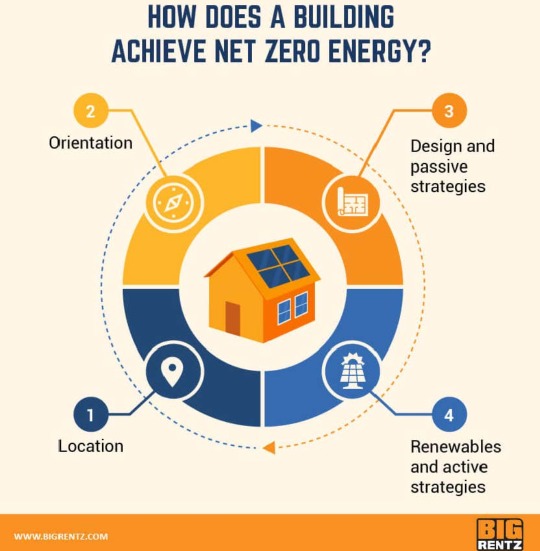
There are four major factors in designing a net zero building: location, orientation, design and renewable resources.
The building designers determine location and orientation. This allows a designer to take advantage of natural solutions. This can include ensuring a north-south orientation for proper natural heating and illumination, or aligning the roof to face the sun’s path for solar panel efficiency.
However, it is in design and renewable energies that HVAC technicians find their specialties.
Building Design
Designing a net zero building begins with a combination of two strategies. Passive strategies are energy-reducing changes. This includes low energy and automated HVAC systems, and high-efficiency appliances such as Energy Star-rated furnaces.
Passive strategies also focus on air sealing and insulation. Energy loss through cracks in HVAC systems and insulation can be massive. Indeed, a building owner can look at any leak as a leak in their wallet.
Likewise, ventilation is just as important, especially in warmer climates. Electric fans are becoming an oft-used solution. They require low power, and they keep the air fresh without needing to run on high-energy systems. As well, smart devices and automated sensors are already improving on that efficiency.
The same holds true when retrofitting a building. Efficient systems should replace outdated systems. Leaks should be filled. And ventilation options should be used that cut down on heating and cooling needs.
Renewable Energies
When we think of renewable energy, solar panels come to mind. While these are important for net zero, they are not the only source of renewable energy.
Geothermal energy is a growing form of energy. Entire buildings are being designed around ground-source heat pumps. These draw heat from the ground and pump it up into your house. From there, heat exchangers convert the energy into hot or cold air blown throughout the house without the need for furnaces and central air conditioning units.
For maximum effectiveness, though, heat pump solutions will need to consider:
- Building sizes: Larger buildings will require longer ground loops.
- Horizontal or vertical: Loop trenches can stretch out flat, or they can drive down hundreds of meters if there isn’t room for a horizontal layout.
- Usage: Will the heat pumps need to heat or cool the building? Or both?
- Source taps: Can groundwater be used for more efficient options?
Renewable energy sources are also called active net zero strategies. These create power for the building. And with enough efficiency, a building can eventually produce extra energy from renewable sources. When this happens, the building has achieved true net zero, and it can now help the community with its energy.
What Role Does HVAC Play?
HVAC systems are some of the greatest consumers of a building’s energy. In a movement designed to reduce energy usage, HVAC is at the forefront of change. They also stand to benefit the most from adapting to the world’s needs. Fortunately, this thought is shared by many. Over 75% of organizations plan to invest more in green heating and cooling systems. That’s up over 15% from the previous year. And that’s not all.
Integrating net zero values is trending across the entire industry. From eliminating harmful refrigerant chemicals like R22, to using efficient mechanical systems, net zero is driving the change. When designing HVAC systems, therefore, techs should keep the following in mind:
- How can existing efficiency be improved? Look into heartier filters, duct cleaning solutions, and air purifiers.
- Where can it be automated? Mechanical and digital systems are being used to reduce waste and improve efficiency.
- Can you replace the furnace? Are heat pumps a viable option for building climate control? What about hydronic radiant heating?
These aren’t the only concerns customers have. As they are common issues, though, HVAC professionals are poised to address them head-on.
Leading the Change
Of course, new systems and upgrades are one thing. However, every building needs to be net zero, not just new construction. This is where the importance of HVAC shines. The truth is that the HVAC industry controls a good part of the nation’s energy usage.
How is that possible? Homes and buildings use about 40% of the nation’s energy. Unfortunately, 30% of that is wasted through cracks, gaps and leaks in ductwork. Extra energy is lost through poor insulation. Still, it goes to show that sealing cracks and air gaps is essential in achieving net zero.
Sealant solutions are allowing HVAC technicians to address the problem at the site. They are able to seal up gaps without redoing the ductwork, and optimize airflow by eliminating leaks in the attic or other underused areas. Reducing energy usage is the true name of net zero.
HVAC system design will forever be moving to achieve net zero goals. High efficiency is the new name of the game. And it will be needed to save the planet. HVAC technicians are some of the most powerful frontline workers against climate change damage. Thus, through high-efficiency systems and high-impact fixes, the HVAC industry can lead the change that the world needs.
Looking for a reprint of this article?
From high-res PDFs to custom plaques, order your copy today!