Indoor Air Quality
Researchers Testing HVAC Air Filter That Kills Coronavirus
Device, which also can kill anthrax and legionella, can be fitted into existing heating and cooling systems
A collaboration inspired by Medistar Corp. and including researchers from the University of Houston and Texas A&M has developed a heating ventilating and air conditioning system filter, made from nickel foam, that can trap and instantly kill 99.8% of the coronavirus responsible for the COVID-19 pandemic, say the lead researchers on the team. The investigators also say the filter catches and destroys 99.9% of anthrax spores and other pathogens, including the legionella bacteria that causes Legionnaires' disease.
The biodefense indoor air protection system, currently under beta-testing at the InterContinental Hotel Houston Medical Center and soon to go into commercial production, can be custom-fitted to existing heating and cooling equipment in all types of HVAC systems in buildings, planes and ships, say the researchers.
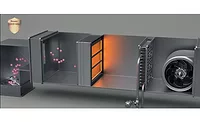
The new filter, which in retrofits is inserted between the existing filter and the heating and cooling elements, distinguishes itself from a HEPA filter in that HEPA filters only trap the virus, says Zhifeng Ren, co-lead investigator and director of the Texas Center for Superconductivity at the University of Houston. The biodefense filter is better than a high-efficiency fiber filter because it kills the virus, making any filter changes and disposal much safer for maintenance workers.
The virus can’t survive temperatures above 70 degrees Centigrade. That led to the idea of a filter with an integral heating element. Ren suggested using nickel foam because it met several key requirements: It is porous, allowing the flow of air. And it is electrically conductive, which allowed it to be heated. It is also flexible.
“Nothing can survive biologically” because the filter is heated to 200 degrees C to kill the pathogens, says Ren.
Ren and his research team collaborated with Monzer Hourani, the mastermind behind the filter and CEO of Medistar, a Houston-based medical real estate developer.
Filter Kills Anthrax Spores and Other Pathogens
The researchers report that virus tests at the Galveston National Laboratory found 99.8% of the novel SARS-CoV-2, the virus that causes COVID-19, was killed in a single pass through a filter made from commercially available nickel foam heated to 200 degrees C. The filter also killed 99.9% of the anthrax spores trapped by the filter in tests at the lab, which is run by the University of Texas (UT) Medical Branch.
Peel adds that the team did not test specifically for the bacteria that causes Legionnaires' disease, often found in HVAC mist given off by cooling towers. But because the filter is 99.9% effective for anthrax spores, "typically the gold standard for air disinfection," it also would destroy legionella.
Ren adds, "It basically can catch and kill spores as small as 100 nanometers or as large as 1,000 nanometers."
Custom retrofits to HVAC systems would cost about $4 per sq ft or $1,000 per ton of HVAC, says Garrett Peel, Ren's co-lead investigator, executive vice president of Medistar and founding partner and CEO of Medistar subsidiary Integrated Viral Protection Solutions (IVPS), which is commercializing the filter and would provide a custom retrofit service. Mobile air purifiers are also under development.
The company will deploy the filter first to places at highest risk of indoor transmission, including schools, health care facilities and transit facilities, Peel says.
The first units will go to schools in Texas, Florida and Arizona and to the InterContinental Hotel Houston Medical Center, which will be the first hotel in the world retrofitted with the technology, says Peel.
Phased Rollout
The phased roll out will be based on demand. IVPS expects to produce 20,000 units of initial capacity by late this year or early next year. “We have manufacturing partners that can meet this goal very easily,” says Peel. He adds that Medistar has invested “millions of dollars” in the product, mostly to commercialize it.
A custom filter measures about 4 ft x 4 ft depending on the size of the HVAC system. It is smaller for individual AC units.
Nickel foam has advantages but it also has low resistivity, making it difficult to raise the temperature high enough to quickly kill the virus, say the researchers. They solved that problem by folding the foam, connecting multiple compartments with integral electrical wires to increase the resistance enough to raise the temperature as high as 250 degrees C.
“There is HEPA filter technology” in both custom retrofit and mobile applications, says Ren. If the power fails, the filter will work the same way as a HEPA filter.
By wiring the filter itself so it is electrically heated internally, rather than heating it from an external source, researchers say they minimized the amount of heat that escapes from the filter, allowing air conditioning to function with minimal strain. “Four centimeters away from the heater, the temperature is the temperature of the environment,” says Peel.
The heat may increase cooling system operating costs 1% or 2%, adds Ren.
A prototype was built by a local workshop and first tested at the UH lab for the relationship between voltage/current and temperature. The Galveston lab then brought in a virologist and prepared samples of the virus. The samples were then aerosolized and run through a prototype filter in a sealed unit, says Sloban Paessler, a professor of pathology at the UT Medical Branch who led the Galveston tests.
Virus Inactivated or Trapped
The filtered air that came out of the unit was then tested using cell cultures. “We never discovered any infectious virus,” says Paessler. “The virus is either inactivated or trapped.”
Paessler says he can’t be sure the virus is killed by the filter because the lab did not collect test samples from the filter itself. “But with such high temperatures, I would be surprised if the virus was not deactivated,” he says.
Ren maintains that because the temperature on the filter is about 200 degree C, there is no reason to believe any virus on the filter can survive. The likelihood of survival is about the same as the likelihood that “the sky will fall tomorrow,” he adds.
Beyond that, the 99.8 % of virus kill was validated in recent repeat experiments on a newer test. The results also showed that 99.97% of anthrax spores were killed. “These data are sufficient to suggest the unprecedented eradication of such biopathogens through a mere subsecond exposure to treatment through this novel nickel mesh,” says Ren.
This article was updated on July 22, 2020 to reflect new information.
Looking for a reprint of this article?
From high-res PDFs to custom plaques, order your copy today!