HVAC BASICS
How does HVAC work? A basic answer every apprentice should know
Whether you're a sheet metal apprentice, an HVAC contractor recruiting or a building owner, it's important to know how to explain the basic principles and technologies behind how HVAC systems work.
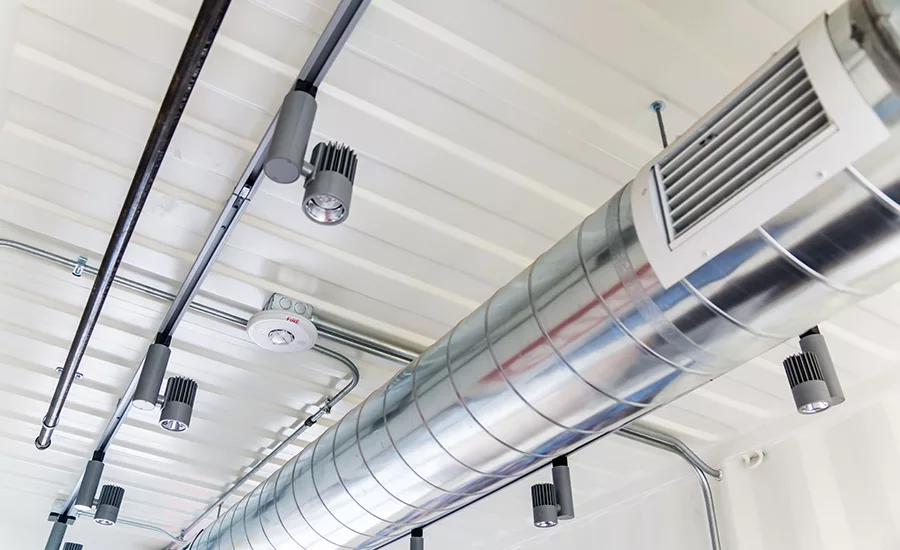
The HVAC industry is positioned for much faster than average job growth in the coming years thanks to demand for HVAC products and competitive training opportunities. But how exactly do HVAC systems work?
Whether you're a sheet metal apprentice, an HVAC contractor recruiting or a building owner, it's important to know how to explain the basic principles and technologies behind how HVAC systems work.
Indeed, knowledge is power in the million-dollar HVAC industry. Here are a few tips for explaining how HVAC systems work like a true pro.
Understanding how components and functionality work in HVAC systems
Here, in more detail, are the major components of HVAC systems along with related classifications and definitions within each one.
Heating
Heating systems are a matter of life and death to many. The heart of a heating system is its furnace or boiler, and the corresponding network of ventilation, pipes and duct are like its veins and arteries.
There is a market for residential boiler systems, but most homes in the U.S. employ natural gas, oil furnaces, electric furnaces or heat pumps to stay warm.
Additionally, heating systems usually fall into one of these varieties:
Radiant systems: Radiant systems use pipes and radiators to distribute heated water and raise the temperature in occupied spaces. However, the pipes can be costly to maintain over time. Modern radiant systems employ electric heating elements in walls or floors to act as hidden radiators.
Forced air systems: Forced air systems use an electric blower and ductwork system to transport air from heating elements throughout a building. Typically, furnaces and air conditioners use the same ductwork, but not always.
Gravity systems: Gravity heating systems are simple, relying only on a combustion chamber (usually a coal, natural gas or propane furnace in the basement) to heat a structure from underneath. Quite simply, it heats the air and allows it to rise naturally.
The differences in HVAC heating systems
Heat pumps provide an efficient alternative in regions where they’re feasible. These work by cycling warm air out of the earth and moving it through your home.
However, electric furnaces promise a low installation cost with the trade off of a higher (but fossil fuel-free) operational cost. Another possibility is an air-source heat pump, which provides higher efficiency than an electric furnace at, potentially, half the operating cost.
No matter the heating system, a home or building requires an airtight “envelope” to keep conditioned air where it belongs. Overtaxed heating systems and high energy costs are often traced back to poor insulation and windows and doors with air leaks.
Ventilation
When fuel such as oil or natural gas is burned, the heat created is channeled through buildings and homes using ventilation.
According to the U.S. Department of Energy, home ventilation systems fall into four categories with different use cases based on climate, budget and other factors.
Those categories include exhaust, supply, balanced and energy recovery ventilator systems.
Balanced systems can be used in any climate, but the cost is higher. Exhaust systems are a good fit for homes in colder climates, but they can introduce pollutants more easily.
Also, newer energy recovery ventilator systems can be used in some locations as an answer to weather extremes and high fuel costs. These recover and re-purpose some of the energy in the outgoing air.
How air conditioning operates in an HVAC system
Both the air conditioning and the heating system in a home or building require a thermostat. Zoned climate control requires multiple thermostats to determine separate climate zones within a structure and allow personalized control and more efficient operation.
Even may new thermostats rely on the simple principle that “bimetallic” metal strips will coil or uncoil as the outside temperature changes. As they do, they can be used to complete or open an electrical circuit.
Air conditioners respond to closed and open circuits at the thermostat in the same way furnaces do: They begin working until the desired conditions are achieved again.
The actual mechanics of air conditioner operation go something like this:
The air conditioner’s compressor compresses a refrigerant (a gas such as Freon or Puron) until it gets hot.
The heated gas moves through condensation coils to force a change into its liquid state.
As it changes states, the refrigerant absorbs the heat around it, forces that heat into the outside environment and expels cool air in its place.
The cooled air is blown from the coils to ventilation ducts and throughout the structure.
Air conditioners cannot function without a compressor, a condensation coil, an expansion valve, an evaporator and a blower. Additionally, the blower helps filter the air for dust and other particulates as it gathers air from the return-air ducts.
HVAC systems and modern living
Heating, ventilation and air conditioning systems contain lots of parts and require our time and attention to stay in good repair.
Still, it is difficult to imagine life without them. Hopefully this has been an instructive look at their inner workings and a useful reminder that the industry stands ready for enviable growth in the coming years.
Looking for a reprint of this article?
From high-res PDFs to custom plaques, order your copy today!