The importance of water-proofing roof penetrations
The fewer people with access to the roof, the better chance the roof has at meeting the basic expectation of keeping the elements out of the building.
Because they make their living on the roof, commercial roofing installers know how to complete a watertight system, one that does not allow damaging moisture into the building. Unfortunately, when the roofing installer finishes the job, more work, perhaps by other trades, most notably HVAC contractors, may be done with possible impacts on the roofing membrane.
Someone has to get on the roof to install that equipment, and at that point, it’s going to be an equipment installer, not a roofing installer. It’s important to be aware of who is doing what on the roof.
Attaching equipment to the building structure through the roof is the most efficient method of attachment, but often such work is done without consideration of waterproofing concerns. Any attachment penetration must not compromise the integrity of the roofing system.
This is why RoofScreen Manufacturing got into the business: to discover and develop a better method for leakproof attachment for all types of roofing and building structures.
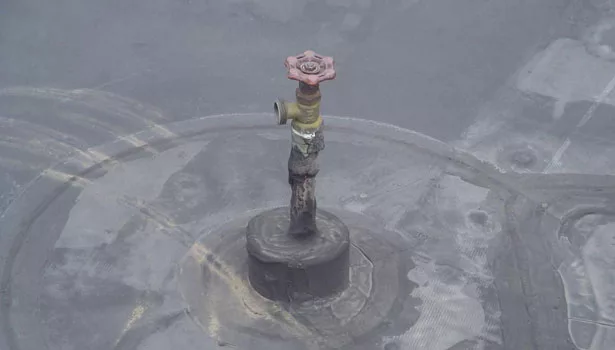
The equipment installer has options. A traditional penetration waterproofing system is what is known as the pitch pocket. Pitch pockets are flanged, open-bottom metal containers, placed around roof penetrations. They are filled with coal tar pitch, hot asphalt, grout or other chemical sealants.
They are effective around odd-shaped penetrations, but require maintenance, which means slapping on more sealant when it leaks.
Caulk-and-band
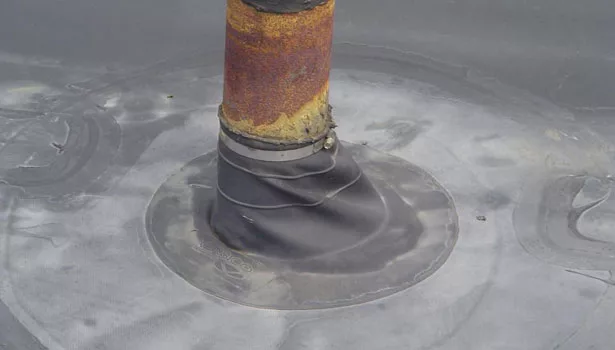
Another method is the “caulk-and-band” method, commonly used on round penetrations, which employs a single-ply or soft-lead pipe flashing around the penetration. Near the top of the flashing is an adjustable draw-band that clamps the flashing to the penetration. Caulking is applied around the top of the flashing to make the final seal.
Both practices are accepted by the National Roofing Contractors Association. The problem is both require annual or semiannual maintenance to check if the sealant has cracked or separated from the penetration, and addition of sealant as necessary.
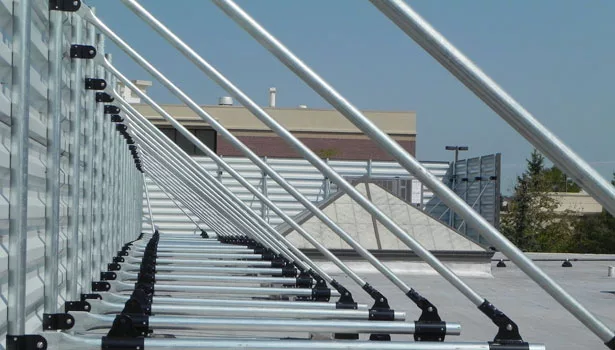
RoofScreen offers a patented engineered and leak-proof roof attachment system to ensure the integrity of the roofing system. It starts with a 6x6-inch steel base support, available in a variety of lengths to accommodate any insulation thickness. The support is attached with bolts or lag screws to the roof structure through the interior of the base support. Specially fitted flashing boots are then installed and roofed in by a qualified roofing contractor. After roofing is completed, a self-adhesive EPDM gasket strip is applied around the top of the flashing, which provides added protection from snow, ice and splashing water. The final step is to install the base cap assembly, which counter-flashes 2.4 inches over the flashing and creates a seal by compressing the gasket. This watertight structural mounting point is ideal for mechanical equipment screens, equipment platforms and solar panel racking systems.
Many roofing manufacturers require penetration flashings to extend a minimum of 8 inches above the roof surface. RoofScreen has performed successful independent lab testing on its roof attachment system with only a 3-inch flashing height and had no leaks. Ultimately, it’s up to the roofing contractor and the roofing manufacturer to determine the flashing height in relation to the roof. Consult with both, especially if there is a roofing warranty involved.
If a base support needs to be raised to meet a required flashing height, RoofScreen offers 5-, 9- and 12-inch versions of the base support, plus 3- and 4-inch extensions. A taller base support should, in most cases, provide enough clearance for the amount of insulation being used. It should be noted the height of base supports impacts the overall design of the frame. RoofScreen provides fully engineered solutions incorporating all equipment screen variables.
In addition to installing a patented engineered leak-proof roof attachment system, RoofScreen eliminates the need for periodic maintenance. There will never be a need to add temporary caulking. With no need for maintenance, there’s one less reason for anyone being up on the roof to compromise the roofing system. That’s a good thing.
Ryan Bruce is the president of RoofScreen Manufacturing. The company designs, manufactures and distributes pre-engineered modular rooftop framing systems designed to be used as equipment screens and solar panel mounting racks on commercial and industrial buildings.
Looking for a reprint of this article?
From high-res PDFs to custom plaques, order your copy today!