ACHR News
search
Ask ACHR NEWS AI
cart
facebook twitter instagram linkedin youtube
  • Sign In
  • Subscribe
  • Sign Out
  • My Account
ACHR News
  • NEWS
    • Breaking News
    • New HVAC Products
    • Featured Products
    • Manufacturer Reports
    • HVAC Data
    • Legislation
    • ACHR NEWS Centennial
  • RESIDENTIAL
    • Air Conditioners
    • Furnaces
    • Residential Heat Pumps
    • Ductless
    • Residential IAQ
    • Testing, Monitoring, Tools
    • Components & Accessories
  • COMMERCIAL
    • Air Handlers
    • Rooftop Units
    • Chillers and Cooling Towers
    • Commercial Heat Pumps
    • Boilers and Hydronics
    • VRF/Ductless
    • Commercial IAQ
  • REFRIGERATION
    • Refrigerants
    • Refrigerant Regulations
    • Leak Management
  • CONTRACTOR PRO
    • Geothermal
    • Homeowner Study
    • VRF and VRV Ductless
    • Unitary Trends
  • EDUCATION
    • Training and Education
    • Business Management
    • Service and Maintenance
    • Continuing Education
    • Market Research >
      • HVAC Brand Awareness Report
      • VRV, VRF, VRVZ Report
      • Unitary Trends Report
      • Water Heat Professionals Report
    • Webinars
    • Sponsor Insights
    • eProducts Info
    • White Papers
  • EVENTS
    • HVAC Contractor Forum
    • Industry Events and Webinars
  • MEDIA
    • Videos
    • AHR Expo 2025 Videos
    • Podcasts >
      • ACHR News Podcast
      • HARDI Podcasts
      • AHR Expo Podcasts
      • ACCA Podcasts
    • Interactive Spotlights
    • Quizzes
    • eBooks
    • HVAC Talkback
  • HVAC GROUP
    • ACHR NEWS >
      • Current Issue
      • Digital Edition
      • Subscribe
    • Distribution Trends
    • SNIPS NEWS >
      • Join SNIPS NEWS
    • Engineered Systems News >
      • Join ES News
    • HVACR Directory
    • Contests
    • Newsletters
    • Contact
    • Advertise
    • My Account

Using Instruments With Increased Safety

By Barbara A. Checket-Hanks
August 18, 2005
When a service tech gets a new digital multimeter (DMM), usually the packaging includes a lot of safety information, particularly instructions on how you should use the instrument safely. Many DMMs have a tilt stand and test leads, meaning it would take three hands to use the DMM.

How do you accomplish this when you only have two hands and you are the only tech assigned to this call?

In many cases, HVACR field service technicians brush safety aside and use their test instruments in a potentially unsafe manner. And Rey Harju believes that's a shame. Harju is the president of Fieldpiece Instruments (www.fieldpiece.com).

"Using a digital multimeter with safety in mind has become a big issue," he said. "To solve the third-hand problem, the user has several choices. He can hold the meter in his hand and play chopsticks with the test leads. It's not very comfortable for 440 VAC, for example. If he sets the meter down, he risks pulling the meter off its perch with the leads, just as he's about ready to touch those 440-VAC test points. It's also not very comfortable."

Technicians tend to get good training on safe procedures for testing live equipment.

"What happens is, they get all this good advice and go out and do whatever they damn well please," said Harju. "Some guys will pay attention to it and some guys won't."

There are two major issues regarding DMMs and safety: industry safety specifications and the ergonomics of safety.

"The two have little to do with one another," said Harju.

Looking for quick answers on air conditioning, heating and refrigeration topics? Try Ask ACHR NEWS, our new smart AI search tool. Ask ACHR NEWS →

Creep And Strike

In the early days of this industry, "Anybody could make a multimeter and sell it without any constraints," said Harju. "Several agencies got involved to make them safer."

Industry safety specs primarily are concerned with factors called "creep" and "strike," he said. If voltage is transmitted across an area in a meter where two pieces of metal are touching, this is referred to as creep. Voltage transmitted through the air is called strike (as in a lightning strike).

"Inside the meter, you want to make sure that the conductors carrying voltage aren't close enough together to carry the voltage," Harju explained. "Strike is the difference between one conductor and another."

Most specs have to do with creep and strike distances, he said, noting that in the early days, people didn't even pay attention to this.

"Over the last 20 years, the more responsible manufacturers and sellers all have standardized on UL, IEC, and CE safety specs. Most responsible suppliers in the United States have instruments that meet the specs," he said, adding, however, "There are no-name guys out there who sell meters without a UL listing."

In the beginning, Harju said almost everybody who made multimeters made them with the bench tech in mind.

"The problem with taking [some multimeters] to the field is that you need three hands to use them," he confessed.
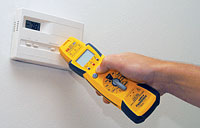
Fieldpiece Instruments' HS36 digital multimeter with noncontact voltage button detects 24V at a thermostat. Only one hand is needed to operate.

Safety In The Field

Safety at the jobsite goes beyond the concepts of creep and strike, which is actually safety within the meter and has precious little to do with the way the tech is using it.

"Most of these guys have taken a class that stresses safety," Harju commented. "They are told to wear insulated shoes, keep one hand in your pocket and the other on the test point. This removes the path of conductivity across the heart. These safety issues have zero to do with UL creep and strike."

Such safety precautions might seem cumbersome "if you're starting with a meter that needs three hands to use."

Newer DMMs (such as his company's HS Series meter) come with test leads with probe tips that unplug. "There's a hanger on the back where you can hang it from a big metal surface. You can clip the alligator clips onto test points," said Harju. "First, you can test to see if there's any AC voltage present without touching anything. It has a built-in, noncontact voltage detector."

Additionally, "Use of the probe tip for two points can allow testing with one hand," he said. "Plug an alligator clip in the COM jack or in the probe handle of the black lead, and clip the COM off the ground. Now you can do your testing one handed. Put your other hand in your pocket, just like they taught you in school. There is no way electricity can go from one hand to the other."

The meter also features a high-voltage indicator.

"Whenever you touch something that has more than 30 volts, it lights up and beeps. Bench techs don't like it, but for field techs, it tells them if there's a voltage that could kill them. I guarantee you, a guy will act differently if he thinks there's 240 volts on the line."

In addition, hold or min-max hold features mean that "You can do your testing without having to take your eyes off the test points," said Harju. "If you are going to be testing the same pair of test points for a while, use a second alligator clip to connect to the test point. 'Look Ma! No hands!'"

In his personal opinion, "Auto-ranging meters are becoming more and more popular. They encourage the user to hook up and look. They develop a mindset of throwing their test leads on the unit and looking up at the meter. A manual-ranging meter forces a user to process in his brain, 'About how big do I think that voltage will be?' If he thinks it's going to be 480, he'll put it on the 600-volt range.

"We sell both manual and auto rangers," he said. "With the manual ranger, a user is forced to look up; he gets in the habit of doing that."

It is inherently safer in the field.

"In HVAC, they have the real low-voltage stuff and very high voltage. It forces a guy to think. Our biggest sellers now are auto rangers, but from a safety standpoint, there's a significant argument for manual rangers," he said.

No meter can guarantee safe testing, he said in closing. "That's up to the technician." But newer products help make it easier for techs to do it right.

Publication date: 08/22/2005

Share This Story

Looking for a reprint of this article?
From high-res PDFs to custom plaques, order your copy today!


Barbara Checket-Hanks is Service & Maintenance Editor. E-mail her at barbarachecket-hanks@achrnews.com.

Recommended Content

JOIN TODAY
To unlock your recommendations.

Already have an account? Sign In

  • HVAC-enrollment

    The Trades Are Back: HVACR Programs See Nearly 30% Enrollment Spike

    A new wave of future technicians is entering the pipeline.  
    News
    By: Matt Jachman
  • 2025 Top 40 Under 40

    2025 Top 40 Under 40 HVACR Professionals List

    The 11th annual Top 40 Under 40 list highlights those...
    HVAC Residential Market
    By: Hannah Belloli-Oster
  • LG Ductless Mini-Split Systems

    The 9 Types of Heat Pumps

    As the U.S. moves toward electrification, heat pumps are...
    HVAC Commercial Market
    By: Joanna R. Turpin
Subscription Center
  • Create an Account
  • Start a Subscription
  • Manage My Account
  • Sign Up for Newsletters
  • Visit Customer Service
  • Update Preferences

More Videos

Sponsored Content

Sponsored Content is a special paid section where industry companies provide high quality, objective, non-commercial content around topics of interest to The News audience. All Sponsored Content is supplied by the advertising company and any opinions expressed in this article are those of the author and not necessarily reflect the views of The News or its parent company, BNP Media. Interested in participating in our Sponsored Content section? Contact your local rep!

close
  • Piggy Bank
    Sponsored byWatercress Financial

    Energy Prices, Inflation, and HVAC: What Today’s Homeowners Care About

  • Refrigerated Food
    Sponsored bySolstice Advanced Materials

    R-455A Refrigeration: A Cold Storage Solution for the Future

  • Airex Rooftop Units
    Sponsored byAirex Manufacturing Inc

    Consolidating Roof Penetrations: A Growing Trend in Multifamily HVAC Design

Popular Stories

HVAC-Price-Increase-graphic

HVAC Price Increase List: June 2026

Trump-Section-232.jpg

Trump Reduces Section 232 Tariffs on HVAC Equipment to 15%

Heat-pump-cutaway.jpg

PFAS Rules and A2L Building Codes Continue to Evolve

Midea-training.jpg

HVAC Workforce Crisis Expands Beyond Technicians to Instructor Shortages

U.S. Supreme Court building

95% Furnace Efficiency Rule to Get New Hearing

View The ACHR NEWS
Centennial Anniversary Timeline

The ACHR News Timeline Chart
Submit a Letter
Submit a letter to our editors.

Events

November 6, 2025

Next-Gen Data Center Cooling: HVAC Innovation and Real-World Solutions

On Demand As AI workloads and high-density computing push traditional cooling methods to their limits, the data center industry is accelerating the adoption of next-generation HVAC technologies.

June 17, 2026

Decarbonization Without Disruption

This webinar will explore practical HVAC decarbonization strategies that minimize disruption while maximizing long-term performance and ROI.

View All Submit An Event

Poll

Summer Staff

Are you fully staffed for the summer season?
View Results Poll Archive

Products

BNI Mechanical/Electrical Square Foot Costbook, 2026 Edition

BNI Mechanical/Electrical Square Foot Costbook, 2026 Edition

See More Products
Decarbonization Without Disruption - Free Webinar - 6/17/2026

Related Articles

  • June 21, 2006: Website Provides Tips for Increased Electrical Safety

    See More
  • heat pumps

    Heat Pump Potential Grows with Increased Environmental Awareness

    See More
  • DtiCorp.com Revamps Website With Increased HVAC Inventory

    See More

Related Products

See More Products
  • drafting.gif

    Sheet Metal Drafting Using Solidworks, 1/e

  • Using Schematic Diagrams to Troubleshoot HVAC/R Electrical Circuits

  • low grade.png

    Low GWP Refrigerant Safety: Flammable & Mildly Flammable Refrigerants Manual

See More Products

Related Directories

  • PCE Instruments

    Explore PCE Instruments' wide selection of monitoring, analysis, testing and measuring instruments used to measure various parameters in the physical, electrical and chemical spectra.
  • MSA Safety (Manufacturer)

    MSA Safety Incorporated (NYSE: MSA) is the global leader in advanced safety products, technologies, and solutions. For the HVAC-R industry, MSA Safety provides gas and refrigerant analysis, detection, monitoring, and tracking solutions. Their FieldServer IIoT gateways are ideal for enabling 24/7 cloud-based monitoring solutions.
  • Winters Instruments

    Winters Instruments is a manufacturer of quality pressure and temperature instrumentation, with distribution in over 90 countries. Visit www.winters.com for more information.
×

Sign Up. Stay Informed.

The #1 trusted source for the HVACR industry since 1926

SUBSCRIBE
  • RESOURCES
    • Advertise
    • Contact Us
    • Advisory Board
    • Classifieds
    • Submit a Letter
    • Directories
    • Store
  • ACCOUNT CENTER
    • Create an Account
    • Start a Subscription
    • Manage My Account
    • Sign Up for Newsletters
    • Visit Customer Service
    • Update Preferences
  • SERVICES
    • Marketing Services
    • Reprints
    • Market Research
    • List Rental
    • Survey/Respondent Access
  • STAY CONNECTED
    • LinkedIn
    • Facebook
    • Instagram
    • YouTube
    • X (Twitter)
  • PRIVACY
    • PRIVACY POLICY
    • TERMS & CONDITIONS
    • DO NOT SELL MY PERSONAL INFORMATION
    • PRIVACY REQUEST
    • ACCESSIBILITY

Copyright ©2026. All Rights Reserved BNP Media, Inc. and BNP Media II, LLC.

Design, CMS, Hosting & Web Development :: ePublishing