ACHR News
search
Ask ACHR NEWS AI
cart
facebook twitter instagram linkedin youtube
  • Sign In
  • Subscribe
  • Sign Out
  • My Account
ACHR News
  • NEWS
    • Breaking News
    • New HVAC Products
    • Featured Products
    • Manufacturer Reports
    • HVAC Data
    • Legislation
    • ACHR NEWS Centennial
  • RESIDENTIAL
    • Air Conditioners
    • Furnaces
    • Residential Heat Pumps
    • Ductless
    • Residential IAQ
    • Testing, Monitoring, Tools
    • Components & Accessories
  • COMMERCIAL
    • Air Handlers
    • Rooftop Units
    • Chillers and Cooling Towers
    • Commercial Heat Pumps
    • Boilers and Hydronics
    • VRF/Ductless
    • Commercial IAQ
  • REFRIGERATION
    • Refrigerants
    • Refrigerant Regulations
    • Leak Management
  • CONTRACTOR PRO
    • Geothermal
    • Homeowner Study
    • VRF and VRV Ductless
    • Unitary Trends
  • EDUCATION
    • Training and Education
    • Business Management
    • Service and Maintenance
    • Continuing Education
    • Market Research >
      • HVAC Brand Awareness Report
      • VRV, VRF, VRVZ Report
      • Unitary Trends Report
      • Water Heat Professionals Report
    • Webinars
    • Sponsor Insights
    • eProducts Info
    • White Papers
  • EVENTS
    • HVAC Contractor Forum
    • Industry Events and Webinars
  • MEDIA
    • Videos
    • AHR Expo 2025 Videos
    • Podcasts >
      • ACHR News Podcast
      • HARDI Podcasts
      • AHR Expo Podcasts
      • ACCA Podcasts
    • Interactive Spotlights
    • Quizzes
    • eBooks
    • HVAC Talkback
  • HVAC GROUP
    • ACHR NEWS >
      • Current Issue
      • Digital Edition
      • Subscribe
    • Distribution Trends
    • SNIPS NEWS >
      • Join SNIPS NEWS
    • Engineered Systems News >
      • Join ES News
    • HVACR Directory
    • Contests
    • Newsletters
    • Contact
    • Advertise
    • My Account

Tech Page: Forced-Air Zoning
September 19, 2002
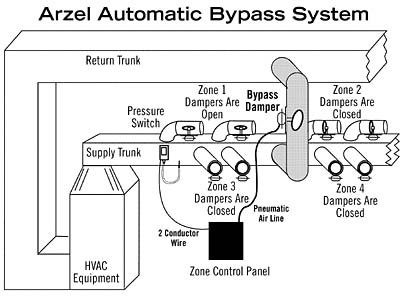
Figure 1. An automatic bypass system limits excessive static pressure in the ductwork. In the example pictured here, Zone 1 is open by itself. (Diagram courtesy of Arzel Zoning.)
Zoning in forced-air systems is accomplished by controlling dampers that are located within the ductwork system. Dampers open, close, or modulate depending on the demand from the controller.

Air is invisible. Distribute excessive conditioned air into an unoccupied area, and we hardly even notice. But, if air were water…

Imagine that Mr. and Mrs. Jones live in a 1,500-square-foot ranch home. The one and only water shutoff in the entire house is located in the basement. When Mr. Jones wishes to flush the toilet, he must yell for Mrs. Jones to run down to the basement and turn the water on. When she does, water pours out from the pipes running to showers, sinks, and spigots. (Remember, there are no shutoffs anywhere.) Whenever they need water from one faucet, the whole house gets a soaking. Sounds pretty absurd, doesn’t it? This is precisely what happens to conditioned air in every system that does not have zoning. Energy is being wasted to condition air that is delivered to unoccupied areas.

Zoning is a simple, effective way of increasing your customers’ comfort and helping to reduce their utility bills.

In addition to occupancy issues, zoning can increase comfort in situations where temperature fluctuations occur from solar gain, outdoor shading, lack of insulation, dwelling construction, remodeling, multi-level houses, and directional exposures.

LAYING OUT THE ZONES

Zones should be set up according to the occupants’ usage and load demands. A typical grouping would be:

Zone 1 — Living and dining room;

Zone 2 — Master bedroom;

Zone 3 — Family room and kitchen;

Looking for quick answers on air conditioning, heating and refrigeration topics? Try Ask ACHR NEWS, our new smart AI search tool. Ask ACHR NEWS →

Zone 4 — Upstairs bedrooms;

Zone 5 — Basement;

Zone 6 — Home office and library.

Always separate upstairs and downstairs zones. Similar usage areas with different sun exposures may require separate zones, as well as rooms of different construction types.

COMPONENTS OF THE SYSTEM

Main Controller — It is generally used when two or more zones are being controlled. On a call for heating or cooling, a thermostat or sensor sends a signal back to the controller for processing. An action to open, close, or modulate the damper is initiated, and an electrical or pneumatic signal is then sent to the damper. The controller regulates heating, cooling, fan, and auto-changeover. In addition, it determines heating and cooling priorities per zone and has night setback capabilities.

Slave Control — Action is initiated by a thermostat that controls only the damper. It does not regulate heating or cooling.

Air Damper — Driven either electrically or pneumatically, a gasketed piece of metal closes, opens, or modulates to control airflow.

Thermostat — A thermostat is located within the zone. It sends a signal to the main controller to initiate heating, cooling, fan, or auto–changeover.

Leaving Air Temperature Controls — These controls prevent excessive discharge air temperatures that may be caused due to closed dampers and where the supply is bypassing directly into the return air.

BYPASS SYSTEMS

When multiple zone dampers are closed in a system, excessive static air pressure builds up within the ductwork. This condition has the potential to cause excessive noise. A bypass system relieves the excessive air pressure. The following are four examples of bypass systems.

Barometric Dampers — This system bypasses air to the return side of the system by maintaining a certain pressure differential between the supply and return.

Wild Zones — Excessive air is dumped in areas that are not subject to overheating or cooling. There are no control dampers in the ductwork supplying these areas.

Blow-by Dampers — Slightly undersized dampers allow air to bleed through, thereby reducing air pressure buildup.

Automatic Bypass System — A pressure switch monitors the static air pressure within the duct system and relays a signal to open or close a bypass damper upon static pressure buildup. Conditioned air is bypassed from the supply back to the return side of the system, ideally as far away from the equipment as possible.

Rothacker is a director of area51hvac.com. For questions or comments on the Tech Page, contact Rothacker at ewizaard@hotmail.com (e-mail).

Publication date: 09/23/2002

Share This Story

Looking for a reprint of this article?
From high-res PDFs to custom plaques, order your copy today!


Recommended Content

JOIN TODAY
To unlock your recommendations.

Already have an account? Sign In

  • HVAC-enrollment

    The Trades Are Back: HVACR Programs See Nearly 30% Enrollment Spike

    A new wave of future technicians is entering the pipeline.  
    News
    By: Matt Jachman
  • 2025 Top 40 Under 40

    2025 Top 40 Under 40 HVACR Professionals List

    The 11th annual Top 40 Under 40 list highlights those...
    HVAC Commercial Market
    By: Hannah Belloli-Oster
  • LG Ductless Mini-Split Systems

    The 9 Types of Heat Pumps

    As the U.S. moves toward electrification, heat pumps are...
    HVAC Residential Market
    By: Joanna R. Turpin
Subscription Center
  • Create an Account
  • Start a Subscription
  • Manage My Account
  • Sign Up for Newsletters
  • Visit Customer Service
  • Update Preferences

More Videos

Sponsored Content

Sponsored Content is a special paid section where industry companies provide high quality, objective, non-commercial content around topics of interest to The News audience. All Sponsored Content is supplied by the advertising company and any opinions expressed in this article are those of the author and not necessarily reflect the views of The News or its parent company, BNP Media. Interested in participating in our Sponsored Content section? Contact your local rep!

close
  • Piggy Bank
    Sponsored byWatercress Financial

    Energy Prices, Inflation, and HVAC: What Today’s Homeowners Care About

  • Refrigerated Food
    Sponsored bySolstice Advanced Materials

    R-455A Refrigeration: A Cold Storage Solution for the Future

  • Airex Rooftop Units
    Sponsored byAirex Manufacturing Inc

    Consolidating Roof Penetrations: A Growing Trend in Multifamily HVAC Design

Popular Stories

Lennox equipment

Platinum Equity to Sell Heat Controller to Lennox

Trade groups challenge EPA refrigerant rule

HVACR Trade Groups Challenge EPA Refrigerant Rule in Federal Court

heat-pump-tech-customer.jpg

DOE Updates $8.8B Home Energy Rebate Program Guidance

Lovato-refrigerant-rooftop_AC_Units_.jpg

When Refrigerants Change, So Do the Contactors

Martin Hoover

ACCA Leadership Shakeup: Barton James Out, Hoover Named Interim CEO

View The ACHR NEWS
Centennial Anniversary Timeline

The ACHR News Timeline Chart
Submit a Letter
Submit a letter to our editors.

Events

November 6, 2025

Next-Gen Data Center Cooling: HVAC Innovation and Real-World Solutions

On Demand As AI workloads and high-density computing push traditional cooling methods to their limits, the data center industry is accelerating the adoption of next-generation HVAC technologies.

July 28, 2026

How Top Home Services Companies Turn Every Conversation Into Predictable Revenue

In this webinar, we'll outline how top contractors are turning every conversation into predictable revenue by coaching every comfort advisor visit, not just the ones a manager rides along on.

View All Submit An Event

Poll

Summer Staff

Are you fully staffed for the summer season?
View Results Poll Archive

Products

BNI Mechanical/Electrical Square Foot Costbook, 2026 Edition

BNI Mechanical/Electrical Square Foot Costbook, 2026 Edition

See More Products
Designing Systems Using A2L Refrigerant - Free Webinar - 7/22/2026

Related Articles

  • Profiting From Residential Forced-Air Zoning

    See More
  • EE_Technical 1

    Installing a Forced-Air Zoning System is Easier Than Ever, Here's Why…

    See More
  • Forced Air Zoning: Friend Or Foe?

    See More

Related Products

See More Products
  • Installing Residential Forced Air Furnaces

  • TGW_Entry Level_cover.jpg

    Technician’s Guide & Workbook for Entry Level Tech's

  • air came to a stop.jpg

    The Air Came to a Stop

See More Products

Related Directories

  • Zone Air

    Based in Salt Lake City, Utah. We specialize in DIY HVAC solutions for homeowners and professionals.
  • ColdZone

    ColdZone, a division of HTPG, delivers green refrigeration technologies and manufactures evaporators, single- and multi-circuit compressor units, and defrost controls designed for foodservice industry.
×

Sign Up. Stay Informed.

The #1 trusted source for the HVACR industry since 1926

SUBSCRIBE
  • RESOURCES
    • Advertise
    • Contact Us
    • Advisory Board
    • Classifieds
    • Submit a Letter
    • Directories
    • Store
  • ACCOUNT CENTER
    • Create an Account
    • Start a Subscription
    • Manage My Account
    • Sign Up for Newsletters
    • Visit Customer Service
    • Update Preferences
  • SERVICES
    • Marketing Services
    • Reprints
    • Market Research
    • List Rental
    • Survey/Respondent Access
  • STAY CONNECTED
    • LinkedIn
    • Facebook
    • Instagram
    • YouTube
    • X (Twitter)
  • PRIVACY
    • PRIVACY POLICY
    • TERMS & CONDITIONS
    • DO NOT SELL MY PERSONAL INFORMATION
    • PRIVACY REQUEST
    • ACCESSIBILITY

Copyright ©2026. All Rights Reserved BNP Media, Inc. and BNP Media II, LLC.

Design, CMS, Hosting & Web Development :: ePublishing