Skyscraper Becoming City's No. 1 Address
Downtown Denver is an increasingly fashionable place to live, with a pedestrian mall, renovated parks, new shopping and entertainment venues plus 100 more restaurants than there were 10 years ago. More and more people want to live in Denver, and RedPeak is helping by renovating a high-rise that was the city's first skyscraper when it was built over 40 years ago.
This is more than a face-lift. Originally, the landmark was an office building but had been vacant since 1997. RedPeak hired general contractor M.A. Mortenson to gut the interiors and reconfigure them into apartments with granite kitchens, wood floors, chrome fixtures, and striking floor-to-ceiling windows.
Not all the luxury is visible. The designers wanted the new apartments to be quiet and comfortable too. That's where fiberglass duct insulation comes in.
Thermal Efficiency
Fiberglass insulation offers solid thermal performance, all designed to help keep temperatures comfortable and reduce energy bills. Perhaps more important is the acoustical benefit.According to the North American Insulation Manufacturers Association (NAIMA), fiberglass insulation absorbs sound so ducts won't transmit fan and equipment noise and "cross-talk" - noise carried down the air duct from one room or apartment to another. A quiet air-handling system is an important part of the luxury package RedPeak is providing its residents.
While the developers of 1600 Glenarm wanted the benefits of fiberglass duct insulation, they also had a keen eye on the budget. They asked HVAC contractor Heating & Plumbing Engineers, Inc. (HPE), Colorado Springs, for ideas to reduce costs. Given recent high sheet metal prices, HPE knew there were opportunities for cost saving in the air-handling system.
In this case, HPE recommended substituting fiberglass duct board for lined sheet metal ducts. Mat-faced Micro-Aire® Fiber Glass Duct Board, from Johns Manville, was selected.
In the specification, HPE promised that using duct board rather than lined sheet metal would deliver the same or better thermal and acoustical performance while facilitating fast track construction. The switch immediately saved the developers several thousand dollars in materials cost, with the added potential of labor savings as well.
Looking for quick answers on air conditioning, heating and refrigeration topics? Try Ask ACHR NEWS, our new smart AI search tool. Ask ACHR NEWS

Staying On The Fast Track
Part of the appeal of duct board at 1600 Glenarm Place was that it fit in easily with the fast track construction schedule. RedPeak set a schedule to open the first four residential floors in September, 2005, and then open four floors each month until the building was completed. There was no room for delays at the sheet metal shop.Careful prior planning helped. The duct runs were designed in lengths compatible with the standard duct board sections of 48 inches. This made it simple for fabricator Hercules Industries, Denver, to supply ducts and fittings with a minimum of extra handling and waste.
Semi-automated fabrication machinery allowed Hercules to organize its work and keep the project on track. Flat sheets of 1-inch thick duct board were stacked in the automatic loader, which fed the sheets one at a time through the grooving machine. This automatic equipment was programmed to cut grooves at intervals so the flat board could be folded into rectangles of the requisite sizes. The grooved board was then formed into shape and fed through an automatic finishing machine that applied tape to close and air seal the duct section. A duct section could be completed in just two to three minutes.
According to Hercules, fittings and offsets are simple to fabricate from completed duct sections using modular duct construction (MDC) techniques. MDC, considered one of the preferred methods for fabricating fiber glass air ducts, increases productivity, produces minimal scrap, and allows quick and easy fabrication of the most complex fittings, said the fabricator. Hercules constructed fittings on a table equipped with a moveable guide, using a band saw to cut the end off a straight duct at the correct angle. The cut piece was then rotated 180 degrees and reattached to the duct, creating a turn. Almost any offset or gored fitting can be fabricated using this method, according to Hercules.
As the job progressed downtown, Hercules kept pace, fabricating the ductwork for one floor at a time and loading the finished pieces onto pallets, one pallet for each apartment unit. Each shrink-wrapped pallet contained all the ductwork and fittings that would be needed for that specific apartment. Hercules continued fabricating while HPE was installing, staying about one week ahead.
"It's Cake!"
The light weight and ease of cutting Micro-Aire duct board made the work of installing it easier for the HPE crew. The lead journeyman on the project (known as "Grizz") said, "It's cake! It's lightweight so it's easier to work with. We can install it while standing on ladders instead of duct jacks. And you don't need a lot of tools, just a knife."His colleague, Dwayne Kiggins, agreed. "I've done both (duct board and sheet metal), and I like duct board best for the ease of it," said Kiggins. "Two guys can hang a 20-foot section. There's nothing to it. I like this stuff."
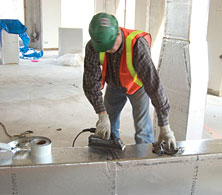
On the jobsite, workers joined duct sections by matching the male and female factory-molded edges, stapling the overlapping flap of the foil-scrim-kraft (FSK) facing, and then applying heat-sensitive UL 181A-H listed tape.
First the installer applied short pieces of tape at a diagonal around the corners to hold the sections together and keep the corners at 90 degrees. Then he applied tape to all the joints, turning the duct as he went.
The tape was sealed with a commercial iron set at a high enough temperature to maintain a constant surface temperature of 450 degrees to 500 degrees F. The iron was pressed down the entire length of tape in a smearing action to get a complete seal. The tape is printed with green dots that turn black when sufficient heat has been applied, creating a complete seal. The whole process took only a few minutes and produced ducts that are completely sealed and virtually leak-free.
New, more rigorous energy codes now require duct systems to be sealed, a costly extra step for sheet metal, but a feature that comes automatically with standard installation for duct board. The same heat-sensitive tape can be used to patch cuts or dents in the duct board jacketing.
The only fabrication on the job was cutting holes for flex duct connections and joining duct sections for trunk runs. The only tools required were a knife and a round hole cutter.
In the end, residents of 1600 Glenarm Place will find themselves at the center of everything downtown Denver has to offer. They will be able to walk or ride a shuttle to anything from a symphony concert to a baseball game, to one of those 100 new restaurants. But when the noise and bustle of living downtown begin to be too much, they can simply go home to a comfortable, quiet apartment.
Sidebar: Report Confirms Cost Effectiveness Of Increased Insulation
An independent study, released recently by ICF Consulting, found that in every climate zone there is a cost-effective, energy-saving insulation wall scenario that meets the 2004 International Energy Conservation Code (IECC).The final report concluded that levels of insulation in the 2004 IECC will lead to increased savings and create more affordable housing by decreasing utility costs immediately and over the life of a home.
ICF, an international management, technology, and policy consulting firm which works closely with the Environmental Protection Agency's (EPA's) Energy Star program, conducted the study on behalf of the North American Insulation Manufacturers Association (NAIMA) and the Polyisocyanurate Insulation Manufacturers Association (PIMA).
Simulating the annual energy consumption of single-family homes, ICF tested homes configured with one of four wall insulation scenarios using a combination of common insulation materials that either met or exceeded the proposed code requirements. This data was then compared with homes designed with insulation that falls short of the 2004 IECC.
"The ICF study conclusively demonstrates the value of the 2004 IECC," said Charles Cottrell, vice president, technical services for NAIMA. "The updated codes are a necessary step towards energy conservation since so many homes and buildings are built to the minimum code requirements. The increased levels of insulation represent sound building practice."
For a copy of the report, go to www.naima.org/icf.
Publication date: 10/10/2005
Looking for a reprint of this article?
From high-res PDFs to custom plaques, order your copy today!