ACHR News
search
Ask ACHR NEWS AI
cart
facebook twitter instagram linkedin youtube
  • Sign In
  • Subscribe
  • Sign Out
  • My Account
ACHR News
  • NEWS
    • Breaking News
    • New HVAC Products
    • Featured Products
    • Manufacturer Reports
    • HVAC Data
    • Legislation
    • ACHR NEWS Centennial
  • RESIDENTIAL
    • Air Conditioners
    • Furnaces
    • Residential Heat Pumps
    • Ductless
    • Residential IAQ
    • Testing, Monitoring, Tools
    • Components & Accessories
  • COMMERCIAL
    • Air Handlers
    • Rooftop Units
    • Chillers and Cooling Towers
    • Commercial Heat Pumps
    • Boilers and Hydronics
    • VRF/Ductless
    • Commercial IAQ
  • REFRIGERATION
    • Refrigerants
    • Refrigerant Regulations
    • Leak Management
  • CONTRACTOR PRO
    • Geothermal
    • Homeowner Study
    • VRF and VRV Ductless
    • Unitary Trends
  • EDUCATION
    • Training and Education
    • Business Management
    • Service and Maintenance
    • Continuing Education
    • Market Research >
      • HVAC Brand Awareness Report
      • VRV, VRF, VRVZ Report
      • Unitary Trends Report
      • Water Heat Professionals Report
    • Webinars
    • Sponsor Insights
    • eProducts Info
    • White Papers
  • EVENTS
    • HVAC Contractor Forum
    • Industry Events and Webinars
  • MEDIA
    • Videos
    • AHR Expo 2025 Videos
    • Podcasts >
      • ACHR News Podcast
      • HARDI Podcasts
      • AHR Expo Podcasts
      • ACCA Podcasts
    • Interactive Spotlights
    • Quizzes
    • eBooks
    • HVAC Talkback
  • HVAC GROUP
    • ACHR NEWS >
      • Current Issue
      • Digital Edition
      • Subscribe
    • Distribution Trends
    • SNIPS NEWS >
      • Join SNIPS NEWS
    • Engineered Systems News >
      • Join ES News
    • HVACR Directory
    • Contests
    • Newsletters
    • Contact
    • Advertise
    • My Account

Simple Tests Can Help Pinpoint IAQ Problems
May 6, 2004
HVAC mechanical ventilation systems provide conditioned air to all occupied spaces within a building. On a good day, they temper, filter, and mix fresh outside air into the recirculated air from the return air duct system. But if there's not enough fresh air ventilation for the number of people present or for the activities performed, indoor air quality (IAQ) will deteriorate as the day progresses.

A variety of factors affect people's environmental indoor comfort levels, including temperature, relative humidity (RH), air movement, clothing, activity level, and individual physiology. By regularly testing temperature, RH, and CO2 at various locations in the ventilation system, you can determine where and when air quality problems exist, identify the source, and maintain optimal comfort levels for building occupants.

Common Causes Of Poor IAQ

Inadequate ventilation, inefficient filtration, and poor air-handling unit hygiene are the most documented reasons for IAQ problems. Less frequently, specific pollutant sources can affect the IAQ of either the building or a localized area within the building.

From an occupant's perspective, these issues often translate into uncomfortable temperatures and humidity levels. Abnormal temperatures can affect both general comfort and people's ability to concentrate. Heating air lowers the humidity. RH below 30 percent can contribute to eye and respiratory symptoms. High humidity or water leaks can lead to mold.
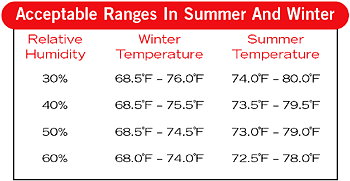
Table 1. Recommended indoor relative humidity levels range from 30 percent to 60 percent year-round, while acceptable temperatures can vary by season.

Temperature And RH

Temperature and RH can be determined using a thermometer and sling psychrometer or a digital thermometer and electronic RH meter (digital hygrometer). Whichever you choose, make sure your tools are accurate within ±1 degree F for temperature measurements.

During each measurement, allow time for the reading to stabilize to normal conditions. This may take several minutes on older analog instruments, while newer digital thermometers, such as the Fluke Model 50 Series, are quick to respond and offer an illuminated display, minimum and maximum readouts, and multiple reading time stamps for taking measurements at several test points.

Electronic RH meters, such as the Meterman TRH22, are simpler to use than sling psychrometers and provide both RH and temperature readings. Since indoor RH is influenced by outdoor conditions, a single indoor measurement may not reflect long-term RH in the building. The best practice is to take multiple readings to get a more accurate analysis of building conditions.
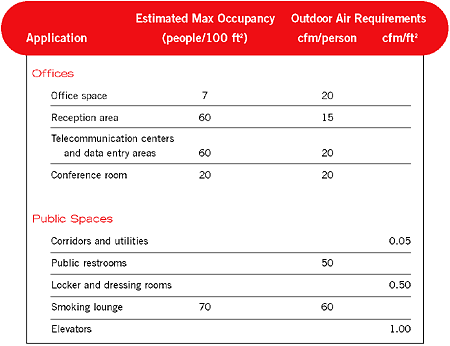
Table 2. The American Society of Heating, Refrigerating, and Air-Conditioning Engineers (ASHRAE) Standard 62-2001 outlines the amount of fresh air to enter a building per person, depending on the building type/application. (Excerpt from Table 2 of ASHRAE Standard 62-2001.)
Recommended RH levels range between 30 percent and 60 percent RH. (See Table 1.) Whether you're troubleshooting a problem or performing regular maintenance, start by comparing indoor and outdoor temperature and humidity readings to determine whether conditions are beyond the capacity of the HVAC equipment.

Next, verify the accuracy of the control system by measuring next to the thermostats controlling the zone. Then, measure at the location of the complaints and evaluate whether they're within the comfort zone. Large variations between readings may indicate a room air distribution or mixing problem. High variations over time may indicate control or balance problems with the HVAC systems.

Next, use the temperature readings to determine the actual amount of fresh air entering the building. The American Society of Heating, Refrigerating, and Air-Conditioning Engineers (ASHRAE) codes require minimum amounts of cfm (cubic feet per minute) per person, depending on the type of occupied space (typically 15 cfm/person). See Table 2 for the ASHRAE Standard 62-2001, "Ventilation for Acceptable Indoor Air Quality" minimum cfm requirements.
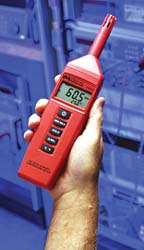
Keeping track of temperature changes and humidity levels can help pinpoint indoor air quality problems.

CO2 And Ventilation

CO2 is a normal part of the atmosphere, and exhaled breath from building occupants is an important indoor CO2 source. Indoor CO2 concentrations can, under some test conditions, provide a good indication of the adequacy of ventilation.

Comparing peak CO2 readings between rooms, between air-handler zones, and at varying heights above the floor may help you identify and diagnose various building ventilation deficiencies.

Looking for quick answers on air conditioning, heating and refrigeration topics? Try Ask ACHR NEWS, our new smart AI search tool. Ask ACHR NEWS →

Use either a direct-reading meter or a detector tube kit to measure CO2, noting the relative occupancy, air damper settings, and weather for each testing period.

For ventilation, collect CO2 measurements away from sources that could influence the reading (e.g., hold the sampling device away from exhaled breath).

Individual measurements should be short term. Start by taking one or more readings in control locations, near the outdoor air intake or in areas with no apparent IAQ problems, to serve as baselines for comparison.

Then, compare measurements at different times of day. If the occupant population is fairly stable during business hours, CO2 levels will typically rise during the morning, fall during lunch, and then rise again, reaching a peak in mid-afternoon. In this case, mid- to late afternoon will be the best time to evaluate your ventilation's adequacy.
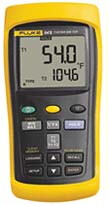
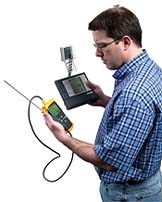
The Fluke Model 54II Thermometer. (Photos courtesy of Fluke Corp.)

Using The Results

Concentrations below 1,000 parts per million (ppm) generally indicate adequate ventilation, but not always.

If strong contaminant sources are present, you may need to control that source to protect air quality.

Measurement errors and varying CO2 concentrations over time can also cause misleading readings.

Peak CO2 concentrations above 1,000 ppm in the breathing zone indicate ventilation problems. Elevated CO2 may be due to one or more causes, such as: increased occupant population, air exchange rates below ASHRAE guidelines, poor air distribution, and poor air mixing.

A higher average CO2 concentration in the general breathing zone (at least 2 feet from exhaled breath) than in the air entering return grilles indicates poor air mixing. In that case, use smoke tubes and temperature profiles to clarify air circulation patterns.

If CO2 measurements taken before the occupied period begins are higher than outdoor readings taken at the same time, the HVAC system may have an operating problem.

Potential problems include:

  • Ventilation terminated too early the evening before (as compared with the occupancy load on the space).

  • Combustion byproducts from a nearby roadway or parking garage drawn into the building.

  • Gas-fired heating appliance in the building with a cracked heat exchanger.

    Outdoor CO2 concentrations above 400 ppm may indicate an outdoor contamination problem from traffic or other combustion sources.

    Inadequate ventilation can also be due to nonenforcement of building codes and poor contractor and maintenance practices. These inadequacies are detrimental to delivering good indoor air quality, especially in public buildings such as offices and schools.

    For more information, contact the Occupational Safety and Health Administration (OSHA) or ASHRAE for recommended building level temperatures, RH levels, cfm, and CO2 levels for the building. Today's ventilation systems offer more precise controls than ever, but nature still can throw us curveballs. Thankfully, temperature, RH, and CO2 tests make it easy to track system performance and prepare for adverse weather. With regular testing and preventive maintenance, you can limit the chances of uncomfortable environmental conditions occurring in the building.

    Jourdan is program director of Environmental Systems & Refrigeration Technology at Wenatchee Valley College (Wenatchee, Wash.). He prepared this article with Fluke Corp. For more information, contact the author at gjourdan@wvc.edu or visit www.fluke.com.

    Publication date: 05/10/2004

  • Share This Story

    Looking for a reprint of this article?
    From high-res PDFs to custom plaques, order your copy today!


    Recommended Content

    JOIN TODAY
    To unlock your recommendations.

    Already have an account? Sign In

    • HVAC-enrollment

      The Trades Are Back: HVACR Programs See Nearly 30% Enrollment Spike

      A new wave of future technicians is entering the pipeline.  
      News
      By: Matt Jachman
    • 2025 Top 40 Under 40

      2025 Top 40 Under 40 HVACR Professionals List

      The 11th annual Top 40 Under 40 list highlights those...
      HVAC Residential Market
      By: Hannah Belloli-Oster
    • LG Ductless Mini-Split Systems

      The 9 Types of Heat Pumps

      As the U.S. moves toward electrification, heat pumps are...
      News
      By: Joanna R. Turpin
    Subscription Center
    • Create an Account
    • Start a Subscription
    • Manage My Account
    • Sign Up for Newsletters
    • Visit Customer Service
    • Update Preferences

    More Videos

    Sponsored Content

    Sponsored Content is a special paid section where industry companies provide high quality, objective, non-commercial content around topics of interest to The News audience. All Sponsored Content is supplied by the advertising company and any opinions expressed in this article are those of the author and not necessarily reflect the views of The News or its parent company, BNP Media. Interested in participating in our Sponsored Content section? Contact your local rep!

    close
    • Piggy Bank
      Sponsored byWatercress Financial

      Energy Prices, Inflation, and HVAC: What Today’s Homeowners Care About

    • Refrigerated Food
      Sponsored bySolstice Advanced Materials

      R-455A Refrigeration: A Cold Storage Solution for the Future

    • Airex Rooftop Units
      Sponsored byAirex Manufacturing Inc

      Consolidating Roof Penetrations: A Growing Trend in Multifamily HVAC Design

    Popular Stories

    HVAC-Price-Increase-graphic

    HVAC Price Increase List: June 2026

    Trump-Section-232.jpg

    Trump Reduces Section 232 Tariffs on HVAC Equipment to 15%

    R410A-Refrigerant-Cylinder.jpg

    Refrigerant Recovery is a Revenue Opportunity

    Heat-pump-cutaway.jpg

    PFAS Rules and A2L Building Codes Continue to Evolve

    Kroger.jpg

    Kroger to Spend $100 Million to Reduce Refrigerant Leaks

    View The ACHR NEWS
    Centennial Anniversary Timeline

    The ACHR News Timeline Chart
    Submit a Letter
    Submit a letter to our editors.

    Events

    November 6, 2025

    Next-Gen Data Center Cooling: HVAC Innovation and Real-World Solutions

    On Demand As AI workloads and high-density computing push traditional cooling methods to their limits, the data center industry is accelerating the adoption of next-generation HVAC technologies.

    June 17, 2026

    Decarbonization Without Disruption

    This webinar will explore practical HVAC decarbonization strategies that minimize disruption while maximizing long-term performance and ROI.

    View All Submit An Event

    Poll

    Summer Staff

    Are you fully staffed for the summer season?
    View Results Poll Archive

    Products

    BNI Mechanical/Electrical Square Foot Costbook, 2026 Edition

    BNI Mechanical/Electrical Square Foot Costbook, 2026 Edition

    See More Products
    Decarbonization Without Disruption - Free Webinar - 6/17/2026

    Related Articles

    • High-Tech Approach Can Pinpoint IAQ Problems

      See More
    • Products Can Help Homeowners Battle IAQ Problems

      See More
    • ERVs Can Be the Answer to IAQ Problems

      See More

    Related Products

    See More Products
    • Evaluating-and-Troubleshooting-Refrigeration-Systems-Video-Cover-210x300.jpg

      Evaluating Refrigeration Systems Troubleshooting & Identifying Problems CONTINUED

    See More Products

    Related Directories

    • TRION IAQ

      Trade NamesAir Bear®Air Boss®ComfortSteam®Forever Filter®Grease Viper™Herrdraulic®Herricane®Herrmersion®Herrmidicool®Herrmidifier®Herrmidisteam®Herrtronic®Trion®
    ×

    Sign Up. Stay Informed.

    The #1 trusted source for the HVACR industry since 1926

    SUBSCRIBE
    • RESOURCES
      • Advertise
      • Contact Us
      • Advisory Board
      • Classifieds
      • Submit a Letter
      • Directories
      • Store
    • ACCOUNT CENTER
      • Create an Account
      • Start a Subscription
      • Manage My Account
      • Sign Up for Newsletters
      • Visit Customer Service
      • Update Preferences
    • SERVICES
      • Marketing Services
      • Reprints
      • Market Research
      • List Rental
      • Survey/Respondent Access
    • STAY CONNECTED
      • LinkedIn
      • Facebook
      • Instagram
      • YouTube
      • X (Twitter)
    • PRIVACY
      • PRIVACY POLICY
      • TERMS & CONDITIONS
      • DO NOT SELL MY PERSONAL INFORMATION
      • PRIVACY REQUEST
      • ACCESSIBILITY

    Copyright ©2026. All Rights Reserved BNP Media, Inc. and BNP Media II, LLC.

    Design, CMS, Hosting & Web Development :: ePublishing